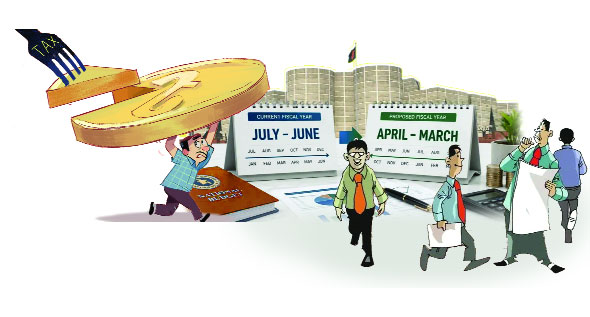
The government has decided to change Bangladesh’s fiscal year from the existing July-June cycle to an April-March system, a major policy shift that is expected to reshape budget planning, development execution, tax administration and corporate accounting across the country.
Under the new arrangement, the fiscal year will begin on 1 April and end on 31 March of the following year. The transition will take effect from fiscal year 2027-28, which will be a shortened nine-month period. Full implementation of the new system will begin from fiscal year 2028-29.
Experts, economists and business leaders have described the move as a “structural reform” with both potential benefits and short-term adjustment costs.
hat is changing in the fiscal system: A fiscal year is the government’s annual financial cycle used for budgeting, revenue collection, expenditure planning and economic reporting.At present, Bangladesh’s fiscal year runs from July 1 to June 30. Under the new system, it will shift to April-March.
This change will affect:National budget preparation and implementation, Annual Development Programme (ADP) scheduling, GDP, inflation and macroeconomic reporting cycles, Tax assessment and filing periods, Accounting systems of public and private institutions. The government approved the change at a Cabinet meeting on Monday, citing the need to improve development execution efficiency and reduce seasonal disruptions.
Why is the fiscal year being changed: Officials argue that the current July-June cycle creates structural inefficiencies in development work. A senior finance ministry official told The Daily Industry that “the monsoon season overlaps with the beginning of the fiscal year, which delays infrastructure projects and increases costs.”He added, “A shift to April-March will allow maximum utilisation of the dry season, improving both speed and quality of project implementation.”
Another concern is the “June rush” phenomenon, where a large portion of development spending is concentrated at the end of the fiscal year.According to government data cited by The Daily Industry, in fiscal year 2025-26, Tk 1.41 trillion was spent under the ADP, with nearly Tk 400 billion disbursed in June alone. Economists say this end-year spending pressure often leads to rushed implementation, weak quality control and inefficiencies in public expenditure.
What will change in development planning: Under the new system, development projects will begin in April, allowing early execution during the dry season.Infrastructure work such as roads, bridges, drainage systems and public buildings is expected to benefit most. Planning experts believe the new cycle could reducce seasonal disruption.
Dr. Selim Raihan, Executive Director of SANEM, told The Daily Industry: “Aligning the fiscal year with the dry season is a positive step. It can improve the speed and quality of project implementation by reducing monsoon-related disruptions.”However, he cautioned that “changing the calendar alone will not solve deep-rooted problems like delays in fund release, weak monitoring and institutional inefficiency.”
What are the expected benefits: Economists and policy analysts highlight several potential advantages:Faster project implementation, with most of the fiscal year aligned with dry months, construction work can proceed more smoothly.
Reduced end-year spending pressure:The current June rush may decline, improving project quality and financial discipline.Better budget execution: Spending can be distributed more evenly across the year.Improved planning efficiency: Development agencies can better align procurement and construction schedules.
A senior economist told The Daily Industry:”The biggest gain will be smoother cash flow management in public spending. It can reduce inefficiency in ADP execution.”
What are the challenges and risks: Despite the expected benefits, experts warn of significant transition challenges.Administrative restructuring, Government accounting systems, budget software and financial reporting frameworks will need major adjustments.
Transitional nine-month fiscal year: Fiscal year 2027-28 will be shortened, requiring complex recalibration of revenue and expenditure targets.Cost for private sector: Companies will need to modify accounting software, audit cycles and tax reporting systems.. A chartered accountant told The Daily Industry:”Large firms will face software modification costs and audit restructuring. While manageable, it will require time and coordination.
Tax system adjustment: Income tax assessment periods will shift from July-June to April-March, requiring changes in filing schedules and compliance systems.
Impact on private companies: Private sector firms will need to align their financial reporting with the new fiscal calendar.Key changes include:Revised accounting periods, Updated tax filing timelines, Modified audit schedules, Software system adjustments. However, experts say profitability calculations will remain unchanged.A corporate finance expert told The Daily Industry:”Only the reporting cycle changes. Business operations and profit calculations will remain the same, but compliance systems will need adjustment.”
For individuals, the impact will be limited but noticeable in tax administration.Income tax year will shift from July-June to April-March. Tax return submission dates will change. Investment windows for tax rebates will be adjusted.
A tax policy analyst told The Daily Industry:”For ordinary taxpayers, the change is procedural rather than financial. But awareness and transition support will be important.”
Historical context of fiscal years: The April-March fiscal cycle is not new to the region.During British rule, India followed an April-March fiscal year. India still maintains this system today, Pakistan shifted to July-June in the 1950s. Bangladesh retained the Pakistan-era system after independence
Globally, fiscal calendars vary:January-December: USA, China, Japan, Germany, France. April-March: India, UK (in some systems). July-June: Australia, Pakistan, Nepal.
Expert debate: reform or disruption: While many economists support the reform, some caution against overestimating its impact.
Dr. Selim Raihan told The Daily Industry:”This is a promising reform, but its success depends on implementation capacity, coordination and accountability.”He added that without institutional strengthening, “the benefits may remain limited.”
A former finance secretary, speaking to The Daily Industry, said:”The fiscal calendar matters, but governance matters more. If execution systems remain weak, the calendar change alone will not transform outcomes.”