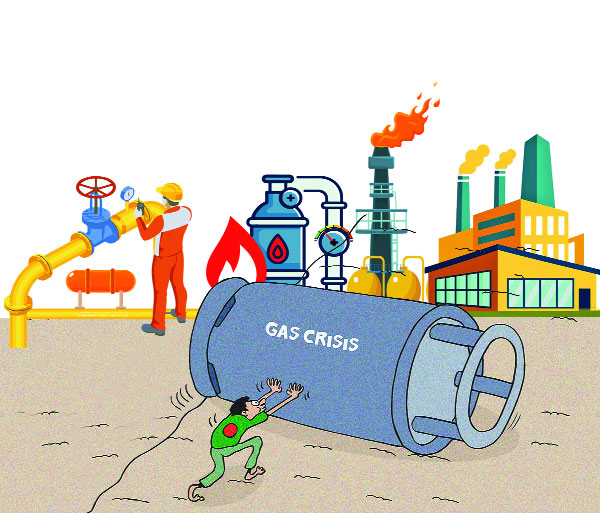
Bangladesh’s industrial sector is facing a major slowdown due to an acute gas shortage, with production falling sharply across several industries and some factories being forced to suspend operations temporarily.
Industry sources said production has declined by 40-70% at many factories, while some industrial zones have announced additional holidays as inadequate gas pressure prevents machinery, boilers and other equipment from operating normally. The crisis has hit a wide range of industries, including ready-made garments, textiles, ceramics, steel, cement, glass, paper, chemicals and food processing. Business leaders warned that if the crisis persists, Bangladesh could lose international market share as overseas buyers may turn to competing countries that can ensure more reliable energy supplies. Export orders at risk: Mohammad Hatem, president of the Bangladesh Knitwear Manufacturers and Exporters Association (BKMEA), told The Daily Industry that the severe gas shortage has already reduced production at many industrial facilities.
“The decline in production is having a negative impact on exports,” he said. Enamul Haque Khan, vice-president of the Bangladesh Garment Manufacturers and Exporters Association (BGMEA), told The Daily Industry that the situation has improved somewhat compared with the previous weeks.
“However, it will be difficult to recover the losses incurred over the past 15 days,” he said. According to Khan, production at many factories has fallen by half, which is likely to affect exports. There are also concerns that orders could decline.
Exporters said failure to deliver goods on time could cost Bangladesh not only current orders but also future business. This is particularly concerning for the garment industry, where losing an order to another country can make it extremely difficult to win the buyer back.
Production hit across industries: Industry sources said the gas shortage has disrupted production in Gazipur and other major industrial areas. Around 20% of factories in Gazipur have reportedly shut down, according to local industry sources. Production at many garment, spinning, ceramics, glass and consumer-goods factories has fallen by 40-70%, while some have been forced to announce additional holidays.
The disruption intensified after interruptions in LNG supply caused gas pressure to fall sharply. Dyeing, spinning, textile, ceramics and paper factories have been particularly affected. In some locations, gas pressure has dropped so low that factories cannot operate their machinery. BGMEA and BKMEA, however, said most member factories are continuing production at reduced capacity. Some factories have provided additional holidays, taking into account government holidays, weekly holidays and workers’ convenience.
Alternative fuel raises costs: Industry owners said garments, textiles, ceramics, steel, cement, glass, paper, chemical and food-processing factories are highly dependent on uninterrupted gas supplies. When gas supply is disrupted, production is affected, machine efficiency falls and operating costs rise. Some factories are attempting to maintain operations using diesel and other alternative fuels, but this has significantly increased production costs.
Factory owners said gas pressure often falls so low at different times of the day that boilers and other equipment cannot function properly. As a result, production schedules have become increasingly difficult to maintain.
Small firms face greater risks: Industrial entrepreneurs said lower production is making it difficult for factories to cover fixed costs. Many companies are struggling to meet bank-loan instalments, workers’ wages and allowances, electricity bills and other operating expenses. Small and medium-sized enterprises are particularly vulnerable. More than 200 garment factories have already shut down, according to industry sources. Businesses fear that prolonged disruption could force more factories to scale down operations or close altogether.
Competitors gaining advantage: Business leaders said international competition has become significantly tougher. Countries such as Vietnam, India, Indonesia and China are able to provide more reliable energy supplies, allowing manufacturers to maintain production and deliver products on schedule. By contrast, Bangladesh’s prolonged gas shortage could encourage foreign buyers to seek alternative sourcing destinations.
Economists said disruption to industrial production affects the broader economy through multiple channels. Lower industrial output can reduce export earnings, shrink employment and weaken government revenue collection. At the same time, reduced supplies of goods in the domestic market can add to inflationary pressures.
Investment could also suffer: Industry stakeholders said the crisis is no longer simply an energy problem; it is becoming a broader challenge to investment and economic growth. If the situation is not resolved quickly, new investment could be discouraged. Foreign investors generally consider reliable energy supplies a key requirement when deciding where to establish manufacturing facilities.
Prolonged gas shortages could therefore slow industrialisation and constrain employment generation and economic growth. Business leaders said the government needs to prioritise industrial consumers when allocating available gas and ensure uninterrupted supplies to major industrial zones.
Long-term energy strategy needed: imports, intensifying domestic gas exploration and raising production from existing gas fields should be pursued simultaneously.
They also called for improved energy management and prioritisation of industrial areas when gas supplies are constrained. Ensuring reliable gas supplies would allow factories to restore production, meet export deadlines and reduce dependence on expensive alternative fuels. For Bangladesh’s export-oriented industries, the stakes are particularly high. A temporary production disruption can lead to missed shipments, while prolonged uncertainty could persuade international buyers to diversify their sourcing away from Bangladesh.
Industry stakeholders therefore stressed that ensuring uninterrupted gas supplies is essential not only to revive factory production but also to protect export earnings, employment, investment and the country’s position in global markets. If the crisis continues without a durable solution, Bangladesh risks losing competitiveness to rival manufacturing economies. Conversely, a reliable and predictable energy supply could help industries recover production, expand exports and support sustainable economic growth.