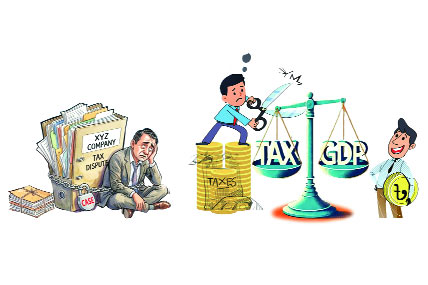
The government has decided to adopt a tougher enforcement strategy to achieve the National Board of Revenue's (NBR) ambitious revenue collection target of Tk604,000 crore for the 2026-27 fiscal year, introducing sweeping legal powers for tax officials to combat evasion and strengthen domestic resource mobilization.
Under the new approach, tax officials will be empowered to enter business premises, factories and commercial establishments without prior notice to verify whether taxes deducted at source are being properly collected and deposited.
The move is part of a broader strategy to improve compliance as the government seeks to finance rising public expenditure and sustain development projects amid persistent fiscal pressures.
The revenue target for the current fiscal year is Tk105,000 crore higher than the previous year's goal, making it one of the most challenging collection exercises in the country's history. To meet the target, the government will need to collect an average of Tk1,654 crore in revenue every day, according to officials. Revenue authorities believe stronger enforcement powers will help reduce tax evasion, particularly at the source, and improve transparency in tax compliance across the business community. Officials familiar with the initiative said tax officers will be authorized to inspect accounting records, VAT invoices, financial statements and transaction documents of businesses suspected of tax irregularities. Previously, such inspections often required lengthy legal procedures or special approvals from higher authorities.
The government expects the streamlined enforcement process to accelerate field-level monitoring and discourage businesses from concealing taxable transactions.
Expanding Tax Net Essential: Economists, however, caution that enforcement alone will not be sufficient to achieve such an ambitious target. "The government's determination to improve revenue collection is understandable given the fiscal challenges it faces. However, administrative reforms must go hand in hand with institutional capacity building and expansion of the tax base," Dr. Fahmida Khatun, Executive Director of the Centre for Policy Dialogue (CPD), told The Daily Industry.
"Unless the tax net is widened and reform efforts continue consistently, achieving the revenue target will remain extremely difficult," she added.
Revenue experts also note that Bangladesh's tax-to-GDP ratio remains among the lowest in South Asia, highlighting the need for structural reforms alongside stronger enforcement measures. Tobacco Sector Under Special Watch: According to NBR sources, one of the government's primary targets will be the tobacco and cigarette sector, which authorities identify as a major source of revenue leakage. Officials estimate that illegal production and marketing of counterfeit and banderol-free cigarettes in various parts of the country deprive the government of thousands of crores of taka in tax revenue every year. As part of the crackdown, the government is preparing nationwide joint operations involving Customs Intelligence, the NBR's VAT Wing and local administrative authorities to identify illegal manufacturers and distributors.
The planned drives are expected to intensify over the coming months as authorities attempt to eliminate tax evasion networks operating in the sector.
Business Community Voices Concern: While acknowledging the need to curb tax evasion, business leaders have expressed concerns over granting tax officials unrestricted access to business premises. They fear that excessive discretionary powers could expose compliant businesses to unnecessary harassment if adequate safeguards are not maintained. "There should be zero tolerance for tax evasion, but enforcement must remain transparent, accountable and business-friendly," a senior business chamber representative told The Daily Industry. "Honest taxpayers should not face unnecessary inspections or administrative pressure because such practices could undermine investor confidence and discourage business expansion."
Government officials have sought to allay those concerns, stating that inspections will be intelligence-based and conducted strictly within the legal framework.
Authorities also said internal monitoring mechanisms would be strengthened to prevent misuse of power and ensure accountability among tax officials.
Fiscal Pressure Driving Tough Measures: The government's hardline stance reflects growing pressure to increase domestic revenue as Bangladesh faces rising development expenditure, debt servicing obligations and expanding social protection commitments.
With external financing becoming more constrained and fiscal deficits under pressure, policymakers increasingly view stronger domestic revenue mobilization as essential for maintaining macroeconomic stability.
Analysts say achieving the Tk604,000 crore target will require not only stronger enforcement but also improved taxpayer services, greater digitalization of tax administration, enhanced data sharing among government agencies and continued efforts to bring informal businesses into the formal tax system.
The success of the government's latest revenue drive is likely to play a critical role in determining fiscal performance during FY2026-27 and supporting the country's broader economic recovery and development agenda.