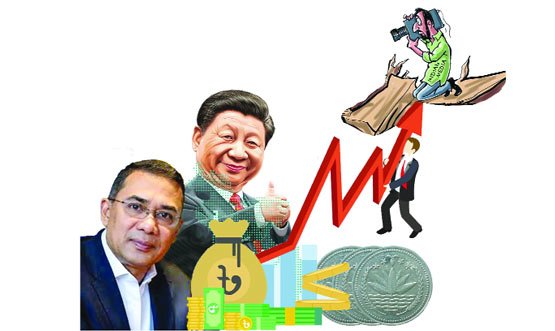
China's state-run newspaper Global Times has dismissed concerns raised by sections of the Indian media over Prime Minister Tarique Rahman's upcoming visit to China, saying there is no reason to interpret the trip through the lens of geopolitical rivalry.
In an editorial published ahead of the Bangladeshi premier's official visit to China, the newspaper said Bangladesh-China relations are not directed against any third country and should not be influenced by the positions or sensitivities of other nations.
“There is no need for Indian media to create a fuss over Prime Minister Tarique Rahman's visit to China,” the editorial stated, emphasizing that Beijing's growing cooperation with Dhaka is based on mutual development interests rather than strategic competition.
First China Visit as Prime Minister: According to the editorial, Prime Minister Tarique Rahman will visit China from Wednesday to Friday, marking his first trip to the country since assuming office. During the visit, he is expected to attend the 17th Annual Meeting of the New Champions, widely known as the Summer Davos Forum, in the Chinese city of Dalian. The newspaper described the visit as a reflection of the importance China places on strengthening ties with Bangladesh's new government.
Bangladeshi media reports indicate that the two countries are expected to sign several cooperation agreements covering trade, investment, infrastructure and strategic collaboration. According to the editorial, these agreements demonstrate the deep political trust and vast potential that exist between the two countries. Economic Cooperation in Focus: The Global Times noted that Bangladesh has faced multiple economic challenges since the political transition of 2024, including financial instability, employment pressures, industrial diversification needs and infrastructure gaps.
Against this backdrop, the paper said the primary objective of Tarique Rahman's visit is to attract foreign investment, expand infrastructure cooperation, facilitate trade and deepen strategic dialogue.China has remained Bangladesh's largest trading partner for 16 consecutive years. The editorial highlighted that nearly 1,000 Chinese companies are currently operating in Bangladesh and have collectively generated hundreds of thousands of jobs.
The paper also pointed to China's decision to grant duty-free access on 100 percent of tariff lines for Bangladeshi products from December 2024, a move that it said has significantly boosted Bangladesh's agricultural exports.”The visit is aimed at promoting investment, trade facilitation, infrastructure development and broader economic cooperation,” The Daily Industry observed, citing the Global Times editorial.
Part of a Wider Regional Trend: The Chinese newspaper argued that Tarique Rahman's visit should be viewed as part of a broader trend of increasing engagement between China and neighboring countries.It noted that several regional leaders have recently visited China, including Min Aung Hlaing of Myanmar, Shehbaz Sharif of Pakistan, Emomali Rahmon of Tajikistan, and Crown Prince Al-Muhtadee Billah of Brunei.
The editorial also referred to the visit of Tô Lâm to China earlier this year, during which agreements were reached on cross-border economic cooperation, energy, minerals and digital industries.According to the newspaper, the growing number of high-level visits demonstrates the desire of many countries to benefit from China's economic growth and development opportunities.
Criticism of Indian Media Narratives: A significant portion of the editorial was devoted to criticizing what it described as negative reactions from certain Indian media outlets.According to Global Times, some Indian commentators have expressed dissatisfaction that Bangladesh's prime minister chose China rather than India for his first major bilateral visit. Others reportedly suggested that expanding Bangladesh-China cooperation in areas such as water management could be sensitive for New Delhi.
The editorial argued that such reactions reflect a “big brother mentality” among some observers who view neighboring countries' diplomatic decisions as indicators of loyalty or allegiance.”Some people interpret the first foreign visit of a neighboring country's leader as a symbol of allegiance to a regional power and regard independent diplomatic decisions as a sign of disrespect,” the newspaper wrote.
Relations Are Not Mutually Exclusive: Global Times stressed that China values its relationship with Bangladesh while simultaneously seeking practical cooperation with India.The newspaper reiterated Beijing's position that stronger China-Bangladesh relations do not come at the expense of India and that all three countries can pursue mutually beneficial cooperation.
It further stated that China welcomes efforts to improve and strengthen bilateral ties between Bangladesh and India, arguing that such relationships are complementary rather than contradictory.”South Asia is fully capable of building a framework of regional cooperation that benefits all parties,” the editorial said.
Cooperation on Shared Challenges: The paper cited the proposed cooperation on the Teesta River as an example of how regional collaboration can be beneficial for all stakeholders.It noted that Bangladesh and India are downstream and upstream riparian countries respectively, while China has maintained long-standing cooperation with Bangladesh on water resources and with India on hydrological monitoring and flood reporting.
According to the editorial, these existing partnerships demonstrate the potential for broader trilateral cooperation in areas such as water management, climate resilience and disaster preparedness.
Focus on Development and Connectivity: The Global Times concluded that cooperation among countries of the Global South has become an increasingly important trend, with South Asian nations sharing common priorities such as improving living standards, advancing modernization and strengthening regional connectivity.The newspaper said China remains committed to the principles of peaceful coexistence and is willing to deepen mutually beneficial cooperation with all South Asian countries.
As China moves forward with its 15th Five-Year Plan for 2026-2030, the editorial said Beijing hopes the benefits of its economic development will increasingly extend to neighboring countries, creating new opportunities for shared prosperity across South Asia.”There is ample room for mutually beneficial development and common prosperity in South Asia, and regional cooperation should not be viewed through a zero-sum lens,” The Daily Industry observed, summarizing the key message of the editorial.