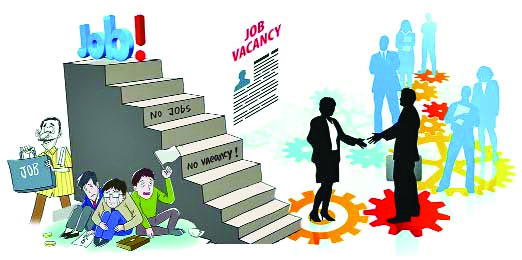
Bangladesh’s industrial sector has recorded steady growth over the years, but this expansion is increasingly being described as “jobless growth,” as employment opportunities fail to keep pace with output. Economists warn that the disconnect between industrial growth and job creation is emerging as one of the most serious structural challenges facing the economy.
According to The Daily Industry, “the industrial sector has grown at an average rate of around 9 percent annually, but employment in the sector has declined by nearly 10 percent.” This paradox highlights a troubling reality: growth is no longer translating into sufficient jobs.
Industrial Growth Without Jobs: Bangladesh’s industrial sector, particularly manufacturing, has been a key driver of economic growth over the past decade. However, recent trends suggest that this growth is becoming less labor-intensive.
The Daily Industry notes that “despite strong industrial growth, employment has declined significantly,” indicating a shift towards automation, capital-intensive production, and efficiency-driven operations. Dr. Selim Raihan, Executive Director of the South Asian Network on Economic Modeling (SANEM) and Professor of Economics at the University of Dhaka, told The Daily Industry,
“This is a classic case of jobless growth. When industries grow without creating jobs, it signals a structural imbalance in the economy. Growth alone is not enough-we need employment-intensive growth.” He explained that technological adoption and cost-cutting measures may be improving productivity but are also reducing the demand for labor.
RMG Sector Dominates Exports, But Jobs Lag: The ready-made garment (RMG) sector continues to dominate Bangladesh’s export earnings, accounting for approximately 82 percent of total exports. However, its contribution to employment growth has been disproportionately low.
The Daily Industry reports that “despite its overwhelming share in exports, the RMG sector accounts for only about 6 percent of total employment.” This imbalance suggests that even the country’s most successful export sector is not generating enough jobs relative to its economic contribution.
Dr. Mustafizur Rahman, Distinguished Fellow at the Centre for Policy Dialogue (CPD), said, “The RMG sector has been the backbone of Bangladesh’s export success, but its capacity to absorb labor is becoming limited. Productivity gains and global competition are pushing firms to adopt more efficient, less labor-intensive methods.” He added that diversification into other labor-intensive industries is essential to address the employment gap.
Youth Employment Crisis Deepens: The employment challenge is particularly severe among young people. According to the World Bank, around 14 million youths entered the working-age population between 2016 and 2022. However, only about 8.7 million jobs were created during this period.
This means that nearly half of the new entrants to the labor market were unable to find employment. The Daily Industry highlights that “a significant portion of young people have been left without jobs, raising concerns about the country’s demographic dividend.”
Dr. Zahid Hussain, former Lead Economist of the World Bank’s Dhaka office, explained, “This is a critical issue. Bangladesh has a large youth population, which could be a major asset. But without adequate job creation, it can turn into a liability.” He warned that persistent unemployment among youth could lead to social and economic instability.
Shift Toward Low-Productivity Jobs: Even among those who have found employment, the quality of jobs remains a major concern. Approximately 70 percent of newly employed individuals have been absorbed into low-productivity agricultural sectors rather than higher-productivity industrial jobs.
The Daily Industry notes that “most new workers are being absorbed into low-productivity agriculture, while employment in productive industrial sectors has declined.”
Dr. Enayet Karim, President of Global Economist Forum said, “This trend is worrying because it indicates a reverse structural transformation. Instead of moving from agriculture to industry, workers are being pushed back into low-productivity sectors.”He emphasized that this shift undermines productivity growth and limits income potential.
Implications for Economic Growth: The mismatch between growth and employment has significant implications for the broader economy. Without sufficient job creation, income levels remain stagnant, consumer demand weakens, and inequality rises. The Daily Industry reports that “export success has not translated into adequate job creation, limiting the overall impact of growth on the economy.”
Dr. Selim Raihan explained, “When growth does not create jobs, it fails to improve living standards for the majority. This weakens domestic demand and slows down economic momentum.”
Structural Challenges Behind Jobless Growth: Economists identify several structural factors contributing to jobless growth in Bangladesh: Increased automation and mechanization in industries, Lack of diversification beyond the RMG sector, Skills mismatch in the labor force, Limited investment in labor-intensive industries, Policy and regulatory barriers affecting business expansion.
Dr. Mustafizur Rahman noted, “Bangladesh’s industrial policy needs to evolve. We must focus on sectors that can generate large-scale employment, such as light manufacturing, agro-processing, and services.”
Need for Policy Reforms: Experts stress that addressing the employment crisis will require comprehensive policy reforms aimed at promoting job-rich growth.
Key recommendations include: Encouraging labor-intensive industries through targeted incentives, Investing in skills development and vocational training, Supporting small and medium enterprises (SMEs), Promoting export diversification beyond garments, Improving the overall business environment. Dr. Zahid Hussain emphasized, “Policy interventions must be aligned with employment goals. It is not enough to focus on growth-we must ensure that growth creates jobs.”
Leveraging the Demographic Dividend: Bangladesh’s large and youthful population has long been seen as a potential driver of economic growth. However, without adequate employment opportunities, this demographic advantage could turn into a burden.
The Daily Industry warns that “failure to create sufficient jobs for the growing workforce could undermine the country’s long-term development prospects.”
Dr. Enayet Karim, a global financial expert said, “The demographic dividend is not automatic. It requires the right policies and investments to translate into economic gains.”
A Critical Turning Point: Bangladesh now stands at a critical juncture, where the nature of its economic growth must be re-evaluated. While industrial expansion and export success are important, they must be accompanied by meaningful job creation.
The Daily Industry concludes that “without addressing the disconnect between growth and employment, the economy may struggle to achieve inclusive and sustainable development.”
Dr. Selim Raihan summed up the challenge, “We need a shift in focus-from growth at any cost to growth that creates jobs and improves livelihoods. Otherwise, the benefits of economic progress will remain limited.”
The Way Forward: As policymakers grapple with multiple economic challenges, the need for a coordinated and forward-looking strategy has become more urgent than ever.
Economists agree that the solution lies in aligning industrial growth with employment objectives, investing in human capital, and creating an enabling environment for businesses to expand and hire.
With millions of young people entering the workforce each year, the stakes are high. The success of Bangladesh’s economic model will ultimately depend on its ability to generate not just growth-but jobs that provide stability, income, and opportunity. As The Daily Industry underscores, the current trajectory serves as a wake-up call. Without decisive action, jobless growth could become a defining feature of the economy-one that limits it’s potential and deepens existing inequalities.