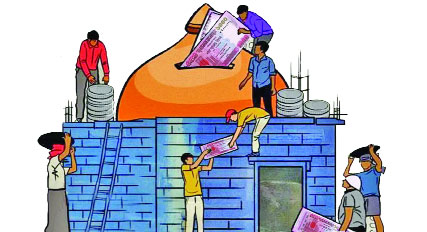
Bangladesh's banking sector is grappling with deepening structural challenges as a lack of meaningful reform, soaring default loans, and persistent governance failures continue to undermine financial stability. Experts warn that without urgent and comprehensive intervention, the crisis could spill over into the broader economy, affecting investment, employment, and growth.
According to observations published in The Daily Industry, the absence of reform in the banking sector is “perhaps the biggest shortcoming” in the country's financial management. The report highlights that defaulted loans have surged to nearly Tk 6 lakh crore, while ongoing debates over bank mergers and consolidations have failed to yield concrete results. At the same time, recurring reports of governance deficits continue to make headlines, yet no effective solutions have been implemented.
Default Loan Burden Raises Alarm: The rapid accumulation of non-performing loans (NPLs) has become one of the most pressing concerns for Bangladesh's financial system.
Analysts say that the scale of the problem reflects not only poor lending practices but also systemic weaknesses in oversight and accountability. “Default loans at this level indicate deep structural flaws in the banking system,” said Dr Enayet Karim, a reputed global financial expert and President of the Global Economist Forum. “It shows that credit discipline has eroded over time, and regulatory enforcement has not kept pace with the risks. Without decisive reform, the situation could escalate into a full-blown financial crisis.” Dr Karim emphasized that a large portion of these defaulted loans is tied to willful defaulters who have exploited regulatory loopholes and weak enforcement mechanisms. He noted that repeated loan rescheduling and restructuring without strict conditions have further encouraged a culture of non-repayment. Governance Deficit Remains a Core Issue: Governance failures have been repeatedly identified as a central weakness in Bangladesh's banking sector. From politically influenced lending decisions to inadequate internal controls, the sector continues to suffer from a lack of transparency and accountability.
Industry insiders point out that despite numerous reports and investigations highlighting irregularities, there has been little progress in addressing the root causes of governance lapses. The Daily Industry notes that news of governance deficits frequently dominates headlines, yet these revelations rarely translate into meaningful corrective action. A senior banking analyst, requesting anonymity, said, “The problem is not a lack of awareness-it is a lack of political will. Until governance reforms are prioritized and enforced, the cycle of irregularities will continue.”
Debate Over Bank Mergers Intensifies: As the crisis deepens, discussions around bank consolidation have gained momentum. Proponents argue that merging weaker banks with stronger ones could help stabilize the sector, improve efficiency, and restore public confidence. However, critics caution that consolidation without addressing underlying governance issues may simply transfer problems from one institution to another.
“Bank mergers are not a magic solution,” said Dr Enayet Karim. “If the same governance weaknesses persist, merging banks will only create larger institutions with larger problems. Structural reform must come first, followed by carefully planned consolidation.”The debate has also raised concerns among depositors and investors, who fear that poorly managed mergers could erode trust in the banking system.
Liquidity and Interest Rate Stability at Risk: Experts warn that a weak banking sector could have far-reaching implications for the broader economy. A robust financial system is essential for maintaining liquidity, ensuring efficient allocation of resources, and stabilizing interest rates.
The Daily Industry report underscores that without a strong banking sector, it is nearly impossible to maintain stability in liquidity and interest rates. As default loans rise and confidence declines, banks become more cautious in lending, leading to a credit squeeze that can stifle economic activity.
“Liquidity management is directly linked to the health of the banking sector,” explained Dr Karim. “When banks are burdened with bad loans, their ability to lend is constrained. This not only affects businesses but also slows down overall economic growth.”
Impact on Investment and Growth: The ongoing challenges in the banking sector are already having a visible impact on investment. Both domestic and foreign investors are becoming increasingly cautious, citing concerns over financial stability and regulatory uncertainty.
Economists warn that if the current trend continues, it could undermine Bangladesh's long-term growth prospects. A weak banking system limits access to credit for businesses, particularly small and medium enterprises (SMEs), which are crucial for job creation and economic diversification.
“Investment thrives on confidence,” said another financial expert. “When the banking sector is unstable, it sends a negative signal to investors. Restoring confidence requires not just policy announcements but tangible action.”
Calls for Comprehensive Reform: There is a growing consensus among experts that piecemeal measures will not be sufficient to address the challenges facing the banking sector. Instead, a comprehensive reform agenda is needed, focusing on strengthening regulatory oversight, improving governance, and enhancing transparency.
Dr Enayet Karim stressed the importance of taking a holistic approach. “Reform should not be limited to addressing symptoms. We need to tackle the root causes-weak governance, inadequate risk management, and lack of accountability. Only then can we build a resilient banking system.”He also called for stricter enforcement against willful defaulters, improved credit risk assessment, and greater independence for regulatory authorities.
The Road Ahead: As Bangladesh navigates a challenging economic landscape, the need for a strong and stable banking sector has never been more critical. The current situation serves as a stark reminder of the consequences of delayed reform and weak governance.While discussions on bank mergers and policy adjustments continue, experts emphasize that time is running out. Without decisive action, the risks to financial stability and economic growth could intensify.”The window for reform is narrowing,” warned Dr Karim. “If we fail to act now, the cost of inaction will be much higher in the future.”
For now, the banking sector remains at a crossroads-caught between persistent structural weaknesses and the urgent need for transformation. Whether policymakers can rise to the challenge and implement meaningful reform will determine not only the future of the financial system but also the trajectory of Bangladesh's economy in the years to come.