The government is considering introducing special tax benefits in the upcoming 2026-27 budget to legalize undisclosed assets or money in the country and abroad. The concerned officials said that this initiative may be taken to end the stagnation in private investment and bring idle capital into the mainstream of the economy. This information has been revealed by the National Board of Revenue (NBR).
The national budget for the fiscal year 2026-27 will be presented in the National Parliament on June 11.
In the pre-budget discussion last April, the Real Estate and Housing Association of Bangladesh (REHAB) proposed not to raise any questions about the source of money of buyers when buying flats to increase investment in the housing sector. In this regard, the organization demanded the reintroduction of the old section (19B) of the Income Tax Ordinance.
The opportunity to whiten black money in Bangladesh was first given in 1975 under martial law. Since then, different governments have continued this benefit from time to time. During the military-backed caretaker government, about Tk 9,683 crore was legalized in the fiscal years 2007-08 and 2008-09, which was the highest till then.
Later, in the fiscal year 2020-21, about 11,839 people legalized Tk 20,500 crore by paying 10 percent tax, which is the highest in the country’s history in a single year. This earned the NBR Tk 2,640 crore in revenue. In addition, in 2021-22 and 2023-24, undeclared money abroad was allowed to be brought home by paying 7.5 percent tax. In the fiscal year 2024-2025, undeclared money, cash, and any investment, including shares, was allowed to be legalized without question by paying 15 percent tax.
In the proposed budget of the last fiscal year, the interim government had allowed the opportunity to launder black money by investing in flats and buildings. However, the government backed away from that decision in the face of criticism. In that budget, the opportunity to launder black money by buying apartments or flats and buildings was continued. However, the tax amount was increased from before. It is said that the NBR believes that the source of the money has been explained only if a certain amount of tax is paid according to the area.
There was a proposal for a tax rate of Tk 100 to Tk 2,000 per square foot for divisional cities, district cities, and municipal areas including the capital Dhaka and Chittagong. In addition, it was proposed to set a tax of Tk 50 to Tk 900 per square foot for building construction to get the same benefit. NBR officials said that under the proposed system, an opportunity may be given to legalize undeclared domestic and foreign assets by providing investment opportunities in some specified sectors. However, in this case, they will have to pay higher taxes than regular taxpayers.
Officials said that this time, it is not a ‘general amnesty’ like before, but an attempt is being made to adopt a balanced policy by imposing relatively higher tax rates and giving limited opportunities to the productive sector.
Opportunities to whiten black money
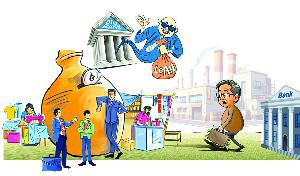
A senior NBR official, who did not want to be named, told Daily Industry that the purpose of this is not to reward tax evaders, but to bring back undisclosed and inactive money to the productive economy. Currently, high inflation in the country, high interest rates on loans and slow private investment have reduced investor confidence. In such a situation, the government wants to revive economic activities by bringing back money outside the banking system or assets abroad.
According to relevant sources, the main goals of this initiative are three-increasing investment flow into the country, boosting the housing sector, which has been stagnant for a long time, and bringing back undisclosed assets abroad. The government also wants to increase revenue collection as part of implementing its commitments to the International Monetary Fund (IMF) on fiscal and financial reforms.
NBR officials said the proposal could be applicable to two types of assets. First, if undisclosed money or assets abroad are brought back to the country and invested in designated sectors, they may be allowed to be legalized by paying a certain tax rate. However, the tax rate will be kept higher than that of regular taxpayers, so that the fairness of the tax system is maintained.
And second, there may be an opportunity to invest undisclosed money in the housing sector, which has been in recession for a long time. Investment in residential flats, commercial buildings or other immovable assets may come under this facility. However, the tax rate may vary based on the source of money, type of investment and geographical location.
Sources say that tax rates may be comparatively higher for investments in Dhaka and Chittagong. On the other hand, there is a thought of setting comparatively lower rates for investments in industrial zones or economic zones.
In addition, new incentives are also being considered for some manufacturing sectors, including agro-processing, light engineering and export-oriented industries, which are included in the Sixth Schedule of the Income Tax Act.
Bangladesh has been given opportunities to whiten black money several times before. However, these initiatives have been criticized in the past, because in many cases, undeclared money was given the opportunity to legalize by paying lower taxes than regular taxpayers.
Those concerned say that such policies can damage people’s trust in the tax system and the culture of paying taxes.
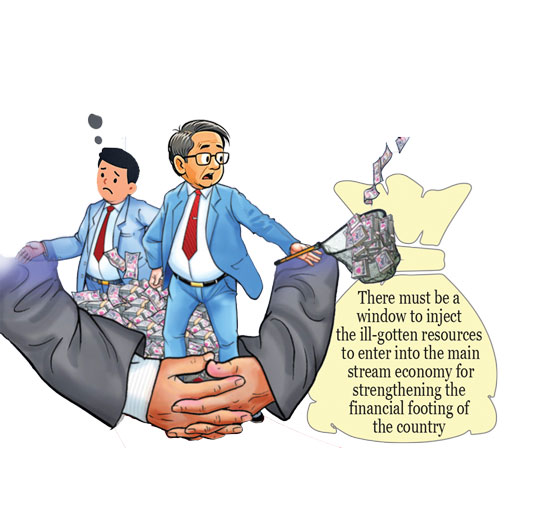
Dr. Enayet Karim, President of the Global Economist Forum said, “There must be a window to inject the ill-gotten resources to enter into the main stream economy for strengthening the financial footing of the country.” Most of the booming economies have been practicing this way to boost their economic health, he added.
Dr. Zahid Hossain, former chief economist at the World Bank’s Dhaka office, said that if regular tax evaders are repeatedly given opportunities and honest taxpayers are put under relatively more pressure, it sends a harmful message to the tax system.
Dr. Mahfuz Kabir, research director and economist at the Bangladesh Institute of International and Strategic Studies (BIS), told that this opportunity creates moral pressure on honest taxpayers. Taxpayers feel helpless. However, due to procedural reasons, sometimes some undisclosed money is created as a result of remittances sent from abroad and sale of assets.
He also said that although this opportunity is kept this year for the sake of the economy, a timeline should also be given. It would not be right to keep this opportunity for too long. In addition, the NBR should be informed about how many taxpayers took this opportunity. Because in the past, we have seen that even though the opportunity to return undisclosed money was given, the money laundered abroad was not returned. Dishonest taxpayers will want to take advantage of this again and again. Therefore, the government has the opportunity to further scrutinize this opportunity, he said.