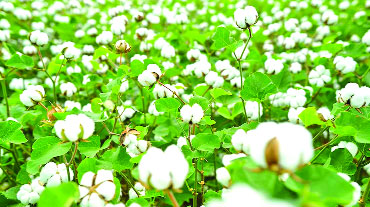
Bangladesh is one of the world’s leading exporters of ready-made garments. Although the main raw material of this industry is cotton, it is almost entirely dependent on foreign countries for its supply. Bangladesh is at the top in importing essential cotton. It was at the top for a few years, surpassing China. Currently, about 97 percent of the total demand has to be met through imports.
Cotton is now being cultivated on approximately 50,000 hectares of land across the country. The production is 200,000 bales (182 kg per bale). Last year, cotton production was 210,000 bales on 45,150 hectares of land.
With the rise of the export-oriented garment industry, the demand for cotton in the country has also gradually increased. However, despite this increase in demand, cotton production in the country accounts for only 3-4 percent of the total demand.
Those concerned say that despite so much demand, the government is not able to do the expected work in cotton production. In that case, the government agency Cotton Development Board also lacks effective research to increase production and develop new varieties. Due to the board’s failure, lack of government cooperation and negligence in allocation, even the minimum amount of cotton required is not being produced. However, it was possible to save a lot of foreign exchange by increasing production.
The Cotton Development Board believes that due to land scarcity, it has never been possible to achieve self-sufficiency in cotton production in Bangladesh. It is even impossible to produce half of the demand. In the current reality, if we make a strong effort, a maximum of 10-15 percent of the demand can be produced.
Cotton imports cost $4-5 billion annually
Cotton is the most important raw material for Bangladesh, which is the world’s leading exporter of ready-made garments. Last year (2025), an agricultural research institute, Bangladesh Agricultural Economics (BAE), published a report analyzing data from the National Board of Revenue, which showed that Bangladesh spends $4 to $5 billion annually on cotton imports.
Analysis of that research data shows that the figures for cotton imports and expenditures are significant every year, although there are some fluctuations from year to year.
The study shows that Bangladesh imported 8.3 million bales of cotton in 2024, at a cost of $3.92 billion. The five-year study from 2020 says that Bangladesh spent $3.29 billion on importing 6.5 million bales of cotton in 2020. The next year, in 2021, it spent $4.72 billion, in 2022, $504 billion, and in 2023, $4.02 billion.
Production, demand and import situation
This year (2025-26 fiscal year) there is a target of cotton cultivation on 48,000 hectares of land across the country. The production target is 252,000 bales. Last year, cotton production on 46,760 hectares of land was 219,000 bales.
For the past few years, production has been hovering between 2 lakh and 22 lakh bales. Currently, cotton is being cultivated in 132 upazilas of 39 districts of Bangladesh. The amount of cultivated land is also increasing slowly. Four varieties of cotton are being cultivated in the country - char cotton for the char areas, hill cotton for the hills, upline cotton for the plains and draught cotton for the Barendra area.
The country has an annual demand for cotton of about 8.5 million bales. Of this, the annual demand for cotton from the country’s 519 textile mills alone is about 8 million bales. About 8.3 million bales have to be imported every year.
Bangladesh currently imports the most cotton from Brazil. Earlier, India was at the top. In addition, it mainly imports cotton from the United States and several countries including the African country of Benin.
Monirul Islam, a cotton farmer from the Ranishankail area of Thakurgaon, told Daily Industry, ‘The government does not pay the same attention to cotton production as it does to food production. There are sometimes problems in getting seeds, and the prices are also high.’
He said, “In addition, the higher the yield of cotton on high land, the easier and more profitable it is to cultivate other crops on that land. That is why many people are now giving up cotton cultivation.”
What is the Cotton Development Board doing?
The Cotton Development Board was formed in 1972 to increase the supply of cotton fiber suitable for use in textile mills for the development of the post-independence textile industry in Bangladesh. In 1991, the responsibility of cotton research was transferred from the Bangladesh Agricultural Research Institute to the Cotton Development Board. Since then, the entire responsibility of expanding cotton production in the country, including the development of new varieties and technologies, has fallen on this organization. Even after this long period, the organization has not been able to come close to the desired success in cotton production. Every year, the organization receives a lot of allocation from the government for research, cotton cultivation expansion, seed production and distribution, training, marketing and ginning support. In addition, it has been implementing micro-credit distribution programs among marginal farmers. However, the expected production is still elusive.
What is the target of this board?
The board wants to produce 20 percent of the country’s cotton demand. However, there are many limitations. Due to land scarcity, it is practically not possible to achieve self-sufficiency in cotton production in Bangladesh. Even producing half of the demand is almost impossible. In the current reality, if we make a strong effort, a maximum of 10-15 percent of the demand can be produced. However, due to the board’s failure, lack of government cooperation, and neglect of research, even this amount of cotton cannot be produced.
In this regard, Rezaul Amin, Executive Director of the Board, told Daily Industry, “We are trying our best. Cotton and its by-products, by using durable and high-yielding varieties are being increased. Efforts are being made to increase cotton production by innovating technologies that are suitable for the climate and according to the needs of farmers through research, supplying seeds of quality high-yielding varieties, expanding cotton cultivation in the existing cultivation areas as well as in the country’s low-yielding lands and assisting in marketing.”
He said, “Despite efforts due to land scarcity, not much can be done. Even then, to ensure maximum utilization of land, the cultivation of vegetables, pulses and spices as companion crops with cotton is being expanded. It is receiving good response in different areas of the country. Cotton cultivation is being expanded in barren, saline, pasture, agroforestry and hilly areas.”
He further said that through Cotton Development Board research, 24 high-yielding varieties have been released so far, namely CB-12, CB-13, CB-14, CB-15, CB-16, CB-17, CB-18, CDB Cotton-19, CDB Cotton-20, CDB Cotton-21 and Pahari Cotton-3. In addition, a high-yielding hybrid named CB Hybrid-1 has been released. Hybrid cotton seeds are being cultivated at the field level from the 2009-10 season through government and private initiatives. The average yield per bigha has now increased to 12-15 maunds.
The Cotton Development Board has so far developed one hybrid, 26 high-yielding varieties and 60 technologies through research. In addition, in the fiscal year 2024-25, hybrid cotton seeds, fertilizers, pesticides, fungicides and growth regulators were distributed free of cost among 21,100 cotton farmers under the agricultural incentive support program worth Tk 168.8 million.