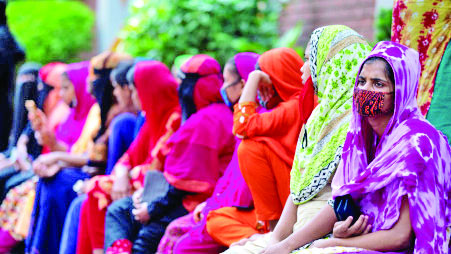
Bangladesh’s vital ready-made garment (RMG) sector is facing mounting pressure as exports continue to decline, raising serious concerns over employment stability in the country’s largest formal job-creating industry. According to data and analysis highlighted by The Daily Industry, the ongoing slump in export earnings-combined with global economic uncertainty and rising production costs-has put millions of jobs at potential risk. The sector, which employs more than four million workers-around 65 percent of them women-has experienced a persistent negative growth trend over the past several months. Exporters, economists, and business leaders warn that if the current downturn continues, it could trigger layoffs, reduced working hours, and factory closures.
Prolonged Decline in Export Earnings: Data from the Export Promotion Bureau shows that export earnings in February 2026 fell by 12.03 percent compared to the same month a year earlier. Over the first eight months of the current fiscal year (July-February), overall export income declined by 3.13 percent.
Total export earnings during this period stood at $31.90 billion, down from $32.94 billion a year earlier. The decline is particularly pronounced in the garment sector-the backbone of Bangladesh’s export economy.
Garment export earnings dropped 13.21 percent in February alone, falling to $2.81 billion from $3.24 billion in the same month last year. Industry insiders attribute the decline to weakening global demand, inflationary pressures in key markets, and ongoing geopolitical instability.
Seven-Month Negative Trend Raises Alarm: The data indicates that Bangladesh’s garment exports have been on a downward trajectory for seven consecutive months. While the fiscal year began on a strong note-with export earnings in July rising by nearly 25 percent year-on-year-the momentum quickly weakened. From August onwards, exports began to decline steadily. The contraction deepened through September, October, and November, with December marking the sharpest fall at over 14 percent. Although January saw a brief period of relative stability, February again recorded a significant drop, reinforcing concerns about a sustained slowdown. Analysts say the trend reflects structural challenges as well as external shocks, including global inflation, reduced consumer spending in Western markets, and supply chain disruptions linked to geopolitical tensions. Employment Concerns Intensify: Experts warn that the continued decline in export earnings could have a direct and severe impact on employment in the garment sector. Khondaker Golam Moazzem, research director at the Centre for Policy Dialogue, emphasized that negative export growth inevitably affects jobs. “When orders decline and export growth turns negative, factories refrain from hiring new workers. In many cases, they struggle to retain existing employees,” he said, as quoted by The Daily Industry. “This increases the risk of layoffs, reduced working hours, and job insecurity.”
He added that if the situation persists, factories may face financial strain in paying wages and benefits, potentially leading to labor unrest and industrial instability. Factory Owners Under Pressure: Garment manufacturers say they are already facing a difficult operating environment, with rising costs and shrinking order volumes. Rezwan Selim, managing director of Softex Cotton (Pvt.) Ltd, described the situation as highly challenging.
“Production costs are increasing, while work orders are declining due to the global crisis,” he said, citing The Daily Industry. “Export growth is currently negative. If this continues, it will become difficult to sustain factory operations, and employers may be forced to lay off workers.” Industry leaders also point to higher energy costs, currency fluctuations, and logistical disruptions as additional burdens.
Cautious Outlook from Business Leaders: Mahmud Hasan Khan Babu, president of the Bangladesh Garment Manufacturers and Exporters Association, said that while the immediate impact on employment has not yet been severe, risks are clearly rising.
“We have not yet seen an immediate impact on employment,” he noted. “However, if factories face order shortages and are forced to shut down, employment will certainly be affected.” He warned that if the sector ends the fiscal year with negative growth, job losses could increase significantly. However, he expressed cautious optimism that government support and improved global conditions could help stabilize the industry.
Global Factors Driving the Slowdown: Exporters and analysts alike point to global economic conditions as a major driver of the current downturn. Inflation in key export markets-particularly in Europe and North America-has reduced consumers’ purchasing power, leading to lower demand for apparel.
In times of economic uncertainty, consumers tend to prioritize essential goods such as food and housing, cutting back on discretionary spending like clothing. This shift has directly affected Bangladesh’s garment exports.
Additionally, ongoing geopolitical tensions and conflicts have disrupted supply chains, increased shipping costs, and created uncertainty in international trade.
Investment Stagnation Adds to Challenges: The slowdown in exports comes at a time when investment in the garment sector has already been stagnating for nearly two years. As a result, the creation of new jobs has slowed significantly.
Industry insiders say that many factories are operating cautiously, avoiding expansion plans and focusing instead on survival. This has further limited employment opportunities, particularly for new entrants to the labor market.
Broader Economic Implications: The garment sector is a cornerstone of Bangladesh’s economy, accounting for more than 80 percent of total export earnings. Any prolonged downturn in this sector could have far-reaching consequences for economic growth, foreign exchange reserves, and overall stability.
A decline in employment in the RMG sector would also have social implications, particularly for women workers who make up the majority of the workforce. Many of these workers come from rural areas and rely on garment jobs as their primary source of income.
Policy Support Seen as Crucial: Experts stress that timely policy intervention will be critical to stabilizing the sector and protecting jobs.
Khondaker Golam Moazzem highlighted the need for measures to reduce production costs, improve efficiency, and enhance competitiveness. “Bangladesh cannot afford to remain passive in the face of global economic instability,” he said. “Efforts must be made to reduce operational costs, improve productivity, and explore new markets.”
Similarly, industry leaders have called for policy support in areas such as energy supply, financing, and export diversification.
Mohammad Hatem, president of the Bangladesh Knitwear Manufacturers and Exporters Association, emphasized the importance of strategic measures. “To remain competitive, we need policy support, reliable energy supply, and diversification into higher-value products,” he said. “With the right steps, the sector can regain momentum and continue contributing to the economy.”
Hope amid Uncertainty: Despite the challenges, stakeholders remain hopeful that the situation can improve. The formation of a new government and its commitment to addressing economic challenges has raised expectations within the business community.
If global demand recovers and appropriate domestic policies are implemented, the garment sector could regain its footing in the coming months. The ongoing decline in garment exports has raised serious concerns about employment and economic stability in Bangladesh. With millions of livelihoods dependent on the sector, the stakes are high.
As The Daily Industry highlights, the coming months will be critical in determining whether the sector can weather the current or face deeper crisis. Ensuring policy support, improving competitiveness, and adapting to changing global dynamics will be key to safeguarding both exports and employment. Without timely intervention, experts warn, the present negative trend could evolve into a broader crisis-one that not only affects industry performance but also threatens the livelihoods of millions across the country.