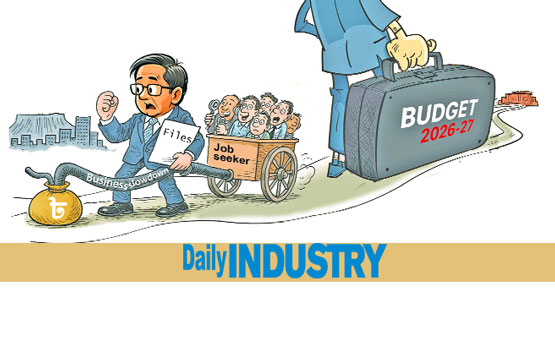
Bangladesh’s economy is showing clear signs of a slowdown in business activity and job creation, placing strong pressure on the upcoming national budget to revive investment and restore growth momentum.
Private investment has been declining steadily over the past few fiscal years. It stood at 24.52 per cent of GDP in fiscal year 2021-22, fell to 24.18 per cent and 23.96 per cent in the next two years, and dropped further to 22.48 per cent in fiscal year 2024-25-the lowest level in a decade, according to provisional estimates.
Economists and business leaders say this persistent decline reflects weakening investor confidence, high input costs, energy shortages, and tighter financial conditions across the economy.
Investment slowdown deepens economic concerns: Several indicators point to a broader slowdown in economic activity. Bangladesh Bank data shows that letters of credit (LCs) opened for capital machinery imports fell by nearly 3 per cent during the first nine months of the current fiscal year compared to a year earlier. LC settlements dropped by almost 10 per cent, signalling weaker execution of investment plans.
Private-sector credit growth has also slowed sharply, falling to 4.75 per cent in April-far below the usual double-digit level-reflecting weak demand for borrowing amid high interest rates and uncertainty.
Lower investment activity is directly affecting job creation, with analysts warning that the slowdown is worsening unemployment pressure.
“Business remains below normal levels,” say entrepreneurs: Entrepreneurs say business activity has yet to fully recover from recent economic and political disruptions. Riyad Mahmud, managing director of NPOLY Group, told The Daily Industry, “Business activity dropped by half following the political transition. Although conditions have improved somewhat, operations are still 18-20 per cent below normal levels. The prolonged slowdown has created pressure on our working capital.”
He added that many firms are delaying expansion and focusing only on survival due to weak demand and financing constraints.
Energy crisis hurting industrial output: Industrial expansion is also being constrained by long-standing energy shortages. Many factories continue to face irregular gas and electricity supply, forcing them to operate below capacity.
A major example is Little Star Spinning Mills in Savar, which depends heavily on natural gas for production. The factory, approved for 10 PSI gas pressure, reportedly receives only 1.5 to 2 PSI.
Khorshed Alam, chairman of Little Star Group, told The Daily Industry, “Due to the gas crisis alone, our company has suffered production losses worth nearly Tk 2.5 billion over the past four years.”
He said the company invested Tk 120 million in solar power and battery storage, but energy shortages continue to disrupt operations, forcing the factory to run at only 60 per cent capacity.
Inflation and demand pressure weigh on businesses: High inflation has further weakened consumer purchasing power, reducing demand for goods and services across sectors. Businesses say rising costs of raw materials, energy, and borrowing are squeezing profit margins and discouraging expansion.
M Masrur Reaz, chairman of Policy Exchange Bangladesh, told The Daily Industry, “High inflation suppresses demand. If inflation continues to rise, pressure on currency depreciation will intensify, increasing import costs and overall business expenses.”
He stressed the need for stronger energy planning and immediate reforms to improve the investment climate.
Job market under strain: The slowdown in business activity is also affecting employment. Several industries, particularly the garment sector, have reported layoffs and reduced hiring.
Following the Eid holidays, Al-Muslim Group laid off 1,868 workers from seven garment factories in Savar. Across industrial zones, thousands of workers have reportedly lost jobs in recent months.
At the end of 2024, Bangladesh had 2.7 million unemployed people, up from 2.55 million in 2023, according to Bangladesh Bureau of Statistics (BBS) data.
Analysts warn that weak investment and slow industrial expansion are limiting new job opportunities, worsening the employment situation.
Budget expected to focus on investment revival: With economic pressure mounting, attention is now focused on the upcoming national budget for fiscal year 2026-27, which is expected to prioritize investment revival, job creation, and inflation control.
Sources at the National Board of Revenue (NBR) said the budget may include tax reductions for at least 19 categories of businesses, including cuts in advance income tax (AIT) at the import stage and lower withholding tax rates.
The government is also expected to introduce incentives for young and women entrepreneurs and streamline business licensing and approval processes. A Tk 600 billion stimulus package has already been announced, including Tk 200 billion for closed industrial units. Businesses will be able to access loans from this fund at an average interest rate of around 7 per cent.
FDI decline adds to concerns: Foreign direct investment (FDI) has also weakened, adding pressure to already sluggish domestic investment. Net FDI inflows during July-March FY2025-26 fell 23.5 per cent to $1.006 billion, compared to $1.316 billion in the same period a year earlier.
Entrepreneurs say foreign investors are hesitant due to energy shortages, policy uncertainty, and high borrowing costs affecting local businesses.
Policy response and reform plans: The Bangladesh Investment Development Authority (BIDA) has announced a 180-day action plan to boost investment, including 25 priority initiatives and the integration of key investment agencies.
BIDA Executive Chairman Ashik Chowdhury said these reforms aim to create a stronger investment ecosystem and attract both domestic and foreign investors.
With declining private investment, weak credit growth, falling machinery imports, and rising unemployment, Bangladesh’s economy is facing a period of visible slowdown.
As business leaders and economists warn, the upcoming budget will be critical in restoring confidence, reviving investment, and creating jobs. However, without sustained reforms in energy supply, financial stability, and policy consistency, experts caution that the slowdown could persist further into the coming fiscal year.