The Middle Eastern sky is now heavy with the smell of gunpowder. The ongoing direct conflict between Iran and the United States has reached a peak. One side is attacking, the other is retaliating. The situation has become even more heated after US President Donald Trump declared the ceasefire ‘broken’. Since then, US forces have been attacking Iran for seven consecutive days. In response, Iran has also been firing missiles and drones at US bases in the Gulf region.
This war is no longer limited to Iran. It has affected many neighboring countries, such as the United Arab Emirates, Iraq, Bahrain, Kuwait, Saudi Arabia, Oman, Qatar, Lebanon, Palestine, etc.
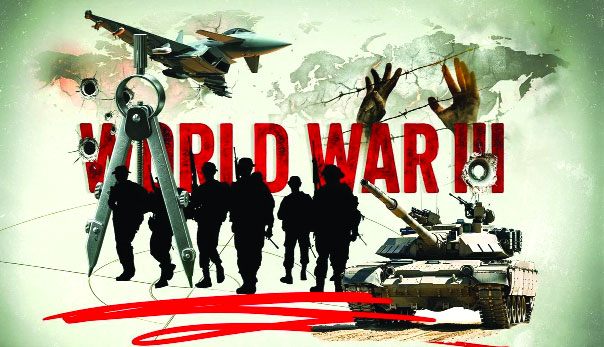
Seeing the spread of such bloody conflicts, many are now asking the question: Does the United States want to start World War III?
Regional war on the way to a great war
The war began in February this year after the death of top Iranian leaders, including the supreme leader, in a US and Israeli strike. A ceasefire agreement was reached in June, but it did not last long. Currently, the US Central Command (Centcom) is continuously bombing inside Iran.
On the other hand, Iran is also attacking US military targets in Bahrain, Qatar, Kuwait and Jordan.
Meanwhile, Israel continues its brutal military campaign in Gaza and Lebanon, prompting an angry Iran to prepare to fully activate its regional proxies, such as Hezbollah in Lebanon and the Houthis in Yemen.
Analysts say this is no longer just a conflict between two countries. It has now turned into a multi-dimensional regional war.
The moves of the superpowers and the equation of world war
With multiple countries involved in the conflict, the possibility of a global war cannot be ruled out. However, there is debate as to whether this can be called a ‘World War III’ right now. For a world war to occur, superpowers like Russia and China would have to go to war directly against the United States on Iran’s behalf.
Russia and China are providing Iran with drone parts, diplomatic support, and economic assistance. But they themselves do not want to engage in a nuclear or all-out war with the United States. Their strategy is to indirectly keep American power busy in the Middle East.
Due to this cautious stance of the superpowers, the conflict is not turning into a world war right now. However, one wrong move or an attack on a nuclear facility could change the whole equation.
The risk of Saudi Arabia and Pakistan getting involved
Another dangerous twist in this war is the threat of Saudi Arabia and Pakistan getting involved.
Tensions with Iran have become clear again with the recent Saudi airstrikes in Yemen. Now, if Yemen’s Houthi rebels launch a major attack on Saudi oil fields or civilian installations at the behest of Tehran, Riyadh will be forced to go to war.
Again, Saudi Arabia has a deep military agreement with Pakistan to protect its sovereignty. Islamabad has already stated that it is committed to protecting Saudi holy lands.
But Pakistan has its own geopolitical constraints. It borders Iran and has a large Shiite population. As a result, Pakistan may not directly attack the Iranian mainland. It will largely provide airspace and defensive military support to Saudi Arabia. But even that would greatly increase the scope of the war.
Risk of attacks on civilian installations
The US has previously mainly targeted Iranian military installations, but is now also attacking civilian installations. Their attacks are damaging Iranian civilian infrastructure such as airports, railway stations and bridges.
Now, if Iran retaliates against civilian installations of US allies in the Middle East (such as Bahrain, Qatar, Kuwait or Jordan), those countries will be drawn directly into the battlefield.
Again, if Iran is on the verge of complete collapse due to continuous attacks on civilian installations, its strategic allies China and Russia may no longer be able to remain silent spectators. They will increase their assistance to Iran with more sophisticated air defense systems, anti-ship missiles, and intelligence information, in their own geopolitical interests.
If the use of Russian technology in Iranian attacks on US forces were revealed, it would greatly increase the risk of direct military conflict between the US and Russia.
Fears of a major disaster in the global economy
Although the world war is not directly, the world is already feeling its economic impact. Iran has vowed not to allow a single drop of oil or gas to be exported through the Persian Gulf unless US attacks on the region stop. The country has already taken control of the Strait of Hormuz, one of the world’s most important waterways, through which one-fifth of the world’s oil is transported.
The world’s major airlines have canceled or suspended flights to Middle Eastern countries. Qatar Energy and Kuwait Petroleum are facing major complications in their oil and gas supplies. As a result, there is a risk of fuel prices skyrocketing in the global market, which could lead to severe inflation and economic collapse in each country.
The ultimate price of miscalculation
According to analysts, no one would intentionally start World War III, but a single ‘miscalculation’ in the midst of ongoing attacks and counterattacks could spiral out of control.
If a US missile hits an Iranian nuclear facility, or an Iranian drone sinks a major US warship, there will be no turning back.
Margaret Macmillan, emeritus professor of international history at Oxford University, told the BBC’s ‘Global Stories’ podcast, “People usually think that wars are started with a lot of planning, and that those who go to war know what they are going to do. But if you look at past wars, you can see... even in the case of the First World War... in the end, the reason behind the start of wars was largely accidents and misunderstandings with the opponent.”
Macmillan said that the assassination of Archduke Franz Ferdinand, nephew of Emperor Franz Joseph of Austria-Hungary, in 1914, triggered the First World War.
The Allied powers quickly joined the war on each other’s behalf. Austria and Hungary launched a joint campaign against Serbia, Germany supported Austria, Russia deployed troops on Serbia’s side, France supported Russia, and Britain joined the war for reasons of honor and strategy.What
happened next turned into a terrible global disaster.
As a result, the current conflict in the Middle East is a signal of great danger not only for the security of that region, but also for the security of the entire world. The world is now watching with deep concern to see where this war will end.