The government is facing mounting pressure to finance the budget at the beginning of the current fiscal year as revenue collection falls short of targets while fuel import costs, subsidies, government salaries and project financing obligations push up expenditure.
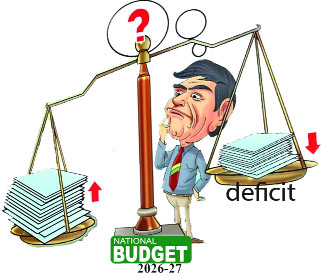
Against a record budget of Tk9.38 trillion for the 2026-27 fiscal year, the government has set a revenue collection target of Tk6.95 trillion, including Tk6.04 trillion for the National Board of Revenue (NBR).
However, revenue mobilisation has started the fiscal year on a weak note. According to NBR data, revenue collection stood at Tk518.92 billion in July and August against a target of Tk 810.53 billion, leaving a shortfall of Tk291.61 billion.
Collection during the first two months was also lower than the Tk547.68 billion collected in the corresponding period of FY2025-26, indicating a contraction at the beginning of the new fiscal year.
Former NBR chairman Dr Nasiruddin Ahmed told The Daily Industry that revenue collection is closely linked to the level of economic activity. “Revenue collection is directly linked to economic activity. If people's incomes increase, income tax will rise; if business profits increase, corporate tax will rise; and if imports increase, customs and other revenues will rise,” he said.
He said stronger economic and business activity would create greater scope for revenue mobilisation, adding that much would depend on how the government supports businesses and trade while addressing global challenges.
Weak investment adds pressure: Stagnant private-sector credit and weak investment are also putting pressure on budget financing. High interest rates, the energy crisis and weak market demand have slowed business and trade activity, affecting industrial production, employment and corporate profits. Private-sector credit growth has remained below 5% for five consecutive months.
The weak investment environment is also reflected in public-sector development spending. In FY2025-26, the government spent Tk1.41 trillion against an Annual Development Programme allocation of around Tk2.09 trillion, achieving only 67.52% implementation-the lowest rate in five decades. The trend has continued into the current fiscal year, with ADP implementation standing at only 1.85% during July-August. Anwar-ul Alam Chowdhury Parvez, president of the Bangladesh Chamber of Industries (BCI), told The Daily Industry that declining private-sector credit and weak public investment were affecting both economic growth and revenue collection. “Private-sector credit flows have been declining steadily, while government spending has been relatively high. ADP implementation was also at its lowest level last year. There has been no significant positive change in the first two months of the current fiscal year either,” he said.
He said investment in both the public and private sectors was declining as businesses faced high borrowing costs, energy shortages and weak demand.
“Many small, cottage and micro businesses in rural areas are shutting down due to high interest rates and the energy crisis. Large industries are also under pressure,” Parvez said.”When businesses shut down, it doesn't only reduce production; employment and people's incomes also decline. This affects government revenue as well,” he added.
Energy costs deepen fiscal pressure: The energy sector has emerged as another major source of expenditure pressure.Higher global energy prices have increased the government's fuel import costs. The government has said Bangladesh Petroleum Corporation incurred losses of Tk228.75 billion over the six and a half months following the government's assumption of office, while spot-market LNG prices have also risen sharply.
In the first two and a half months of FY2026-27, the government provided Tk103 billion in LNG subsidies, against a full-year allocation of Tk60 billion.
If current LNG prices persist, import expenditure on LNG could exceed Tk900 billion during the fiscal year, while losses in the power sector could reach Tk600 billion, according to estimates cited in the report.
The government has already increased electricity and energy prices to manage part of the additional cost. Analysts, however, have warned that higher energy prices could increase production costs and consumer prices, potentially placing additional pressure on household spending and economic activity.
Salary burden adds to spending: Higher salaries and allowances for government employees are also expected to increase expenditure.Although the government plans to implement the salary and allowance increases in phases, the financial burden will begin in the current fiscal year. Once fully implemented, the additional government expenditure could exceed Tk1 trillion.
The government will also face increased salary-related costs for employees of state-owned entities and institutions, as well as teachers and staff covered by the Monthly Pay Order (MPO) scheme.
At the same time, export growth has weakened amid industrial stagnation and the energy crisis, while import costs have risen because of higher global energy and commodity prices.
Central bank data show that goods exports declined 1.6% year-on-year to $4.35 billion in July of FY2026-27 from $4.42 billion a year earlier.In contrast, imports increased 8.6% to $6.44 billion from $5.93 billion during the same period.
The widening gap between export earnings and import expenditure could put further pressure on the balance of payments and foreign exchange reserves if the trend persists.
Debt repayment adds pressure: The government's financing pressure is also being aggravated by foreign loan repayments.During July-August of FY2026-27, the government received $294.56 million in foreign loan disbursements but repaid $698.9 million, more than twice the amount received.
Debt-servicing obligations are expected to increase further during the fiscal year, along with interest payments. To finance the budget deficit, the government borrowed nearly Tk200 billion from domestic sources in July, according to Bangladesh Bank data. The government's demand for domestic borrowing reportedly increased further in August and September, although the latest figures have not yet been released
Borrowing could squeeze private creditFormer World Bank Dhaka office lead economist Dr Zahid Hussain told The Daily Industry that several indicators suggested the government was facing financial pressure at the very beginning of the fiscal year.”Although raising fuel and electricity prices may help ease the expenditure pressure to some extent, the overall pressure isn't declining,” he said.
He noted that the government would have to accommodate higher salaries for public employees, increased costs for state-owned institutions and MPO-listed teachers, as well as financing requirements for major projects.”As expenditure is rising, the sources of financing are still unclear,” he said.
Dr Zahid said the pressure was not solely the result of international market conditions, as government policy decisions were also contributing to the spending burden.
“The big question now is how the government will finance the major spending commitments already made,” he said, adding that the pressure could not be managed simply through higher taxes or cuts in development spending.
He suggested coordinating domestic and foreign borrowing, revenue mobilisation and expenditure rationalisation to manage the financing gap.Regarding possible international bond issuance, Dr Zahid said borrowing from global markets would not necessarily be inexpensive given prevailing international interest rates.”Bond financing will also create repayment pressure when the bonds mature,” he said.He cautioned that financing spending commitments in anticipation of future funds could increase fiscal pressure over the longer term.
Risk of crowding out private investment: Greater reliance on domestic borrowing could increase the government's demand for bank funds and potentially reduce credit available to the private sector.This could put further pressure on lending rates and make it more difficult for businesses to finance new investment.
Former finance secretary and former comptroller and auditor general Mohammad Muslim Chowdhury told The Daily Industry that signs of macroeconomic pressure were emerging within the government's budget framework.”Even after fuel prices have been increased, the pressure from subsidies remains. Revenue collection is also weakening as private-sector credit and investment decline,” he said.
He noted that revenue expenditure was increasing while capital expenditure remained below the desired level, creating a risk that the budget deficit could exceed its target.”If the government relies more heavily on domestic borrowing, access to credit for the private sector could shrink and interest rates could rise,” Chowdhury said.
He added that continued spending without restoring balance between revenue and expenditure could create additional risks for the currency and the country's international credit standing.
The NBR is taking measures to increase revenue collection, including efforts to resolve long-pending revenue disputes in courts. However, the immediate revenue impact of these measures remains uncertain.
Experts said sustained revenue growth would ultimately depend on stronger economic activity, fresh investment, business expansion and a broader tax base.
With revenue underperformance coinciding with rising energy, salary, subsidy and debt-servicing costs, the government's ability to finance the FY2026-27 budget without increasing borrowing or compressing development spending is emerging as a key fiscal challenge.