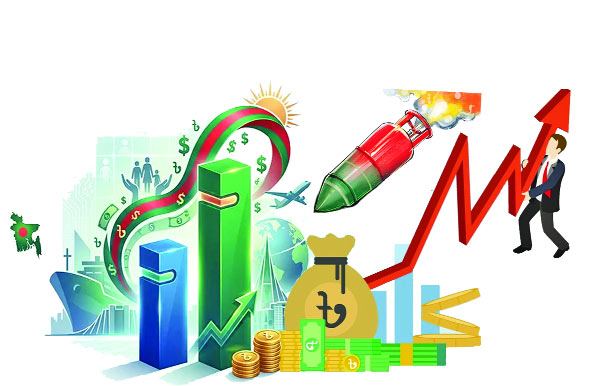
Bangladesh is facing mounting economic risks from escalating conflict in the Middle East, with rising energy prices, higher import costs, disruptions to trade and investment, and growing uncertainty over overseas employment and remittance inflows threatening an already fragile recovery.
The International Monetary Fund’s (IMF) October 2026 outlook has added to these concerns, projecting Bangladesh’s economic growth to slow to 3.2% in the current fiscal year 2026-27, while average inflation could rise to 10.9%. Economists warn that a prolonged conflict could intensify pressure on the country’s foreign exchange reserves, industrial production, export competitiveness and household purchasing power. Disruptions to energy supplies and shipping routes could further increase production costs, while an economic slowdown across the Gulf region could affect millions of Bangladeshi migrant workers.
The risks are particularly significant because Bangladesh depends heavily on imported fuel, raw materials and fertilisers, as well as remittances from workers employed in the Middle East. Instability around the Strait of Hormuz, along with potential disruptions to shipping through the Suez Canal and Bab el-Mandeb Strait, has raised concerns about the movement of goods and energy supplies.
Higher freight charges, insurance premiums and commodity prices could increase the cost of imports, putting additional pressure on businesses already struggling with expensive energy, limited investment and weak domestic demand.
Growth slows as inflationary pressure builds: The IMF’s latest projections suggest that Bangladesh’s economic recovery could lose further momentum in FY27, with growth falling to 3.2% and average inflation reaching 10.9%.
Slower growth combined with persistent inflation would weaken real incomes, reduce household consumption and discourage private investment. Low- and middle-income households are likely to face the greatest pressure as food, transport, housing and other essential expenses absorb a larger share of their income.
The World Bank has also highlighted weaknesses in Bangladesh’s economic performance, including sluggish private investment, employment constraints, energy shortages and vulnerabilities in the banking sector.
Rising non-performing loans and capital shortages have weakened banks’ capacity to finance businesses, while unreliable gas and electricity supplies have disrupted industrial operations.These structural problems could make it more difficult for Bangladesh to absorb another external shock.
Economists call for investment-friendly polic: Investment Corporation of Bangladesh Chairman and retired Dhaka University economics professor Abu Ahmed said the Middle East conflict had created a serious challenge for Bangladesh by disrupting oil and gas production and supply.
The resulting increase in energy prices is affecting economic growth, inflation and industrial activity, while economic difficulties in Middle Eastern countries could also undermine the employment and earnings of Bangladeshi workers living there.
He argued that Bangladesh needs a policy response suited to its own economic conditions rather than adopting every recommendation from international lenders without considering the domestic consequences.
Instead of raising interest rates further, he suggested reducing borrowing costs to encourage investment and economic activity. He also called for austerity in government luxury spending and less essential expenditure.
The policy challenge is to contain inflation without further discouraging private investment, production and employment.Businesses require affordable financing and reliable energy supplies to expand operations, while the government needs to maintain fiscal discipline and protect vulnerable households from rising living costs.
Remittance inflows face Gulf-region uncertainty: The potential impact on remittances is another major concern because Saudi Arabia is Bangladesh’s largest overseas labour market and one of its most important sources of foreign exchange.
More than four million Bangladeshis are currently working in Saudi Arabia, according to government figures cited in the report. During the first eight months of 2026, 276,877 Bangladeshi workers travelled to the country for employment.
Data from the Bureau of Manpower, Employment and Training show that 70,304 Bangladeshi workers went abroad in September, including 32,915 destined for Saudi Arabia.
Bangladesh Bank data show that Saudi Arabia contributed $5.85 billion in remittances during FY26. Between January and August 2026, the country sent $4.45 billion to Bangladesh, accounting for approximately 17.7% of the country’s total remittance inflows of $25.15 billion during the period.
Any prolonged economic slowdown in Saudi Arabia could therefore have significant consequences for Bangladesh.If businesses reduce operations, construction activity slows or employers cut costs, migrant workers could face reduced working hours, lower earnings or job losses. Higher living expenses in the Gulf could also reduce the amount workers are able to send home.
However, the eventual impact on remittances will depend on the duration and geographical spread of the conflict, as well as its effects on employment and economic activity across the region.A sustained decline in remittances would put additional pressure on foreign exchange inflows at a time when Bangladesh needs dollars to pay for fuel, industrial raw materials, food and other essential imports.
Energy security under growing pressure: Bangladesh’s dependence on imported petroleum makes it particularly vulnerable to disruptions in international energy markets.
The country consumes approximately 6.5 million to 7 million tonnes of petroleum products annually, of which around 1.4 million to 1.5 million tonnes consist of imported crude oil.
Saudi Aramco supplies approximately 750,000 tonnes of Arabian Light crude annually to Bangladesh, while additional crude oil is purchased from Abu Dhabi National Oil Company (ADNOC).
The crude oil is processed at Eastern Refinery to produce diesel, petrol, bitumen and other petroleum products.Saudi Arabia is also an important supplier of fertilisers to Bangladesh. The Bangladesh Chemical Industries Corporation imports urea from the country, while the Bangladesh Agricultural Development Corporation imports diammonium phosphate fertiliser.
A wider conflict or prolonged disruption to shipping routes could complicate these supply arrangements, increase transportation costs and delay deliveries.Higher energy and fertiliser prices would affect not only transport and electricity generation but also agriculture, manufacturing and food production.
For export-oriented industries, especially the ready-made garment sector, rising fuel and raw-material costs could weaken competitiveness in international markets. If production costs increase faster than export prices, manufacturers may struggle to maintain profit margins and preserve employment.
Hormuz disruption threatens regional economic activity: The conflict involving Iran, the United States and Israel, together with the closure of the Strait of Hormuz, has created wider risks for energy production, maritime transportation and regional trade.
An IMF report published on Tuesday projected that the Middle East and Central Asia economy could contract by 0.3% in 2026 amid the conflict and shipping disruptions.Oil production, maritime traffic and exports have been affected, while prolonged restrictions around the Strait of Hormuz could deepen economic pressure on energy-producing countries.The report warned of particularly severe contractions in Iraq, Kuwait, Qatar and Bahrain, with their economies potentially shrinking at double-digit rates this year. A broader regional slowdown could affect Bangladesh through several channels simultaneously: higher energy prices, more expensive shipping, weaker demand for exports and reduced earnings among migrant workers.
The potential disruption to trade through the Suez Canal and Bab el-Mandeb Strait also raises concerns about longer shipping routes, delivery delays and increased freight costs for goods moving between Asia, Europe and the Middle East.
Industrial production and investment remain weak: The external shock comes at a time when Bangladesh’s industrial sector is already facing significant difficulties.According to the World Bank’s assessment cited in the report, industrial growth was only 2% in FY26. The sector also contracted in the third quarter for the first time since the COVID-19 pandemic.
Uncertainty over gas supplies, electricity shortages and weaknesses in the banking sector have discouraged private investment. At the same time, severe fiscal constraints and implementation difficulties have pushed public investment to historically low levels, according to the assessment.
Weak investment affects both immediate demand and the economy’s long-term productive capacity. When businesses postpone expansion, fewer jobs are created, industrial output remains constrained and export growth becomes harder to sustain.
The Middle East crisis could aggravate these problems by increasing the cost of imported machinery, fuel and intermediate goods.For Bangladesh’s garment manufacturers and other export-oriented businesses, the combination of expensive inputs, unreliable energy and weak financing could further undermine their ability to compete with producers in other countries.
World Bank calls for structural reforms: The World Bank has identified banking-sector stability, energy security, improved governance and stronger revenue mobilisation as key priorities for Bangladesh.It has also recommended gradually replacing broad-based subsidies with targeted support for poor and vulnerable households.Such reforms could help reduce pressure on public finances while ensuring that assistance reaches people most affected by higher prices.
Strengthening banks is equally important. Financial-sector weaknesses restrict credit flows to productive businesses and undermine confidence among investors and depositors.Improving loan recovery, restoring capital adequacy and strengthening supervision would help rebuild the financial system’s capacity to support economic activity.Meanwhile, a more reliable energy supply is essential for restoring industrial growth and attracting new investment. Without improvements in fuel availability and electricity supply, lower financing costs alone may not be sufficient to revive production.
Policy priorities for Bangladesh: Economists say Bangladesh needs a coordinated response that addresses immediate external risks while tackling longstanding domestic weaknesses.The government will need to monitor fuel supplies and foreign exchange requirements closely, diversify energy procurement where feasible and minimise disruptions to essential imports.
Maintaining remittance channels and providing support to migrant workers facing employment uncertainty will also be important. At the same time, stronger engagement with overseas labour markets could help reduce dependence on a limited number of destinations over the longer term.
On the domestic front, policies should focus on restoring investor confidence, improving the banking sector, ensuring reliable industrial energy supplies and strengthening tax collection.Fiscal resources will also need to be directed towards essential services and targeted assistance rather than less productive spending.
Bangladesh’s exposure to the Middle East crisis is not limited to energy prices or shipping disruptions. It extends to employment, remittances, inflation, exports and the financial system.The scale of the eventual impact will depend on how long the conflict continues and how severely it disrupts regional economic activity. However, the combination of external uncertainty and domestic structural weaknesses means that a prolonged crisis could make Bangladesh’s economic recovery significantly more difficult.