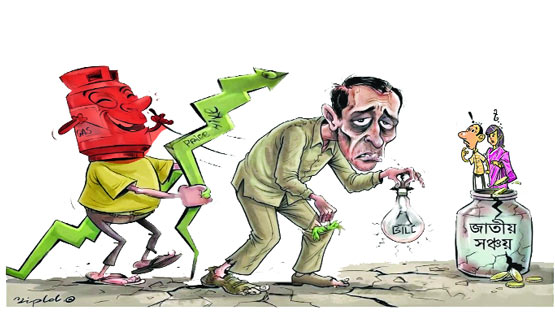
Bangladesh’s national savings rate has continued to decline as rising living costs push households to spend a larger share of their income on consumption, raising concerns over investment, capital formation and the economy’s long-term growth prospects.
According to the latest National Accounts Statistics published by the Bangladesh Bureau of Statistics (BBS), the national savings rate fell to 26.93 percent of gross domestic product (GDP) in the provisional fiscal year 2025-26, down from 29.95 percent in FY2022-23.
Domestic savings also declined sharply during the period. The ratio of domestic savings to GDP fell from 25.76 percent in FY2022-23 to 21.38 percent in FY2025-26-a decline of 4.38 percentage points in three years.
Economists say the decline reflects growing pressure on household finances amid prolonged inflation, while weaker remittance growth and losses at state-owned enterprises have also contributed to the deterioration in the savings position.
“The rise in prices of essential goods and services has increased the cost-of-living pressure on ordinary people. As consumers try to balance their income with their living expenses, their ability to save has declined significantly,” said Mustafizur Rahman, distinguished fellow of the Centre for Policy Dialogue (CPD). He also identified slower remittance growth and losses at various state-owned enterprises as other factors behind the declining national savings rate.
Consumption rises as savings fall: The BBS data show that the decline in savings has coincided with a rise in the share of consumption expenditure in GDP.Total consumption expenditure increased from 74.24 percent of GDP in FY2022-23 to 78.62 percent in FY2025-26.
Economists attribute much of the increase to persistent inflation, which has forced households to allocate a greater portion of their income to food, housing, transport, healthcare and other essential expenses.
M A Rajzak, chairman of Research and Policy Integration for Development (RAPID), said prolonged high inflation is one of the major reasons behind the decline in national savings.”Inflation is causing a large portion of people’s income to be spent on consumption. As households struggle to meet their living expenses, their capacity to save has declined,” he said.
Bangladesh has experienced elevated inflation for several consecutive years. According to BBS data, overall inflation stood at 8.26 percent in August, while inflation remained above 10 percent during FY2024-25.
Savings decline threatens investment: The weakening savings position is also reflected in the country’s investment performance.BBS data show that the investment-to-GDP ratio has fallen from above 31 percent around six years ago to below 28 percent currently. Both public and private investment have declined during the period.
Economists say lower domestic savings can restrict the availability of funds for investment through banks and other financial institutions.”Lower national savings reduce investment because funds available to banks and other financial institutions decline. This creates obstacles to overall investment and business expansion,” said M A Rajzak.
Mustafizur Rahman said the decline in the savings-to-GDP ratio means the country is increasingly unable to meet its investment requirements from domestically generated capital.”In such a situation, dependence on domestic and foreign borrowing increases to sustain investment. This creates additional pressure in terms of securing loans, managing debt and repaying borrowed funds,” he said.
Savings still rising in nominal terms: Although savings have declined as a share of GDP, their nominal value has increased because the overall size of the economy has expanded.BBS data show that national savings stood at around Tk13.45 trillion in FY2022-23. The figure increased to Tk16.48 trillion in FY2025-26.
Economists, however, generally focus more on the savings-to-GDP ratio when assessing the strength of savings and capital formation because an increase in savings in nominal taka terms does not necessarily mean that households’ real savings capacity has improved.The savings-to-GDP ratio provides a clearer indication of whether savings are keeping pace with the expansion of the economy.
Long-term decline: The decline in the savings ratio began largely during the Covid-19 period. Although there was a slight improvement in FY2022-23, the ratio subsequently declined for three consecutive fiscal years.
Before the pandemic, domestic savings accounted for around 27 percent of GDP in FY2019-20, while national savings stood at 31.42 percent.By FY2025-26, provisional BBS figures showed domestic savings had fallen to around 21 percent of GDP and national savings to nearly 27 percent.The trend indicates that the expansion of the economy has not translated into a corresponding increase in its savings capacity.
What needs to be done: Economists have called for measures to strengthen household purchasing power, improve productivity and create a more conducive investment environment to reverse the declining savings and investment trends.
Mustafizur Rahman said Bangladesh needs to increase productivity, attract more foreign direct investment and reduce losses at state-owned enterprises.He also called for reducing unnecessary expenditure in both the public and private sectors and restoring public confidence in the financial sector.
A stronger savings base, economists say, is important for mobilising domestic capital and financing investment without excessive reliance on borrowing. Sustaining higher savings and investment relative to GDP will therefore remain crucial for Bangladesh’s long-term and sustainable economic growth.