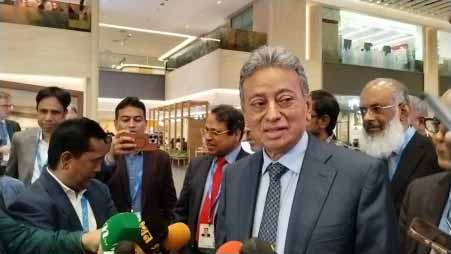
Finance Minister Amir Khosru Mahmud Chowdhury has said Bangladesh will meet conditions under a potential new agreement with the International Monetary Fund (IMF), signalling a shift from his earlier rejection of the lender’s terms.
“There will, of course, be conditions. The conditions will be met. There are also some issues that both sides will have to resolve through mutual understanding. Those are not a problem,” he said after meeting IMF Deputy Managing Director Nigel Clarke on Thursday on the sidelines of the IMF and World Bank Group Annual Meetings in Bangkok.
Khosru said discussions with the IMF, the World Bank and other multilateral organisations would continue in a spirit of partnership, adding that outstanding issues would be addressed through further negotiations.
He said the IMF had raised concerns about several aspects of Bangladesh’s economy, particularly the banking sector and the tax-to-GDP ratio. The government agreed with most of the lender’s observations, he added, noting that some issues had already been resolved while others would be discussed.
His remarks contrast with statements made at an event in Dhaka on October 4, when he said the government had cancelled the previous IMF loan agreement because its conditions were unacceptable.
At that time, Khosru said Bangladesh would no longer accept IMF conditions and would pursue economic self-reliance. He also expressed confidence that the country’s economy could reach $1 trillion by 2034 without assistance from donor agencies.
IMF lending programmes typically require reforms in revenue collection and the banking sector, reductions in energy subsidies, market-based pricing and measures to broaden the tax base. The lender had also questioned how the government would finance higher salaries for public servants.
Khosru said discussions with the IMF and the World Bank would continue for several months, expressing hope that cooperation with the multilateral lenders would progress smoothly.
He also claimed the IMF was satisfied with Bangladesh’s progress despite global economic uncertainty, wars and the ongoing conflict in West Asia.
Responding to concerns about the credibility of the government’s reform strategy, the finance minister argued that the progress of negotiations demonstrated that a credible plan was in place.
The previous IMF loan programme had been agreed during the Awami League administration to help address pressure on Bangladesh’s foreign exchange reserves. The BNP government subsequently scrapped the agreement, criticising its conditions.