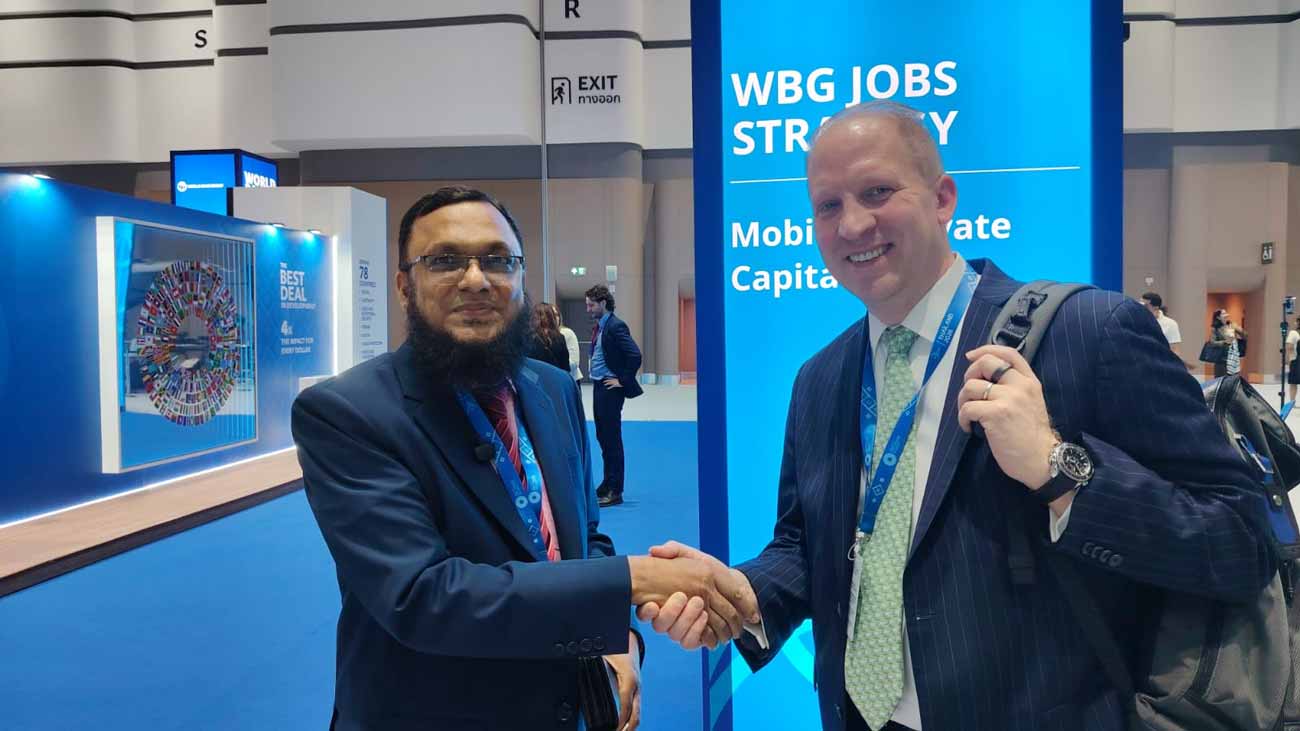
Bangladesh's investment prospects discussed in Bangkok as international banking executive Brian J. Cogliandro meets economist and Daily Industry Editor Dr Enayet Karim.
Bangladesh's investment opportunities and prospects for attracting international capital came into focus as Brian J. Cogliandro, a senior international banking executive at Mitsubishi UFJ Financial Group (MUFG), held an investment meeting with economist and Daily Industry Editor Dr Enayet Karim on the sidelines of the annual meetings of the International Monetary Fund (IMF) and the World Bank Group in Bangkok, Thailand.
The meeting focused on exploring investment opportunities in Bangladesh and the potential for mobilising international financing to support the country's economic development. The discussions brought together expertise in international banking, capital markets and economic analysis, highlighting the importance of connecting Bangladesh's investment needs with global financial institutions and investors.
Cogliandro serves as Head and Managing Director of International Syndicate and Deputy International Head of Capital Markets at MUFG, one of the world's major financial groups. His professional experience in international syndication, capital markets and global banking operations provides a relevant background for discussions on cross-border financing and investment opportunities.
Dr Karim, President of the Global Economist Forum and editor of the English-language newspaper The Daily Industry, brings experience in economic analysis, business journalism and engagement with international economic issues. He also serves as president of the Bangladesh Sangbadpatra Shilpa Parishad, a national organisation representing the newspaper industry.
The meeting took place against the backdrop of the IMF-World Bank annual meetings, which bring together finance ministers, central bank governors, policymakers, business leaders, development professionals and representatives of financial institutions to discuss global economic challenges, development financing and investment priorities.
Bangladesh's investment potential in focus
For Bangladesh, attracting foreign investment remains important for strengthening industrial capacity, expanding infrastructure, creating employment and diversifying exports. International financing can also play a role in supporting energy security, logistics, manufacturing, technology adoption and other sectors essential to long-term economic growth.
Discussions between international banking executives and representatives of Bangladesh's economic and business community can help identify potential areas of cooperation, assess financing requirements and build connections with global capital markets.
International syndication and capital markets expertise is particularly relevant to large-scale investments. Syndicated financing allows multiple financial institutions to participate in funding a transaction, distributing financial exposure among lenders. Depending on the project, financing may support infrastructure development, corporate expansion, industrial investment or other commercially viable initiatives.
Capital markets can provide additional channels for companies and institutions seeking to raise funds for long-term investment. Access to these channels, however, depends on factors such as project viability, financial transparency, regulatory compliance, risk assessment and investor confidence.
Against this background, engagement with experienced international banking professionals could help Bangladesh explore financing structures suited to its development priorities and the needs of potential investors.
While the meeting highlighted the prospect of investment in Bangladesh, any specific investment commitment, financing agreement or project announcement would require separate confirmation.
Cogliandro holds a senior position at MUFG, with responsibilities spanning international syndication and capital markets. His work involves the international banking environment, where financial institutions assess funding requirements, structure transactions and coordinate financing across markets.
His professional background includes experience as an associate at Commerzbank, where he further developed his capabilities in banking and financial services, including financial analysis and client support.
Before entering the banking sector, he worked as a project manager at Edwards and Kelcey, gaining experience in project planning, coordination and execution. This combination of project management and financial services experience provides a foundation for understanding the relationship between investment planning, financing requirements and implementation.
Cogliandro holds a Master of Business Administration from New York University's Stern School of Business and an engineering degree from The Cooper Union for the Advancement of Science and Art.
His background in engineering, business administration and international finance is relevant to evaluating investment proposals that require financial structuring, commercial assessment and coordination among multiple stakeholders.
MUFG operates internationally across banking and financial services, including corporate banking, global markets and capital markets activities. Its international presence makes the group part of the broader financial ecosystem through which businesses and institutions access cross-border funding.
For countries seeking to attract foreign capital, engagement with international financial professionals can help open discussions on financing options, provided that prospective projects meet the relevant commercial, legal and risk requirements.
Dr Enayet Karim's economic and business engagement
Dr Enayet Karim is an economist, President of the Global Economist Forum and editor of The Daily Industry, an English-language newspaper covering business, economics, industry and financial developments.
His professional activities connect economic analysis with business journalism and discussions concerning investment, trade and development. As president of the Bangladesh Sangbadpatra Shilpa Parishad, he is also associated with an organisation representing the country's newspaper industry.
In addition to his work in economics and journalism, Dr Karim was appointed Regional President for Asia of the World Council of Indigenous Games (WIG). According to an earlier announcement, the appointment was made public by WIG Secretary General Dr Ramya, with the stated term running from April 20, 2025, to March 2027.
His involvement in economic and professional organisations provides a platform for engagement with business leaders, policymakers and international stakeholders on issues affecting Bangladesh's economic development.
Participation in international economic forums can help representatives of Bangladesh's business community understand changing global financial conditions, communicate the country's investment priorities and develop professional connections with potential financing partners.
The meeting with Cogliandro brought together this economic and business perspective with experience in international banking and capital markets.
The annual meetings of the IMF and the World Bank Group are among the major gatherings on the international economic calendar. They provide a forum for discussions on global growth, financial stability, debt sustainability, poverty reduction, infrastructure development and financing for emerging and developing economies.
For countries such as Bangladesh, the meetings offer opportunities to engage with international financial institutions, development partners, investors and private-sector representatives.
Although the IMF and the World Bank have distinct mandates, both play important roles in the international economic system. The IMF focuses primarily on international monetary cooperation, macroeconomic stability and balance-of-payments support, while the World Bank Group provides development financing and expertise for projects and programmes aimed at improving economic and social outcomes.
Alongside formal discussions, meetings held on the sidelines can facilitate conversations about private investment, financing arrangements and cooperation between international financial institutions and domestic stakeholders.
Bangladesh's participation in such international engagement is particularly relevant as the country seeks to strengthen its investment environment, increase productivity and expand opportunities for private-sector-led growth.
However, converting discussions into actual investments requires further work, including identifying bankable projects, conducting due diligence, establishing suitable financing terms and ensuring a predictable business and regulatory environment.
The meeting between Cogliandro and Dr Karim reflects an effort to bring international financial expertise into discussions about investment in Bangladesh. Its potential significance lies in creating opportunities to examine how international capital markets and banking relationships might support commercially viable projects in the country.
Bangladesh has investment needs across several areas, including energy, transport and logistics, industrial production, export-oriented manufacturing and digital infrastructure. Mobilising financing for these sectors requires coordination among government agencies, domestic businesses, international lenders and investors.
International banking professionals can contribute expertise in transaction structuring, financing arrangements and risk assessment. Economists and business representatives can help identify national priorities, explain local market conditions and facilitate communication between prospective investors and stakeholders in Bangladesh.
Nevertheless, the scale and outcome of any prospective investment would depend on the projects identified, the participation of relevant parties and the completion of appropriate financial and regulatory assessments.
No specific investment amount, sector-specific commitment or formal agreement was provided in the information available about the meeting.
The discussion in Bangkok therefore represents an investment-focused engagement rather than confirmation of a concluded investment deal.
As Bangladesh continues to seek greater international investment, such exchanges can provide a starting point for exploring financing possibilities, building relationships with global financial professionals and bringing potential investment opportunities to the attention of international stakeholders.