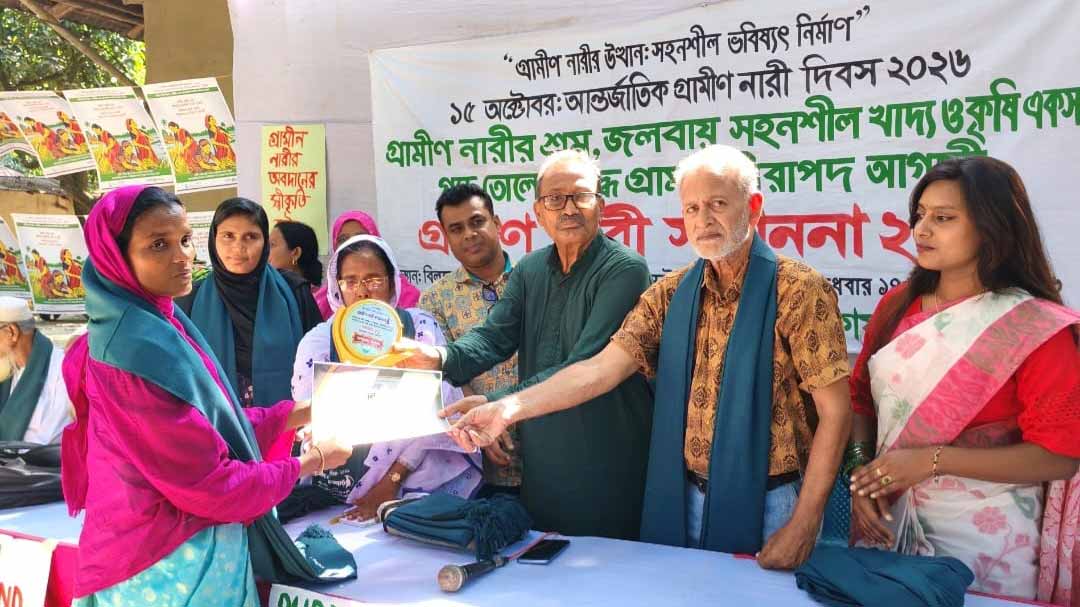
Twenty-two rural women from the drought-prone Barind region have received the ‘Rural Women’s Honour 2026’ for their contributions to conserving native seeds, protecting agricultural biodiversity, promoting eco-friendly farming and advancing women’s economic empowerment.
The awards were presented on Wednesday, October 14, at the Agroecology Learning Centre in Bilnepalpara, Paba upazila, Rajshahi, marking International Day of Rural Women.
Organised by BARCIK and Green Coalition, the programme recognised women from Paba and Tanore in Rajshahi and Nachole in Chapainawabganj for their initiatives in sustainable agriculture and community development.
The awardees are preserving indigenous seeds, cultivating diverse vegetables, producing organic fertiliser, rearing livestock, growing water-efficient crops and promoting environmentally friendly cooking stoves. Their efforts are helping improve household food security while preserving traditional agricultural knowledge and biodiversity.
Among the awardees, Shilpi Begum rears livestock from five varieties and facilitates the exchange of 25 types of seeds. Ayesha Begum preserves and exchanges 14 varieties of native bananas suited to the Barind region.
Minara Begum has helped 120 women in six villages adopt environmentally friendly cooking stoves. Setara Begum has facilitated the exchange of 21 vegetable seed varieties among 145 women in five villages.
Marjina Tudu has collected and preserved 47 seed varieties and facilitated seed exchanges among 175 women across 10 villages. Bilkis Begum has achieved economic self-reliance through vermicompost production and sales and has received divisional-level Joyeeta recognition.
For many women in the region, farming remains a daily struggle against drought and water scarcity.
Chichilia Hembram, an Indigenous woman farmer from Mahali Para in Tanore, said they often had to travel long distances to collect water while their fields remained dry.
“We have to struggle against drought to survive. I grow drought-tolerant winter crops that require less water. I also help other women in my neighbourhood by sharing seeds,” she said.
Jasmine Begum of Duari Para in Paba said she learned vermicompost production with support from BARCIK and gradually became self-reliant. She also said she had been invited to Italy to exchange experiences related to her work.
Shahana Begum of Azhoir village in Nachole said women’s contributions to agriculture often went unrecognised. She has taught organic pest-management methods to 110 women in seven villages.
Md Shahidul Islam, an anthropologist and regional coordinator of BARCIK, said the women’s contributions extended beyond agricultural production. Through seed exchanges, mutual support, traditional knowledge-sharing and community organisation, they were strengthening rural communities.
Mahbub Siddiqui, an environmental researcher and president of Green Coalition’s Rajshahi district committee, said rural women played a vital role in protecting agriculture and traditional farming practices.
Presiding over the event, Rahima Begum, president of Green Coalition’s Paba upazila committee, called for greater adoption of safe, chemical-free farming through joint efforts by women and men.
The awardees represent grassroots leadership in sustainable agriculture, demonstrating how rural women can help protect biodiversity, strengthen local food systems and build resilient communities in a changing climate.