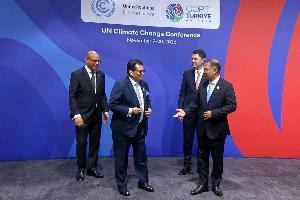
At the COP31 conference, Bangladesh announced a plan to add 4,000 megawatts (MW) of solar power capacity within the next three months. The government also reiterated its target of meeting 20 percent of the country’s total electricity demand through renewable energy by 2030.
However, despite these ambitious plans for renewable energy, Bangladesh’s position regarding the European Union’s Carbon Border Adjustment Mechanism (CBAM) and global electrification initiatives remains unclear.
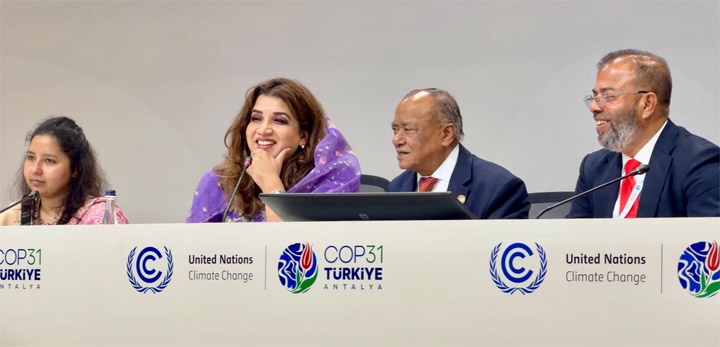
These details emerged during a joint press conference held by the Ministry of Foreign Affairs and the Ministry of Environment, Forest and Climate Change in the 'Blue Zone' at COP31 in Antalya, Turkey. Speaking at the event, Environment Minister Abdul Awal Mintoo stated that Bangladesh is actively working to expand renewable energy and address the risks posed by climate change.
Also present were State Minister for Foreign Affairs Shama Obaid Islam, State Minister for Environment Sheikh Faridul Islam, Member of Parliament Mansura Akter, and other relevant officials.
4,000 MW of Solar Power in Three Months State Minister for Environment Sheikh Faridul Islam announced that Bangladesh aims to meet 20 percent of its electricity demand from renewable sources by 2030. To achieve this, a plan has been set to add 4,000 MW of solar power capacity within the next three months.
However, he did not provide a detailed breakdown of how much of this 4,000 MW capacity represents newly installed capacity, projects currently under construction, or capacity expected to become operational.
The State Minister noted that achieving the renewable energy targets would be possible if investment in the sector is increased.
No Clear Stance on the EU’s Carbon Tax
A critical issue for Bangladesh’s export trade concerns the government’s position on the European Union’s Carbon Border Adjustment Mechanism (CBAM). In response to a question from a journalist regarding the potential impact of the European Union’s carbon tax on the trade and exports of developing nations—and Bangladesh’s stance on the matter—the Minister of Environment did not state a definitive position on the Carbon Border Adjustment Mechanism (CBAM). He remarked that climate change knows no borders. He emphasized that nations that have benefited most from industrialization and contributed significantly to the global climate crisis must shoulder a greater responsibility in supporting vulnerable countries.
The Minister cautioned that measures ostensibly aimed at addressing climate change should not create new barriers to Bangladesh’s trade, exports, or economic growth.
It should be noted that the EU’s CBAM entered its full financial phase on January 1, 2026. Currently, it covers six sectors: iron and steel, aluminum, cement, fertilizers, electricity, and hydrogen. While Bangladesh’s ready-made garment (RMG) sector is not explicitly included in the current list, there are concerns regarding the potential future expansion of the mechanism’s scope and the impact of carbon-related costs throughout the supply chain.
Need for $100 Billion in Climate Finance
The Minister of Environment stated that Bangladesh requires approximately $90 to $100 billion to address the impacts of climate change.
He noted that although there are international commitments for climate finance, the process of actually securing these funds is often complex. Bangladesh does not seek all of this funding as grants; rather, it advocates for transparent and accessible financing provided under favorable terms, including long-term repayment options.
At COP29, a target was set to mobilize $300 billion annually in climate finance by 2035. Furthermore, a call was made to increase total annual financing from all sources to at least $1.3 trillion.
According to Bangladesh’s updated national climate commitments, the country aims to reduce greenhouse gas emissions by 6.39% through its own efforts, with an additional 13.92% reduction targeted, contingent upon receiving international support. Demand for Funding for Riverbank Erosion and Displaced Populations
Bangladesh has emphasized that climate finance should not be limited solely to emissions reduction; rather, it must also be directed toward protecting the lives and livelihoods of affected communities.
The Minister of Environment stated that international assistance is essential to address the losses faced by people displaced due to riverbank erosion, high tides, droughts, and other climate-related factors.
Furthermore, Bangladesh has aligned itself with the demand from Least Developed Countries (LDCs) to increase annual adaptation finance to $120 billion by 2035.
There have also been calls to simplify the processes for accessing funds from the Green Climate Fund, the Global Environment Facility, and the Adaptation Fund.
Opportunity for a $30 Million Investment Plan for Climate Resilience
Bangladesh has been selected for the first phase of the Climate Investment Funds (CIF) RISE program. Under this initiative, there is an opportunity to develop an investment plan—with a potential value of up to $30 million—aimed at enhancing climate resilience.
The development of coastal infrastructure and climate-resilient agriculture are being considered as potential priorities for this plan. However, these funds have not yet been approved or disbursed; a final decision on financing will be made following a review of the investment plan.
From Announcement to Implementation—Focus Shifts to Solar Power Plans
At COP31, Bangladesh presented several demands, including the expansion of renewable energy, increased climate finance, and the protection of the rights of affected populations. A critical question now arises: how will the announced addition of 4,000 megawatts of solar power capacity over the next three months be effectively implemented in reality?
At the same time, Bangladesh is also closely monitoring the global electrification initiative "35 by 35" and the European Union’s Carbon Border Adjustment Mechanism (CBAM).