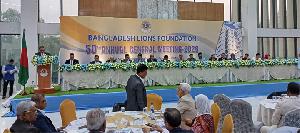
A crucial seminar titled “Hand in Hand: Synergies among Agricultural Stakeholders fpr Better Future” was held on Thursday at the Bangladesh Agricultural Research Council (BARC) auditorium in Farmgate, Dhaka.
Organized by the Ministry of Agriculture to celebrate 'World Food Day 2025', speakers at the event emphasized the importance of strengthening synergy among all stakeholders for sustainable agricultural transformation.
The seminar was presided over by Mr. Md. Abu Zubair Hossain Bablu, Additional Secretary (Research) of the Ministry of Agriculture.
Md. Masudul Hasan, Secretary of the Ministry of Food, attended as the Chief Guest.
Special Guests included Mr. Abu Taher Muhammad Zaber, Secretary of the Ministry of Fisheries and Livestock; Dr. Dia Sanou, FAO Representative in Bangladesh; and Dr. Valantine Achancho, IFAD Country Director in Bangladesh. The welcome address was delivered by Dr. Nazmun Nahar Karim, Executive Chairman of BARC.
Professor Dr. A. H. M. Saiful Islam, Head of the Agricultural Economics Department at Bangladesh Agricultural University, Mymensingh, presented the keynote paper. He highlighted that agricultural growth is 3.1 times more poverty-reducing than the non-agricultural sector. However, crop sector growth has recently slowed down or become stagnant.
The paper outlined several persisting challenges to food security and agricultural development in Bangladesh: Diet remains cereal-dominated, with a prevalence of Micronutrient Malnutrition and increasing Obesity. Rising food prices, the decreasing land-man ratio, declining soil fertility, and the impact of climate change are severely complicating the situation. Slow mechanization, poor agro-processing, and weak market linkages are significant barriers. Slow adoption of new technologies is observed due to weak research-extension-farmer linkages.
Food Ministry Secretary Mr. Md. Masudul Hasan stressed the importance of market management starting from the farmer level. He urged scientists to develop strategies for maintaining the dynamism of agricultural production in the context of climate change. Furthermore, he called for planning on how to utilize the new land emerging in the Bay of Bengal for agricultural purposes.
BARC Executive Chairman Dr. Nazmun Nahar Karim stated that given the challenges of population growth, land scarcity, and a changing climate, they are committed to achieving self-sufficiency in safe food supply and nutrition. Expressing concern, she noted that the indiscriminate use of chemical fertilizers and pesticides, along with water wastage, is destroying soil fertility. She stressed the need to increase farmers' income through improved market management.
Fisheries and Livestock Ministry Secretary Mr. Abu Taher Muhammad Zaber addressed the existing issue of scientists' promotions. Citing the example of Hilsha fish, he mentioned that despite the fish not requiring farming or feeding, the price increases 3-4 times by the time it reaches the consumer due to the influence of middlemen and those who control the fishermen, adding that efforts are ongoing to uncover this mystery.
The overall discussion concluded that despite Bangladesh's notable progress in agriculture, challenges remain in technology adoption, market linkage, climate resilience, and crop diversification. Speakers agreed that collaboration among academia, research institutions, extension workers, farmers, and the private sector is still fragmented. Strengthening synergy among these stakeholders is therefore vital for sustainable agricultural transformation.
The seminar was attended by senior scientists and officials from the Ministry of Agriculture, BARC, and various NARS-affiliated institutions, university teachers, and representatives from domestic, foreign, and NGO organizations.