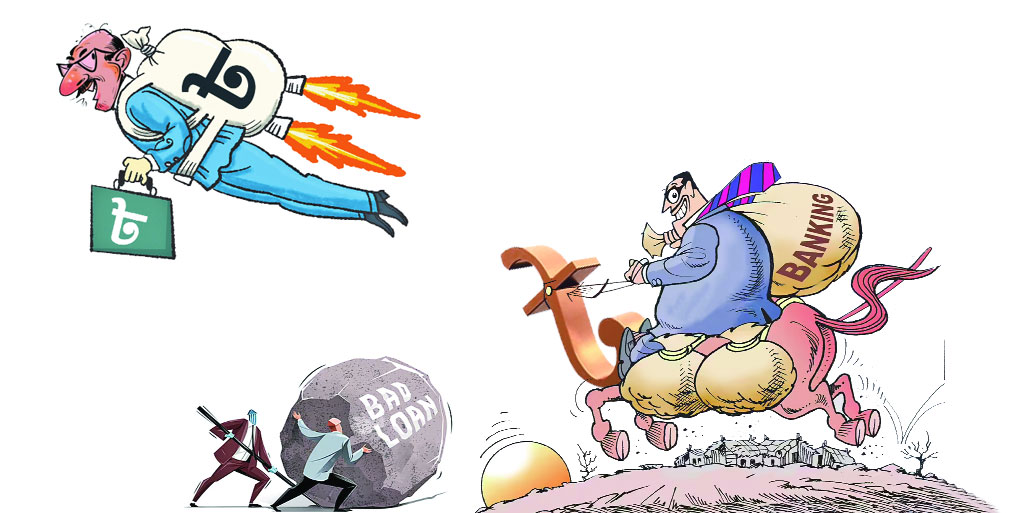
Bangladesh's state-owned banks are struggling to recover massive amounts of defaulted loans from a small group of large borrowers, exposing deep-rooted weaknesses in governance, risk management, and legal enforcement in the financial sector.
A recent internal review by the Financial Institutions Division under the Ministry of Finance reveals that the top 120 defaulters across six state-owned banks owe a staggering Tk 92,627 crore. Yet, recovery efforts have yielded only Tk 469 crore in 2025-barely 0.5 percent of the outstanding amount.
Bankers and economists, speaking to The Daily Industry, warned that such poor recovery performance reflects systemic failures and poses serious risks to financial stability. Concentration of Default Risk: The six state-owned banks-Sonali Bank, Agrani Bank, Janata Bank, Rupali Bank, BASIC Bank, and Bangladesh Development Bank Limited-have long been burdened by high levels of non-performing loans (NPLs).
The review shows that each bank's top 20 defaulters account for a disproportionately large share of bad loans, highlighting a dangerous concentration of credit risk among a handful of borrowers. A senior official familiar with the findings told The Daily Industry, “The data clearly shows that a small group of large borrowers is responsible for a significant portion of defaulted loans. Without strong legal and institutional action, recovery will remain extremely difficult.” Weak Recovery Performance: Among the six banks, Rupali Bank has performed relatively better in recovering loans from its top defaulters. The bank recovered Tk 361 crore over the past two years against outstanding loans of Tk 8,774 crore from its top 20 defaulters.
In contrast, Janata Bank recovered only Tk 56 crore against Tk 58,642 crore owed by its top defaulters, while Sonali Bank managed to recover just Tk 9 crore out of Tk 6,743 crore.
A banking sector executive told The Daily Industry, “Recovery from large defaulters is often entangled in lengthy legal battles. In many cases, borrowers exploit loopholes in the judicial process to delay repayment indefinitely.”
Capital Shortfalls Worsen: The massive burden of defaulted loans has severely impacted the financial health of these banks. According to the review, four out of the six banks are currently facing capital shortfalls. Janata Bank is in the worst condition, with its capital adequacy situation deteriorating significantly. Rupali Bank is also experiencing a decline in its capital position, while BASIC Bank continues to operate in negative territory. Only Sonali Bank and Bangladesh Development Bank Limited have managed "to avoid capital deficits, largely due to continued government support. Financial experts say this dependence on public funds is unsustainable in the long run.
Structural Weaknesses Persist: The Financial Institutions Division's analysis also points to structural inefficiencies in lending practices. Despite strong deposit growth, several state-owned banks have failed to expand their loan portfolios effectively.
Moreover, some banks have not complied with regulatory requirements set by Bangladesh Bank, particularly in lending to small and medium enterprises (SMEs) and the agricultural sector.
Najma Mobarek, Secretary of the Financial Institutions Division, recently held meetings with managing directors of the six banks, urging them to improve credit disbursement and ensure better utilization of deposits.
According to officials present at the meeting, she emphasized the need to diversify lending rather than concentrating loans among a few large corporate borrowers.
Profitability Remains Uneven: Despite the sector's challenges, some banks have managed to generate profits. Sonali Bank reported a net profit of Tk 2,379 crore last year-the highest among the six banks.
Agrani Bank and Rupali Bank also posted modest profits. However, Janata Bank, BASIC Bank, and Bangladesh Development Bank Limited failed to make any profit.
Shawkat Ali Khan told The Daily Industry, “As deposits grow, it is not always possible to increase lending at the same pace. This is why our loan-to-deposit ratio remains relatively low. However, we are working to expand lending in SME and agricultural sectors.” He also noted that legal complications have slowed recovery efforts from top defaulters.
Rising Non-Performing Loans: By the end of last year, total defaulted loans across the six banks stood at nearly Tk 1,46,000 crore. Janata Bank alone accounted for Tk 72,539 crore in defaulted loans, followed by Agrani Bank with Tk 26,772 crore and Rupali Bank with Tk 19,670 crore.
Default rates are alarmingly high. Janata Bank has a default rate of 70 percent, while BASIC Bank follows with 65 percent. Other banks also report elevated default rates, indicating widespread stress in the sector.
Overall, the six banks managed to recover Tk 4,168 crore from their total defaulted loans last year-still a fraction of the total outstanding amount.
Write-Offs and Limited Recovery: The situation is further complicated by the large volume of written-off loans. The six banks have written off a combined Tk 21,672 crore, with Sonali Bank alone accounting for Tk 9,481 crore.
Recovery from these written-off loans remains minimal, with only Tk 245 crore recovered last year. A senior banker told The Daily Industry, “Write-offs are often necessary to clean up balance sheets, but without strong recovery mechanisms, they become a way of masking the true extent of the problem.”
Call for Urgent Reforms: Economists argue that the persistent weaknesses in state-owned banks require comprehensive reforms, including improved governance, stronger regulatory oversight, and more effective legal frameworks.
Mustafizur Rahman Mujeri, former chief economist of Bangladesh Bank, told The Daily Industry, “The weaknesses of state-owned banks have existed for many years. Their capital has been sustained through government support. To make these banks stand on their own, structural reforms in the banking sector are essential.”
He warned that without such reforms, the problems of defaulted loans and capital shortages would continue to undermine the sector.
Outlook: A System Under Pressure: The findings highlight the urgent need for policy action to address the root causes of loan defaults and strengthen financial discipline. As Bangladesh's economy navigates a challenging period marked by inflation, liquidity constraints, and external pressures, the stability of the banking sector will be critical. For now, the inability to recover even a small fraction of loans from top defaulters serves as a stark reminder of the systemic vulnerabilities that continue to plague state-owned banks.