Bangladesh Bank has announced significant repayment concessions for large loan defaulters, allowing borrowers with outstanding defaulted loans of more than Tk 1,000 crore to reschedule their loans over a period of up to 15 years, including a two-year grace period.
Under the new policy, borrowers will not have to make any instalment payments during the first two years after rescheduling. The central bank issued a circular on Monday, providing substantially greater flexibility to large defaulters than to borrowers with smaller outstanding loans.Borrowers seeking the facility must apply within September, while banks have been instructed to settle the applications by December.
The move comes as the banking sector struggles with a sharp rise in non-performing loans and businesses face mounting pressure from gas and electricity shortages, higher interest costs and disruptions to production.
At the same time, Bangladesh Bank has announced a Tk 60,000 crore incentive fund at subsidised interest rates to help revive economic activity. Banks have been instructed to begin disbursing loans from September 1, with a target of distributing the entire fund between September and December.
Larger borrowers get longer repayment period: According to the new circular, a borrower whose outstanding loan exceeds Tk 1,000 crore can reschedule the loan for up to 15 years, including a two-year repayment holiday.Borrowers who have already received special rescheduling facilities will have to deduct the period already enjoyed from the new repayment period.
The latest facility builds on a policy announced in September 2025, under which defaulting borrowers could regularise loans by depositing at least 2% of their outstanding balance in cash. Once regularised, borrowers were allowed up to 10 years to repay the loans, including a two-year grace period.An additional 1% cash deposit was required if a loan had previously been rescheduled three or more times.That facility had expired but has now effectively been reopened under the new policy
Bangladesh Bank officials said the latest measure was introduced primarily to reduce default loans and help revive factories and businesses. They said many businesses that faced difficulties during the previous 15-year period are now seeking access to incentive financing but remain ineligible because of their default status. At the same time, the ongoing gas and electricity shortages have disrupted production at several large industrial groups, weakening their repayment capacity.
Sources said several established business groups, including City Group and GPH Ispat, had approached Bangladesh Bank seeking special concessions. Their requests were reviewed before the central bank introduced the additional relief for large borrowers.
Experts warn against blanket concessions: Former Association of Bankers, Bangladesh (ABB) chairman Anis A Khan described the move as a timely measure aimed at supporting businesses under pressure.He said the policy could help revive trade and industry at a time when businesses are dealing with energy shortages and rising prices of essential commodities.
However, he cautioned that the facility should not be provided indiscriminately.According to him, the benefit should be restricted to established and credible businesses whose financial difficulties have resulted primarily from the current economic environment.Such targeted support, he argued, could send a positive signal to the business community without encouraging habitual loan defaulters.
Bangladesh Bank cites economic pressures: In a written statement issued Monday night, Bangladesh Bank said the conflict in the Middle East has temporarily affected Bangladesh's export sector, similar to the situation in other countries.
The central bank said fuel shortages have particularly disrupted production at export-oriented industries, adversely affecting borrowers' ability to repay loans.It also pointed to the introduction of a market-based interest rate regime, which has significantly increased borrowing costs for businesses. At the same time, economic weakness has reduced the ability of many borrowers to service their debts.
Bangladesh Bank said it has adopted an 18-month roadmap to reduce non-performing loans, and the latest rescheduling policy forms part of that broader initiative.The central bank said additional time has been provided particularly to large borrowers-those with loans of Tk 1,000 crore or more-to facilitate rescheduling and restructuring.
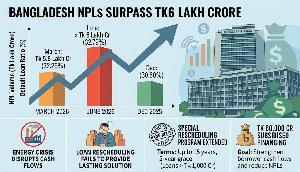
Default loans cross Tk 5.88 lakh crore: The scale of the banking sector's problem remains severe.At the end of March, total outstanding loans disbursed by 61 scheduled banks stood at Tk 18,24,668 crore. Of this, Tk 5,88,704 crore had become classified as defaulted loans.This means around 32.26% of total bank loans had turned non-performing by the end of March.Default loans increased by Tk 31,487 crore in just three months from December, when the banking sector's non-performing loans stood at Tk 5,57,217 crore.
During the same period, total lending increased by only around Tk 4,000 crore. In other words, the increase in default loans was roughly four times the increase in total lending.Bankers attribute the deterioration largely to widespread irregularities, fraud, corruption and loan-related misconduct accumulated over the past decade and a half.
Several major business groups, including S Alam Group, Beximco Group, Nassa Group, Sikder Group, Premier Group, Bismillah Group and Hall-Mark Group, have been associated with major banking-sector controversies. Loan-related irregularities at National Bank, Islami Bank and BASIC Bank have also contributed to the sector's vulnerability.
The five banks that have been merged are also carrying exceptionally high levels of classified loans, with default loans accounting for more than 80% of their respective portfolios.
Debate over rewarding defaulters: The new concessions have reignited the debate over whether repeated restructuring of bad loans encourages borrowers to avoid repayment.Bangladesh Bank, however, argues that the current situation requires exceptional measures.
Mustafizur Rahman, distinguished fellow at the Centre for Policy Dialogue (CPD), said the banking sector had fallen into a deep crisis and required extraordinary measures to recover.He said the latest opportunity could be justified for investors who have been genuinely affected by the economic situation and have the potential to recover.
However, he stressed that such concessions should not become a mechanism for protecting individuals involved in money laundering or financial embezzlement.”Those who can recover should be given the opportunity,” Mustafizur said, while calling for legal action against money launderers and those responsible for siphoning off funds.He also stressed that the policy must be implemented with political prudence and sound economic governance.
Tk 60,000 crore incentive fund: Alongside the loan-rescheduling facility, Bangladesh Bank is attempting to inject fresh financing into the economy through a Tk 60,000 crore incentive fund.The fund will provide loans at subsidised interest rates, with banks instructed to begin disbursement from September 1.The four-month target is to distribute the full Tk 60,000 crore between September and December.
The central bank hopes the financing will help businesses restart production, particularly those that have been struggling because of energy shortages, elevated borrowing costs and weaker demand.However, the effectiveness of the measures will depend heavily on whether banks can distinguish between viable businesses temporarily affected by economic shocks and borrowers who have deliberately avoided repayment.
With default loans already accounting for nearly one-third of the banking sector's outstanding credit, analysts say Bangladesh Bank faces a difficult balancing act: supporting businesses capable of recovery while preventing fresh moral hazard and ensuring that deliberate financial misconduct does not receive preferential treatment.The latest policy therefore represents both an attempt to revive distressed businesses and a major test of Bangladesh's efforts to clean up its troubled banking sector.