Monday ● 2 November 2026


 |


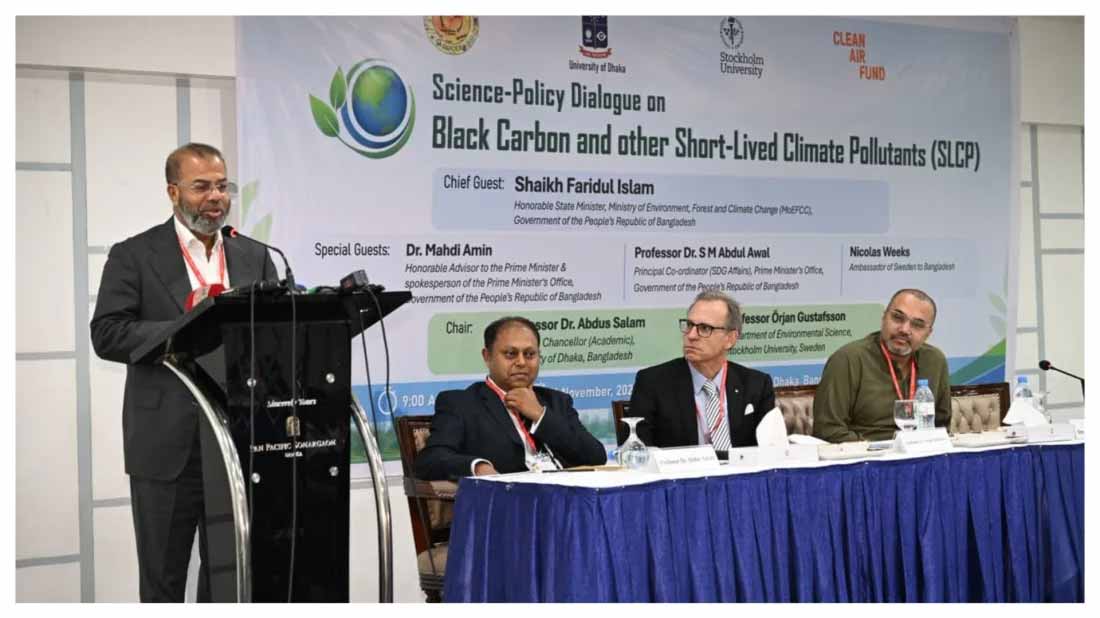
He said research-based evidence must be incorporated into policymaking and implementation to reduce black carbon and other air pollutants. Effective cooperation among government agencies, universities, research institutions and international development partners is also essential to achieving this goal.
The state minister made the remarks as the chief guest at a dialogue titled “Black Carbon and Other Short-Lived Climate Pollutants” at Pan Pacific Sonargaon Hotel in Dhaka on Sunday (November 1).
The University of Dhaka and Stockholm University jointly organised the event with support from the Clean Air Fund.
Sheikh Faridul Islam said coordination among research, policymaking and practical implementation must be strengthened to address air pollution and climate change.
He emphasised developing practical and sustainable solutions through the collective participation of relevant institutions to build a clean-air and climate-resilient Bangladesh.
He further said a healthier and climate-resilient Bangladesh could be achieved through evidence-based measures and stronger cooperation at national, private-sector and international levels.
Adviser to the Prime Minister Dr Mahdi Amin, Principal Coordinator for SDGs at the Prime Minister's Office Professor Dr SM Abdul Awal and Swedish Ambassador to Bangladesh Nicolas Weeks attended the event as special guests.
Dhaka University Pro-Vice-Chancellor (Academic) Professor Dr Abdus Salam chaired the dialogue, which was also attended by Stockholm University Professor Örjan Gustafsson.
The discussion focused on the links between air pollution, public health and climate change, highlighting the importance of science-based measures to address these interconnected challenges.
Participants particularly emphasised reducing emissions of black carbon and other short-lived climate pollutants t