Civil society leaders from the Global South have urged developed countries to fulfil their climate financing obligations, demanding predictable, accessible and grant-based funding to help developing nations tackle climate change.
They said countries that have contributed the least to global warming are suffering its worst consequences, yet are being forced to take on additional debt to address the climate crisis.
Climate finance must not increase the debt burden of developing countries, they stressed, calling for greater financial responsibility from countries most responsible for global emissions.
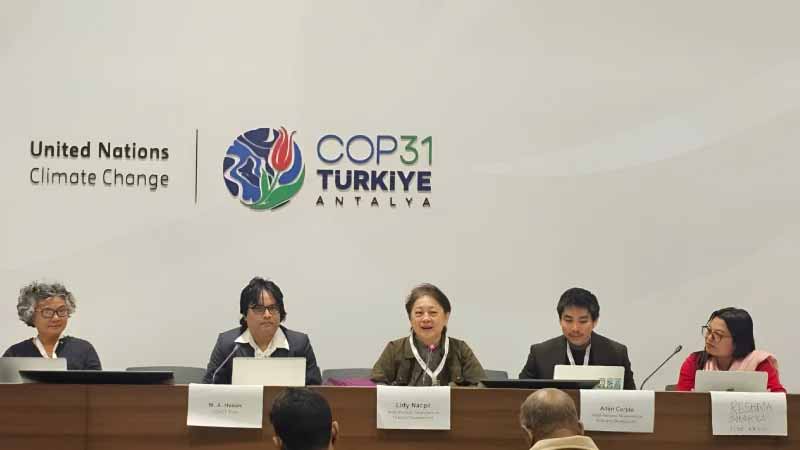
The demands were raised at a side event of the 31st UN Climate Change Conference (COP31) in Antalya, Turkey, on Tuesday.
The discussion, titled "Climate Finance Needs and Opportunities: Perspectives from the Global South", was held at Side Event Room 5 at 11:30am local time.
The event was jointly organised by the Asian Peoples' Movement on Debt and Development (APMDD), COAST Foundation Bangladesh, LDC Watch Nepal and Climate Watch Thailand.
Speakers included APMDD Coordinator Lidy Nacpil, MA Hasan of COAST Foundation Bangladesh, Mariana of Oxfam, Wanun Permpibul of Climate Watch Thailand and Allen John Carpio of APMDD Philippines. Reshma Shakya of LDC Watch Nepal moderated the session.
The speakers said developed countries must fulfil their responsibility under Article 9.1 of the Paris Agreement to provide financial support for climate action in developing nations.
They also called for adequate funding, technology transfer and capacity-building support to achieve the Global Goal on Adaptation (GGA).
They demanded new and additional funding for addressing climate-related loss and damage, simpler disbursement procedures and mechanisms to ensure that money reaches affected countries and communities directly.
The speakers rejected loans and private investment as substitutes for developed countries' public climate finance obligations. They also called for fair taxation of major polluters and increased contributions from them to public climate funding.
APMDD Coordinator Lidy Nacpil said climate finance must go beyond international pledges and reach vulnerable countries quickly and effectively through international funds and financing mechanisms.
She stressed the need for transparency and accountability in the use of funds to ensure that projects and programmes deliver direct benefits to affected communities.
Nacpil also said governments in the Global South should prioritise climate finance in their national budgets and policies rather than relying entirely on international funding.
Wanun Permpibul of Climate Watch Thailand said adopting the 59 indicators of the Global Goal on Adaptation would not be enough unless they produced tangible improvements in people's resilience.
She said the real measure of progress would be whether climate risks were reduced and livelihoods, food and water security, and ecosystems became more resilient.
Developing countries cannot be expected to achieve adaptation targets without adequate financing, technology and implementation capacity, she added.
Permpibul also called for clarity on the commitment to triple adaptation finance by 2035, including the baseline year, sources of funding, contributing countries, disbursement timelines and financing arrangements.
Oxfam's Mariana emphasised the need to combine scientific research with practical solutions that respect local languages and cultures.
She said financing requirements, quality and effectiveness must be ensured at every stage, from planning to implementation. Existing plans should also be regularly reviewed and updated based on research and reliable data.
MA Hasan of COAST Foundation Bangladesh said the success of climate finance should not be measured solely by the amount pledged.
It is equally important to establish who will provide the money, where it will come from, when it will be disbursed, under what conditions, who will receive it and what tangible changes it will bring, he said.
"The Global South is not asking for charity; it is demanding climate justice," Hasan said, arguing that countries with the least responsibility for the climate crisis should not be forced to borrow more to protect their people from its consequences.
He said financing arrangements that increase national debt or protect lenders' interests while ignoring the needs of ordinary people were unacceptable.
The speakers urged COP31 to deliver not merely fresh funding pledges but also a transparent and accountable disbursement system backed by a clear implementation roadmap.
They called for effective monitoring mechanisms to track whether pledged funds are actually disbursed and reach the countries and communities most affected by climate change.