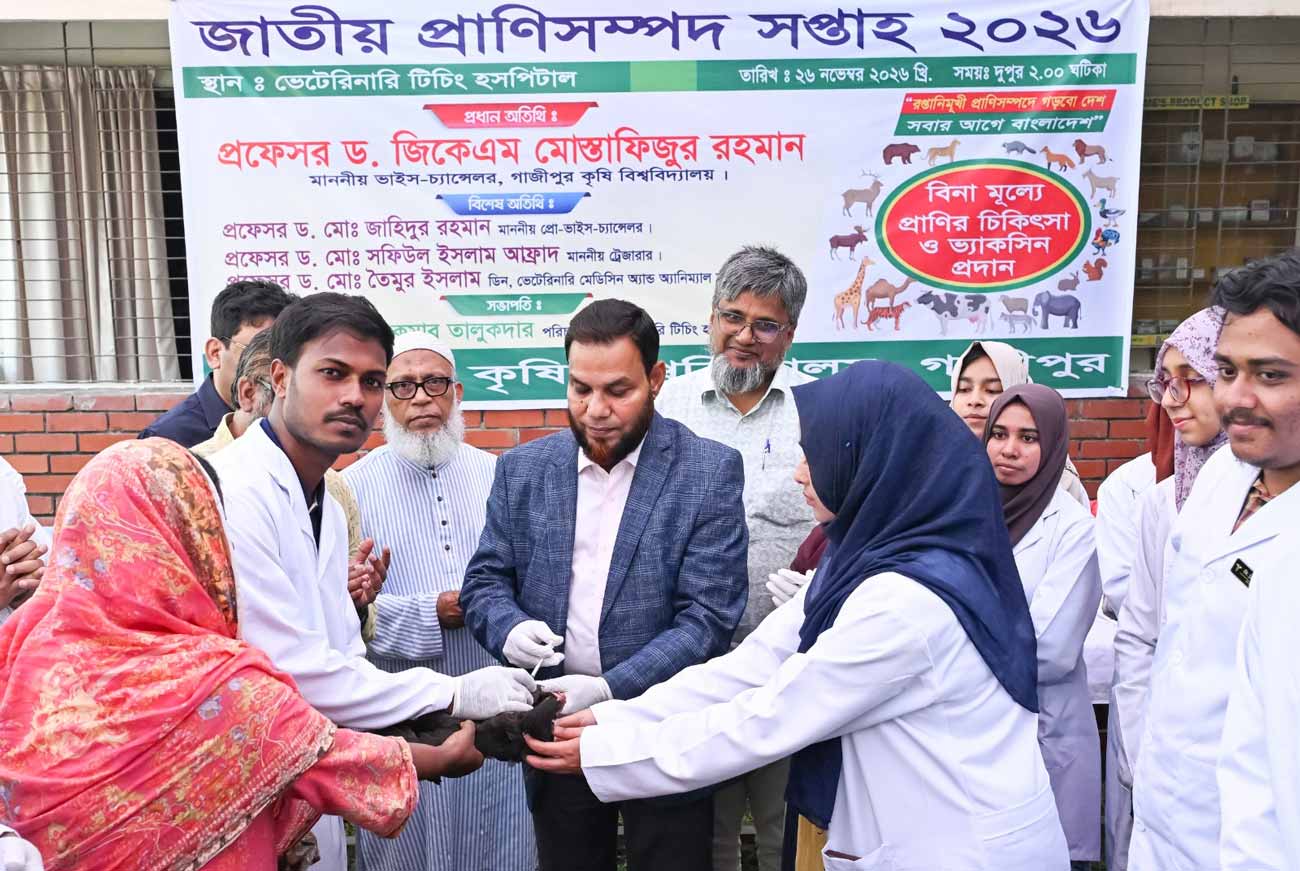
Emphasizing the importance of livestock health in ensuring food security and strengthening the rural economy, Gazipur Agricultural University (GAU) Vice-Chancellor Professor Dr GKM Mustafizur Rahman has called for improved veterinary services, disease prevention and greater support for livestock farmers. He made the remarks at a day-long free veterinary treatment, consultation and vaccination program organized by the university's Veterinary Teaching Hospital (VTH) on Thursday, marking National Livestock Week 2026.
This year's theme is “Building the Nation through Export-Oriented Livestock: Bangladesh First.” Addressing the inaugural discussion, the vice-chancellor said livestock was closely linked to nutrition, livelihoods, food security and the rural economy. Animal diseases not only cause financial losses for farmers but also affect families, communities and the broader animal-source food system. He stressed that veterinary treatment, disease prevention and technical advice for farmers should be integral to the university's social responsibility. He also expressed his ambition to transform GAU's Veterinary Teaching Hospital into one of the country's leading modern animal healthcare centers through improved facilities, modern technologies, quality services and enhanced professional skills. He urged collective efforts to develop the livestock sector and increase its contribution to the national GDP.
The program was chaired by Professor Dr Anup Kumar Talukder, director of the VTH. GAU Treasurer Professor Dr Md Safiul Islam Afrad and Dean of the Faculty of Veterinary Medicine and Animal Science Professor Dr Md Taimur Islam attended as special guests. Among others, Professor Dr Farhana Yeasmin, director of the Outreach Centre, Registrar Md Abdullah Mridha, faculty members, students, officials and livestock farmers from different parts of Gazipur were present. Following the discussion, the vice-chancellor visited the hospital's service facilities and exchanged views with farmers and pet owners.
A team of experienced faculty members, veterinarians and veterinary interns provided free diagnosis, treatment, consultation, medicines, deworming and vaccination throughout the day. A total of 270 animals received treatment and preventive healthcare services, including cattle, goats, poultry birds, cats and dogs.