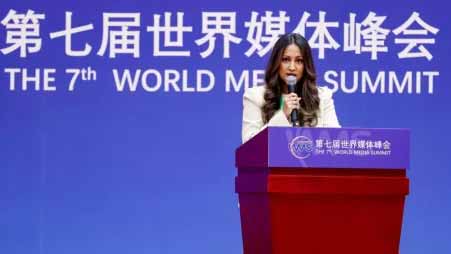
United News of Bangladesh (UNB) Executive Editor Nahar Khan has called for greater international cooperation to ensure artificial intelligence (AI) strengthens inclusion in global media rather than deepening existing inequalities, urging countries in the Global South to play a more active role in shaping the technology, its language capabilities and the future of journalism.
Speaking at the 7th World Media Summit at the Great Hall in Beijing, Nahar said AI was transforming journalism and creating significant opportunities for news organisations, but warned that access to technology alone would not ensure equal participation in the global information ecosystem.
She made the remarks at the “Dialogue with the Future” session, where the discussion brought together media professionals and journalists from different regions to examine the changing media landscape.
The session also featured Zhou Yushu, Deputy Director of the Department of International Journalism and Communication at Renmin University of China; Milagrosa Ada Micha Abeso, Chief Executive Officer of Real Equatorial Guinea News Agency; Levente Horvath, Chief Editor of Eurasia Magazine, Hungary; Jesper Skeel, Co-owner of The Copenhagen Post, Denmark; and Jiang Jiang, journalist at Xinhua News Agency, China.
Nahar said AI could significantly strengthen journalism by helping newsrooms analyse large volumes of information, investigate complex issues, translate across languages and reach audiences beyond national borders.
However, she stressed that the ability to generate information was not the same as the ability to shape the global information landscape.
“If AI works best in the world’s dominant languages, what happens to communities whose languages and experiences are less represented?” she asked, highlighting the risk that technological advances could reinforce existing disparities between large media organisations and smaller, resource-constrained newsrooms.
Drawing on UNB’s experience, Nahar pointed to the news agency’s reporting network across all 64 districts of Bangladesh as an example of how local perspectives could inform national conversations and, through international partnerships, reach audiences beyond the country’s borders.
She said AI could help extend this capacity, particularly for smaller news organisations, but access to the technology, relevant expertise and the resources to use it effectively would be essential.
Nahar Khan urges inclusive AI, stronger Global South voices and sustainable journalism at World Media Summit.
Nahar outlined three priorities for a more inclusive AI-driven media landscape: meaningful participation in technological development, greater linguistic and cultural representation, and the long-term economic sustainability of journalism.
On participation, she called for closer cooperation between large and smaller newsrooms, technology companies and media organisations to share expertise, develop responsible AI practices and ensure that smaller players were not merely consumers of tools developed elsewhere but active contributors to their development.
She also emphasised that linguistic diversity must go beyond translating content into different languages.
Language, she said, carried history, cultural context, local knowledge and distinct ways of understanding the world. Without these dimensions, AI systems risked reproducing an incomplete representation of societies and their experiences.
She urged countries across the Global South to collaborate on developing language resources, strengthening local datasets and incorporating cultural context into multilingual AI systems.
“Otherwise, we risk creating a world in which information can travel everywhere, while the perspectives shaping it remain concentrated in relatively few hands,” she stated.
Nahar also raised concerns about the economic sustainability of journalism as AI makes content production increasingly faster and less expensive.
She cautioned that a greater volume of generated content should not come at the expense of original reporting, which requires sustained investment in journalists, local knowledge, investigative capacity and the time and resources needed to establish facts.
“If the world becomes richer in generated content but poorer in original reporting, we will have mistaken abundance for progress,” she said.
She stressed that while AI could assist journalists in research, analysis and production, it could not assume the fundamental responsibilities of journalism: establishing facts, examining evidence, scrutinising competing accounts, verifying information and exercising independent professional judgment.
Nahar said the future relevance of journalism would depend not on competing with machines in the speed or volume of content production, but on providing the evidence, context and editorial judgment that audiences need to make informed decisions and maintain trust.
Referring to the World Media Summit’s call to move from consensus to action, she said commitments to responsible AI and media cooperation must translate into practical initiatives.
These should include partnerships enabling smaller newsrooms to access AI expertise, collaborative development of multilingual tools and verification systems, clear standards for responsible AI use, and sustainable economic arrangements that recognise the value of original journalism in an increasingly automated information economy.
She said the success of AI in global media should not be measured solely by improvements in efficiency or the volume of content produced, but also by whose voices were represented, whose languages were served, whether independent journalism remained economically viable and whether public trust was strengthened.
Nahar urged media leaders, technology companies and governments to move beyond broad commitments and build practical partnerships that ensure the benefits of AI are more widely shared, while protecting the diversity, independence and credibility of journalism.
The 7th World Media Summit, co-organised by Xinhua News Agency and the Beijing municipal government, brought together nearly 500 representatives of media organisations, think tanks and government bodies from 112 countries and regions, as well as the United Nations and other international organisations.
Initiated in 2009, the World Media Summit has developed into an international platform for dialogue and cooperation among media leaders and professionals across regions and language communities.