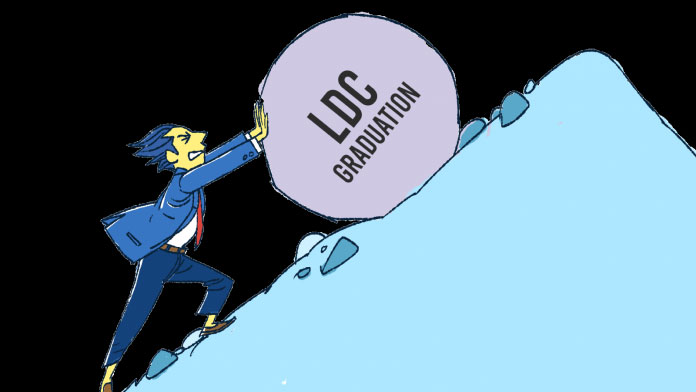
“The question of graduation doesn’t arise now, because almost all economic indicators are declining,” the finance minister said.
Bangladesh cannot exit the UN’s list of least developed countries given the current state of its economy, Finance Minister Amir Khasru Mahmud Chowdhury said on Sunday. He said the government is currently fighting mounting debt pressures and global supply shocks.
“The question of graduation doesn’t arise now, because we have found the economy in a state where almost all economic indicators are declining,” Chowdhury told reporters after a multi-stakeholder consultation in Dhaka. “We’re in a war to salvage the economy. The government is trying its best to keep it afloat.”
The meeting reviewed a standalone assessment by the UN Office of the High Representative for the Least Developed Countries, Landlocked Developing Countries and Small Island Developing States (OHRLLS) on Bangladesh’s graduation preparedness.
The finance minister said the Middle East conflict had unleashed multi-dimensional pressure on Bangladesh, causing “bleeding” from government funds. “We’re firefighting every day,” he added.
Foreign and domestic debt, high interest rates and weak financial management pose major challenges, the minister said. “The cost of financing must be considered for any future financing. We have to move forward through capacity building.”
He warned that a fuel crisis and disruptions to global supply chains could have long-term effects on the economy. The impact would not stay confined to the energy sector but would hit food and other essential goods, driving up inflation.
Many countries have seen sharp rises in fuel prices. Bangladesh has tried to keep them under control, Chowdhury said, adding that the government cannot absorb the pressure indefinitely.
The minister acknowledged that extra burdens might eventually fall on the public. “The government doesn’t want to suddenly create excessive pressure on the people,” he said. “But if expenditure continues from the government fund, the impact will ultimately fall on the public. Economic decisions must be taken very cautiously to protect public interests while ensuring long-term stability.”