Farmers, women farmers, researchers, environmental activists and civil society representatives have called for a review and reform of the national seed policy to protect indigenous seed diversity, farmers’ seed rights and the traditional knowledge of women farmers in the Barind region.
They also demanded the establishment of farmer-led community seed banks, formal recognition of farmer-to-farmer seed exchange, registration of indigenous crop varieties and initiatives to recover lost indigenous seeds and uncultivated food and medicinal plants.
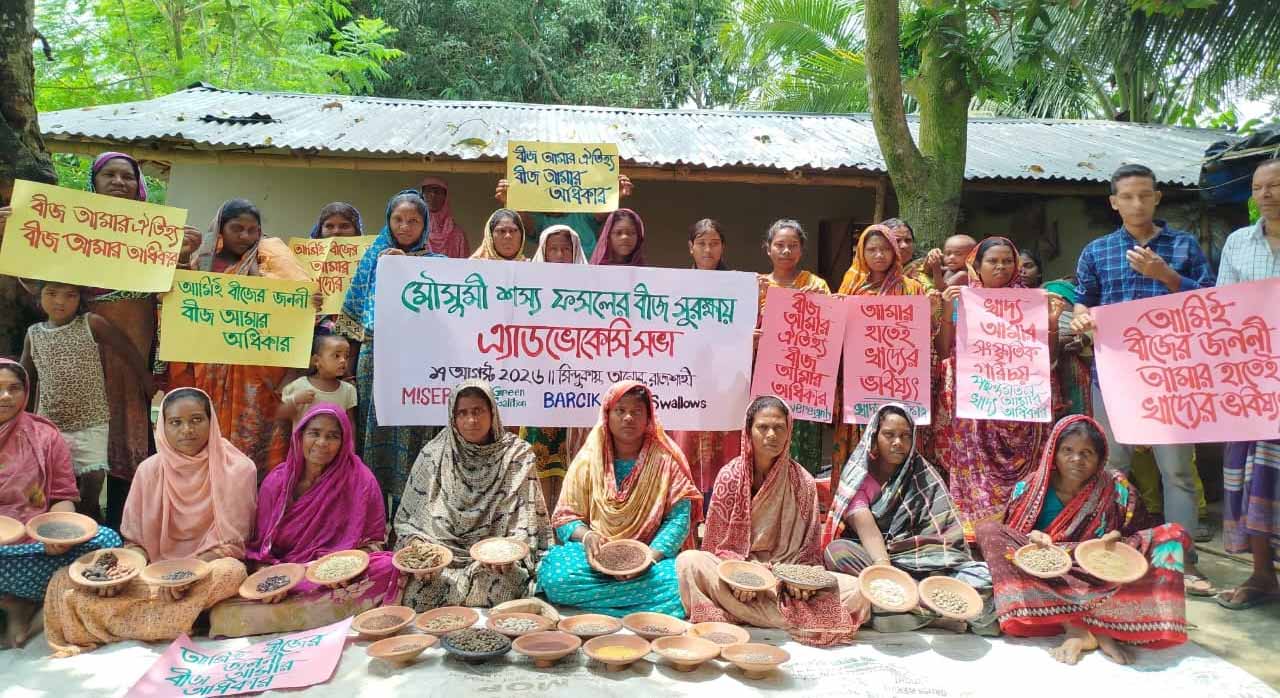
The demands were raised at a community-based policy dialogue on “Monsoon Indigenous Seed Diversity and Seed Sovereignty” held at Sindukai village in Tanore upazila of Rajshahi on Sunday.
The dialogue was organised by development research organisation Bangladesh Resource Centre for Indigenous Knowledge (BARCIK) and Green Coalition.
At the dialogue, a participatory field study based on information collected from six communities in Paba and Tanore upazilas was presented. The study examined monsoon seed exchange festivals where local farmers brought seeds preserved in their homes, exchanged them with other farmers and identified existing, rare and locally disappeared seed varieties and plants through community discussions.
The study found considerable diversity among local crop varieties in the Barind region. In the Sindukai community of Tanore, information was found on four local varieties each of bottle gourd, sweet pumpkin and beans, three varieties of chilli, and two varieties each of ridge gourd, jute greens and taro.
The Thanthala community was found to have various local seeds, including pumpkin, red amaranth, short bean, long bean, wood bean, bottle gourd, yardlong bean, snake gourd, ivy gourd, bitter gourd, garo potato, Jira rice and BR-26 rice.
In the Gokul Mathura community, farmers identified 29 locally disappearing or declining food, medicinal and uncultivated plants, while 27 such plants were identified in Mohor Hindupalli through farmers’ memories and discussions.
The researchers, however, cautioned that the figures do not represent national statistics on the extinction of plant varieties. Rather, they reflect locally held knowledge, experience and memories about seeds and plants that have disappeared or become rare in the respective communities.
Mst Kobuljan, a woman farmer who runs the Haridebpur Agroecology Learning Centre, said the centre has a living collection of around 160 varieties of different crops and plants.
“These seeds have been collected from different villages and preserved. We exchange the seeds among farmers according to the season,” she said. The study also highlighted the significant role played by women in preserving local seed systems. At the seed festivals, women constituted 38 of 40 participants in Madhabpur, 40 of 55 in Dubail and 50 of 60 in Sindukai.
Speakers said women had preserved seeds for generations while also carrying traditional knowledge about selecting plants for seed collection, determining the right time for harvesting seeds, drying and storing them, and identifying seeds suitable for cultivation in the following season.
They called for women farmers to be recognised not merely as beneficiaries of agricultural programmes but as custodians of local seed and agricultural knowledge.
Jitendra Nath, a farmer from Gokul Mathura village, said the Barind region was prone to drought and local crop varieties were adapted to its climatic conditions.
“These varieties should therefore be protected through a national initiative,” he said. Farmers at the dialogue said the decline of indigenous seeds should not be viewed merely as a problem of agricultural production. It is closely linked with farmers’ production autonomy, the right to choose food, local food culture, agricultural biodiversity, women farmers’ traditional knowledge and local ecological knowledge, they said.
Participants identified the expansion of commercial and hybrid seeds, growing market dependence, monocropping, the use of chemical inputs and herbicides, promotional activities by agricultural input companies and negative perceptions about indigenous seeds as some of the factors contributing to the decline of local seed diversity.
BARCIK anthropologist and regional coordinator Md Shahidul Islam presented the field research findings based on information collected from the six communities.
He said community-based preservation of farmers’ own seeds and recognition of their traditional knowledge should be incorporated into the national seed management system.
“Farmers have played a crucial role in conserving seed diversity for thousands of years. Indigenous seed varieties should therefore be documented and protected on a regional basis, while local agricultural researchers should also receive due recognition,” he said.
The policy dialogue put forward an eight-point set of demands. These include a participatory review and reform of the national seed policy; formulation of a national policy for farmer-led community seed banks; clear policy recognition of farmer-to-farmer seed exchange; introduction of a registration system for locally conserved crop varieties; establishment of a network of women and men farmers for indigenous seed conservation; programmes to recover locally lost or endangered seeds; preparation of community biodiversity registers for uncultivated food and medicinal plants; and inclusion of seed diversity as an indicator of climate adaptation.
The speakers also noted that Bangladesh is a signatory to the International Treaty on Plant Genetic Resources for Food and Agriculture (ITPGRFA). Article 9 of the treaty recognises farmers’ rights and their contribution to the conservation of plant genetic resources and associated traditional knowledge.
They called for stronger recognition of farmers’ rights to conserve their own seeds, protect local varieties, exchange seeds and participate in decision-making related to seed management.
Atiqur Rahman, president of Barind Youth Forum, said, “We have a system for regulating seeds; now we need a governance system that ensures farmers’ seed sovereignty.”
Sindukai Women’s Organisation president Pari Tudu, indigenous leader Gonesh Soren, BARCIK programme officer Amrit Kumar Sarker, farmers, women farmers, researchers and civil society representatives also attended the dialogue.
The speakers said seeds should not be treated merely as agricultural inputs. “Seeds are an important resource for farmers’ rights, biodiversity, food sovereignty and climate adaptation. Protecting a local seed variety means protecting not only a crop but also a food system, a knowledge system and the rights of future generations,” they said.