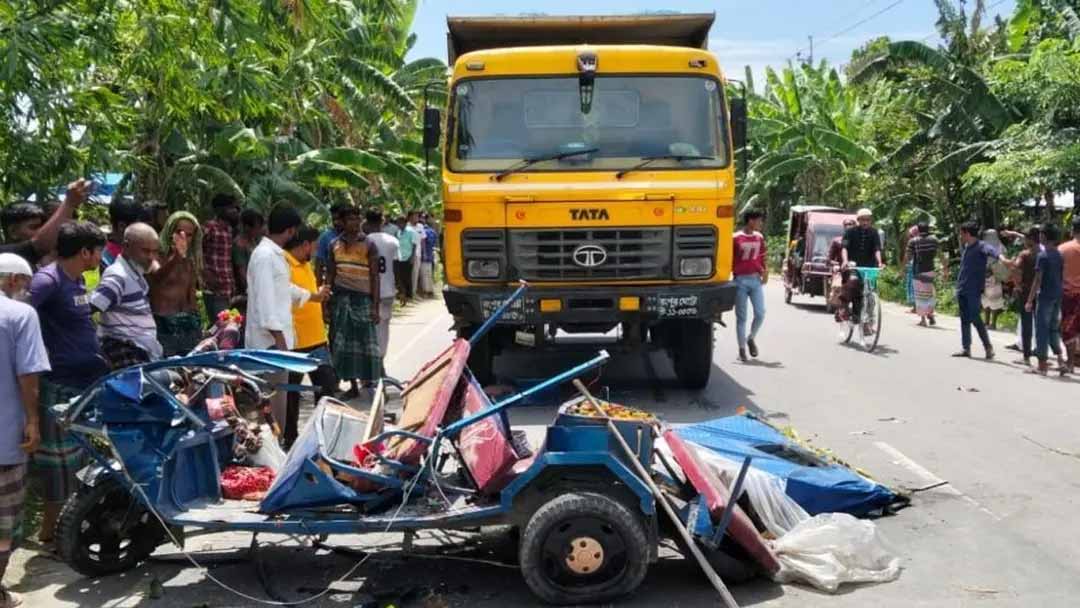
At least 423 people were killed and 674 injured in 442 road accidents across Bangladesh in September, with an average of 14 deaths a day, according to a report by the Road Safety Foundation (RSF).**
Of the deceased, 73 were women and 61 were children. Motorcycle accidents accounted for 139 deaths, or 32.86 per cent of the total, while 106 pedestrians were killed, representing 25.5 per cent of all fatalities.
The figures were released in the foundation's monthly road accident report sent to the media on Sunday. The report was compiled using information from nine national dailies, 17 national and regional online news portals, electronic media and the organisation's own sources.
According to the report, 154 motorcycle accidents occurred during the month, accounting for 34.84 per cent of all recorded road crashes. Fifty-three drivers and transport workers were also killed, representing 12.52 per cent of the total fatalities.
The foundation's analysis showed that 178 accidents, or 40.27 per cent of the total, occurred on regional roads. Another 145 took place on national highways, 56 on rural roads and 63 on urban roads.
Loss of vehicle control was the leading cause of accidents, accounting for 168 incidents, or 38 per cent of the total. Pedestrians were run over or struck in 109 accidents, representing 24.66 per cent. Head-on collisions accounted for 98 accidents, or 22.17 per cent, while 61 incidents involved vehicles being hit from behind. Six accidents occurred due to other causes.
In terms of transport modes, 139 motorcyclists and pillion riders were killed, followed by 88 passengers in three-wheelers, 26 bus passengers, 21 occupants of microbuses, private cars, ambulances and jeeps, 19 people travelling in trucks, covered vans and trolleys, 18 occupants of locally manufactured vehicles and six cyclists.
A total of 691 vehicles were involved in the accidents during September. These included 162 motorcycles, 129 three-wheelers, 113 buses, 93 trucks, 46 unidentified vehicles, 32 locally manufactured vehicles, 29 covered vans, 17 pickup trucks, 12 microbuses, 15 private cars, eight ambulances, five jeeps, seven lorries, six trolleys, four tractors, three dump trucks, two city corporation waste-collection trucks and eight bicycles.
Dhaka Division recorded the highest number of accidents and deaths, with 132 crashes claiming 134 lives. The division accounted for 29.86 per cent of all accidents and 31.67 per cent of total fatalities.
Chattogram Division accounted for 17.87 per cent of accidents and 17.73 per cent of deaths, while Khulna recorded 17.42 per cent of accidents and 14.42 per cent of fatalities. Rajshahi accounted for 12.21 per cent of accidents and 10.87 per cent of deaths.
Mymensingh recorded 7.23 per cent of accidents and 7.80 per cent of fatalities. Barishal accounted for 5.20 per cent of accidents and 6.61 per cent of deaths, Rangpur for 5.65 per cent and 5.91 per cent respectively, and Sylhet for 4.52 per cent of accidents and 4.96 per cent of fatalities.
Gazipur recorded the highest number of deaths among individual districts, with 38 fatalities. Sylhet Division had the lowest number of accidents, recording 20 crashes that killed 21 people.
In the capital, Dhaka, 21 people were killed and 47 injured in 52 road accidents during September.
The foundation also analysed the occupational identities of victims based on media reports. The deceased included two police personnel, one army member, 13 teachers, three journalists, two doctors, four engineers, one customs official and one foreign national.
Eleven employees of banks and insurance companies, 18 NGO workers and 24 political party leaders and activists were also killed.
Other victims included 25 businesspeople, 21 sales representatives of pharmaceutical and other consumer goods companies, three mosque imams or caretakers, four motor mechanics, six garment workers, one sanitation worker and 14 day labourers. Fifty-eight students from different educational institutions also lost their lives.
An analysis of the timing of accidents showed that 8.14 per cent occurred in the early morning, 24.43 per cent in the morning, 21.26 per cent at noon, 17.42 per cent in the afternoon, 11.76 per cent in the evening and 16.96 per cent at night.
### Waterway and Railway Accidents
Besides road crashes, 11 waterway accidents in September killed 16 people, injured seven and left four missing.
During the same period, 23 railway track accidents claimed 19 lives and injured six people.
The Road Safety Foundation said excessive speed and loss of vehicle control were among the major factors behind road accidents. It called for technology-based monitoring to control vehicle speeds and motivational training for drivers.
The organisation also linked the rising number of pedestrian deaths to reckless driving and a lack of awareness among road users. It recommended extensive public awareness campaigns through traditional media and social media.
The report identified several major causes of road accidents, including defective vehicles and roads, reckless speeding, irresponsible driving behaviour, lack of driving skills, physical and mental health problems among drivers, irregular wages and excessive working hours, the movement of slow-moving vehicles on highways, reckless motorcycle riding by young people, inadequate knowledge of traffic laws and non-compliance with them.
Weak traffic management, limited institutional capacity at the Bangladesh Road Transport Authority (BRTA) and extortion in the public transport sector were also cited as contributing factors.
To improve road safety, the foundation recommended restructuring the National Road Safety Council and reforming the management and organisational structures of the BRTA, Bangladesh Road Transport Corporation (BRTC) and Dhaka Transport Coordination Authority (DTCA).
It also called for mandatory use of modern safety technology, removal of unfit and expired vehicles from roads, and the introduction of a modern, company-based bus service in the capital.
The organisation stressed the need to train skilled drivers and ensure appropriate wages, regulated working hours and healthcare for transport workers.
Other recommendations included constructing service roads for slow-moving vehicles on highways, appointing gatekeepers at all railway crossings, allocating funds in the national budget for road-user education and skills development, and establishing an integrated communications ministry covering road, rail and water transport.
The foundation said safer roads could be achieved through timely policy measures, technological and infrastructure improvements, and education and awareness programmes for road users. It added that strong political commitment from the government was essential to implementing these measures.