Bangladesh's economic growth lost significant momentum in the second quarter of the current fiscal year, with Gross Domestic Product (GDP) expanding by just over 3 percent-down sharply from nearly 5 percent in the previous quarter-raising fresh concerns among economists and policymakers amid a worsening global fuel crisis.
According to the latest data released by the Bangladesh Bureau of Statistics (BBS) on Tuesday, GDP growth stood at 3.03 percent during the October-December quarter, compared to 4.96 percent recorded in the July-September period.
The Daily Industry, citing analysts and officials, said the slowdown reflects a combination of domestic structural weaknesses and emerging external shocks, particularly linked to geopolitical tensions in the Middle East.
Growth Momentum Weakens: The decline in quarterly growth underscores the fragile state of Bangladesh's economy at a time when it is already grappling with inflationary pressures, energy shortages, and declining private sector investment.
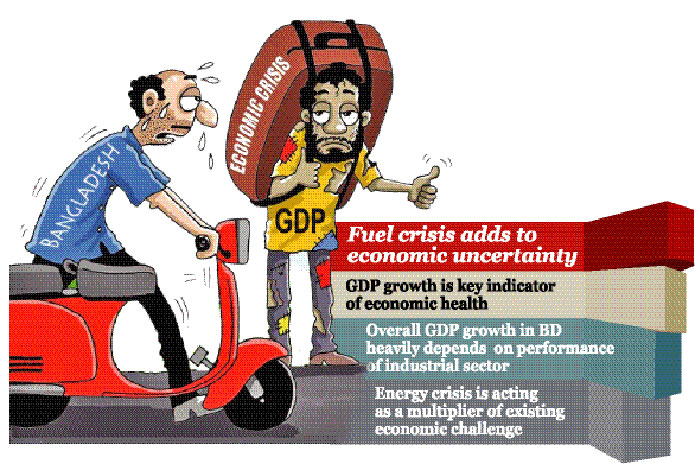
Economists note that while a 3 percent growth rate still indicates expansion, it is significantly below the level required to sustain employment generation, industrial output, and income growth for a developing economy like Bangladesh.”GDP growth is a key indicator of economic health, but the quality and inclusiveness of that growth matter equally,” The Daily Industry noted in its analysis.
GDP growth measures the increase in the total value of goods and services produced within a country over a specific period. While higher growth typically leads to rising incomes and economic dynamism, the benefits are not always evenly distributed across society.Middle East Crisis Triggers Fuel Shock: A major factor behind the recent slowdown is the global fuel supply disruption caused by the escalating conflict between Iran and Israel, which began in the last week of February.
The crisis has led to heightened uncertainty in global energy markets, prompting countries to adopt precautionary measures to conserve fuel. As a result, fuel supply chains have tightened, and prices have shown upward pressure.
Bangladesh, which relies heavily on imported fuel, is already feeling the impact. Reports of long queues at fuel stations across the country signal growing stress in the energy supply system. According to The Daily Industry, such disruptions could slow economic activity not only in Bangladesh but also across both developed and developing economies, as higher fuel costs increase production and transportation expenses.
Weakness: The BBS data reveals that the slowdown is particularly pronounced in the industrial sector, which recorded the lowest growth among the three major sectors of the economy.
Industrial growth stood at just 1.27 percent in the October-December quarter, a sharp deceleration that has raised alarm bells, given the sector's critical role in driving exports, employment, and overall economic expansion.
“The overall GDP growth in Bangladesh heavily depends on the performance of the industrial sector,” The Daily Industry reported, adding that the current figures reflect a worrying trend. In contrast, the agriculture sector posted a moderate growth of 3.68 percent, while the service sector performed relatively better with a growth rate of 4.45 percent.
However, economists argue that the stronger performance in services and agriculture is not sufficient to offset the weakness in industry, particularly in an export-oriented economy where manufacturing plays a dominant role.
Export Sector Under Pressure: The slowdown in industrial growth is closely linked to challenges in the export sector, especially ready-made garments (RMG), which account for the bulk of Bangladesh's export earnings.
Industry insiders say that rising energy costs, supply chain disruptions, and weakening global demand have combined to dampen production and export performance.
At the same time, ongoing trade uncertainties and tariff-related issues in key markets such as the United States have added to the pressure on exporters.
The Daily Industry noted that if the current trend continues, Bangladesh may struggle to maintain its export growth targets for the fiscal year.
Energy Crisis Spreads Across Economy: The fuel shortage is not only affecting industrial production but also disrupting transportation, agriculture, and small businesses.
Higher fuel costs have increased logistics expenses, making it more expensive to move goods across the country. Farmers are also facing higher costs for irrigation and transportation, which could eventually translate into higher food prices.
Small and medium-sized enterprises (SMEs), already burdened by high interest rates and limited access to credit, are finding it increasingly difficult to cope with rising operating costs.
“The energy crisis is acting as a multiplier of existing economic challenges,” The Daily Industry observed.
Inflation and Living Standards: Despite positive GDP growth, many households are not experiencing improvements in their living standards. High inflation has eroded purchasing power, making it difficult for ordinary citizens to cope with rising costs of essentials.
Economists caution that growth figures alone do not provide a complete picture of economic well-being. “For growth to be meaningful, its benefits must reach all segments of society, particularly low-income groups,” The Daily Industry highlighted. This concern is especially relevant in Bangladesh, where income inequality and regional disparities remain significant challenges.
Policy Challenges Ahead: The slowdown in GDP growth presents a major challenge for policymakers as they prepare the national budget for the upcoming fiscal year. The government will need to strike a delicate balance between maintaining fiscal discipline and providing stimulus to support economic recovery.
Key policy priorities are expected to include: Ensuring stable energy supply, Supporting industrial production and exports, Controlling inflation, Boosting private sector investment. Analysts suggest that targeted incentives for key sectors, improved energy management, and structural reforms will be crucial to reversing the slowdown.
Global Risks Add to Uncertainty: Beyond domestic challenges, Bangladesh's economic outlook is increasingly tied to global developments. The ongoing Middle East crisis has underscored the vulnerability of import-dependent economies to external shocks. Any further escalation could lead to higher fuel prices, supply disruptions, and reduced global demand.
Additionally, tighter monetary policies in advanced economies and slowing global growth could affect export demand and capital flows. The Daily Industry warned that “external risks are becoming as significant as domestic constraints in shaping Bangladesh's economic trajectory.”
Outlook Remains Uncertain: While some economists remain cautiously optimistic that growth could recover in the coming quarters, much will depend on how quickly the energy situation stabilises and whether global economic conditions improve. The government's response to these challenges-particularly in terms of energy policy, trade strategy, and fiscal management-will play a critical role in determining the pace of recovery.
For now, the latest GDP figures serve as a reminder that Bangladesh's economy is navigating a complex and uncertain environment, where both internal weaknesses and external shocks are converging. As The Daily Industry concluded, “the slowdown in growth is not just a statistical shift-it is a signal that deeper structural and external challenges must be addressed to sustain long-term economic progress.