Bangladesh’s education system must be transformed in a way that strengthens the link between learning and earning and equips students with practical skills for real-life application, Education Minister Dr. ANM Ehsanul Hoque Milon said today. He noted that alongside conventional theoretical education, the country now needs a more practical, skill-based and technology-driven approach to learning.
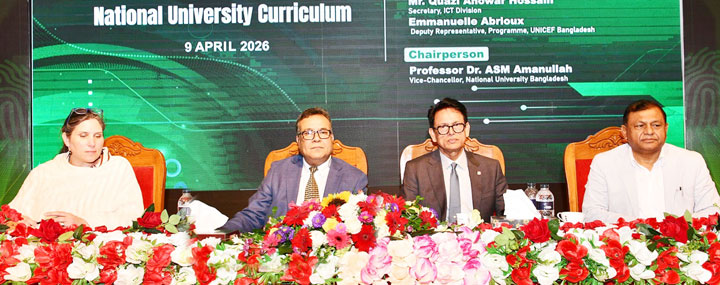
He made the remarks while inaugurating a workshop titled “Inclusion of Technical Courses in National University Curriculum” at the International Mother Language Institute in Segunbagicha, Dhaka. The initiative aims to make higher education more timely, practical and aligned with the demands of a rapidly growing digital economy.
The workshop was organised by the National University (NU), with technical support from the Aspire to Innovate (a2i) Programme under the ICT Division and UNICEF Bangladesh. Special guests at the event included Abdul Khaleque, Secretary of the Secondary and Higher Education Division; Professor Dr. ASM Amanullah, Vice-Chancellor of the NU; Prof. Md. Lutfor Rahaman, Pro-Vice Chancellor; Md. Abdur Rofiq, Project Director of a2i; and Emmanuelle Abrioux, Deputy Representative of UNICEF Bangladesh.
Thanking all stakeholders involved, the minister said the initiative marks an important step towards making the country’s education system more skill-oriented and employment-focused. He said that by gaining up-to-date technical skills, students will be able to develop competencies based on their interests and needs, making them more competitive in the job market. He also noted that nearly 12,000 teachers have already been brought under training as part of the broader effort, describing it as a major achievement.
Secretary Abdul Khaleque said the government would extend full support to ensure the successful implementation of this employment-oriented education initiative at NU.
Professor Dr. Amanullah said that nearly 70 percent of students enrolled in higher education in Bangladesh study at the university’s 2,257 affiliated colleges. He said that improving the skills of such a large number of students and aligning education with labour market needs is crucial for national development.
He added that a compulsory ICT and English course has already been introduced for first-year honours students, with around 400,000 students currently taking part.
He also said initiatives are now underway to develop an integrated ICT curriculum for honours students from the second to fourth year, along with a micro-credential framework. Under this system, students will be able to take short-term, skill-based training courses aligned with labour market demand and earn certifications.
According to the vice-chancellor, the initiative is expected to further strengthen students’ digital skills, technological capacity and employability. He said teacher training, the inclusion of Outcome-Based Education (OBE), blended learning strategies and digital content development are all contributing to the creation of a modern education ecosystem.
a2i Project Director Md. Abdur Rofiq said the integration of skill-based courses into the National University curriculum would play an important role in making higher education more modern, relevant and market-oriented. Students must build competence in emerging fields such as artificial intelligence and machine learning if the country is to make the best possible use of technology.
Application of such technologies extends beyond education and can contribute significantly across different sectors of the state. These skills, he said, will help students and citizens use technology effectively in a changing world, both for their own advancement and for the greater national interest.