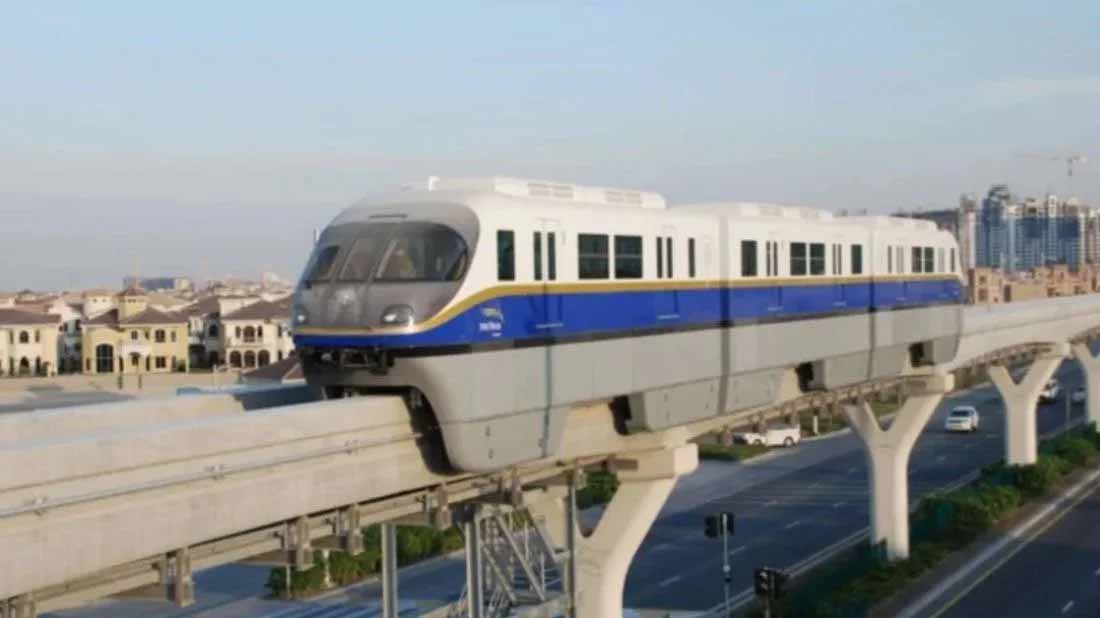
The government is planning to introduce two monorail routes in Dhaka by 2030 as part of efforts to ease traffic congestion and expand the capital's public transport network.
The initiative has moved forward with the completion of a pre-feasibility study by consultants from the Bangladesh University of Engineering and Technology (BUET), while detailed designs are expected to be submitted within the next six months.
Dhaka Transport Coordination Authority (DTCA) Additional Executive Director Dr Md Moshiur Rahman said the proposed monorail system would provide an environmentally friendly, sustainable and efficient transport option, particularly in areas with high passenger demand.
He said the proposed routes could be integrated with existing and planned metro rail lines and other public transport services, allowing commuters to connect more easily to their destinations.
The DTCA conducted transport modelling surveys in different parts of the capital to assess passenger demand and shared the findings with BUET consultants for analysis.
BUET's Bureau of Research, Testing and Consultation (BRTC) completed the pre-feasibility study. Under the agreement, detailed designs are scheduled to be submitted within six months.
The government has allocated Tk7.57 crore from the revenue budget for the pre-feasibility study and detailed designs of the two proposed routes.
The final routes will be selected based on technical, economic and environmental assessments, considering passenger demand, potential benefits and financial viability.
The revised Strategic Transport Plan has proposed five preliminary monorail routes covering approximately 79.4 kilometres. Authorities aim to select a priority route within three months and complete the overall study within six months.
The five proposed corridors are Airport-Bashundhara via Purbachal and Jolshiri (25.2km), Moddho Badda-Bhulta (14.6km), Rampura-Demra (10.3km), Mohammadpur-Postogola (11.7km) and Airport-Savar via Uttara Centre (17.6km).
The proposal also includes three additional corridors: Monorail-8, connecting TSC at Dhaka University to Kamrangirchar with nine stations; Monorail-10, from Alubdi to either West Agargaon or Shyamoli with 10 stations; and Monorail-13, from Paltan to either Sadarghat or Jhilmil with six or 11 stations.
A BUET consultant said the pre-feasibility study examined population patterns, potential passenger catchment areas around stations, gaps in public transport services, traffic congestion, land availability for depots and opportunities for future expansion.
The assessment will also examine route alignments, station and depot locations, passenger demand, technical and structural suitability, construction and operating costs, and environmental and social impacts.
A monorail operates on an elevated structure, making it a potential transport solution for densely populated areas where road space is limited and conventional infrastructure is difficult to develop.
Local and expatriate Bangladeshi experts have been engaged as consultants for the government-funded assessment.
The initiative is part of the government's broader plan to improve urban mobility and reduce traffic congestion in the capital, in line with its election pledges.