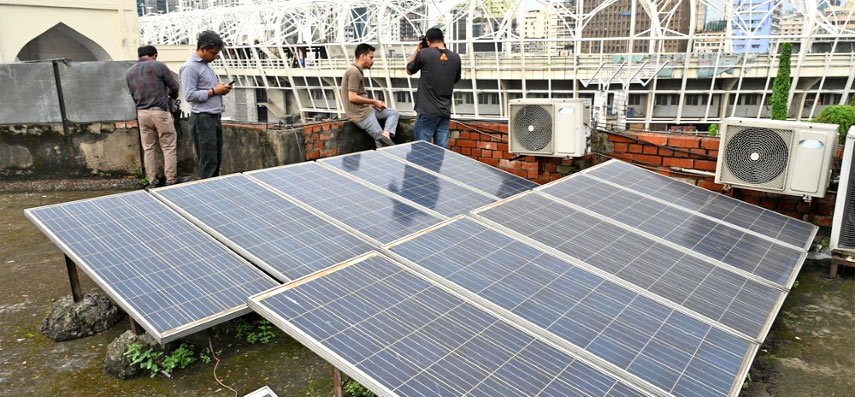
Rooftop solar power can generate 26514 million units of electricity per year in Bangladesh. At the same time, 2.98 crore taka of foreign exchange can be saved every year by installing every megawatt of solar power.This information was given by Ujjwal Chakraborty, Executive Director of DOPS, at a press conference titled ‘Energy Risk in Bangladesh due to the instability of the Strait of Hormuz: Green and Renewable Energy Transformation in Rangpur’ organized at the Sumi Community Center in Rangpur city on Friday afternoon. Ujjwal Chakraborty, Executive Director of DOPS, an environmental and developmental non-governmental organization, said that there are 42 million 60 thousand families in Bangladesh, in which 57 percent of the electricity of the national grid is used. 41 percent of these families can install at least one kilowatt of rooftop solar power. This can surprisingly increase the capacity of rooftop solar power to 16,361 megawatts. Which is capable of generating 26,514 million units of electricity annually.He further said that to generate this amount of electricity from furnace oil or crude oil, it will cost Tk 48,813 crore just for fuel costs. By installing every megawatt of solar power, Tk 2.98 crore foreign exchange can be saved every year. With the widespread use of rooftop solar panels, the poorest people will be protected even if the price of electricity increases in the futureAnd they will have a stable source of electricity.At the press conference, Forum on Ecology and Development Rangpur President SM Piyal urged the government to take appropriate initiatives to use its own buildings to get rid of fuel burning furnaces and reduce the demand for fossil fuels.He said that the 3,000 MW solar power program taken in August 2025 can play a positive role in this regard.
Besides, it is possible to install at least 2,500 megawatts of solar power in 1,22,000 primary and secondary schools, 1,137 colleges and technical institutions and 170 universities in the country. By installing solar power in these educational institutions, the government will be able to significantly reduce energy imports. If the use of gas in the power sector is reduced, it can be allocated to the industrial sector. If this is possible, export earnings will increase by keeping factories operating uninterrupted.SM Piyal said that one of the main sectors dependent on diesel is agriculture. Currently, there are 1.2 million diesel-powered irrigation pumps in Bangladesh. In comparison, the number of electrified irrigation pumps is only 5.1 million and solar-powered irrigation pumps is only 3,602. If diesel-powered pumps can be converted to solar power, the government will be able to reduce diesel imports by Tk 10,914 crore (US$ 887 million) annually. Solar irrigation systems have already succeeded in conserving groundwater in exchange for a fixed fee.Expressing deep concern over the growing energy risks in Bangladesh, Forum General Secretary Farhaduzzaman Faruk said that in addition to rooftop solar power and solar-powered irrigation pumps, other sources such as agro-power, floating solar power, canal-based and river-side solar power can significantly reduce energy imports. At least 11,000 MW of solar power can be installed in 32,315 water bodies across the country. It is possible to achieve 15,000 MW of capacity by using just one-third of the country's 1,500 sq km ponds. These innovative technologies will address the challenge of land scarcity as well as provide green energy.Earlier in the morning, a discussion session titled 'Freedom from fuel-burning furnaces and Bangladesh's position in the global market' was held at the same venue. It was jointly organized by the Development of Poor Society (DOPS), Forum on Ecology and Development (FED) Rangpur, Coastal Living and Environment Alliance (CLEAN) and Bangladesh Environment and Development Working Group (BWGED).The event was chaired by renowned journalist Monabbor Hossain Mona, editor of Dainik Agamir Sandhane, and was attended by journalists Joynal Abedin, Siddiqur Rahman, Abedul Hafiz, Abdur Rahman Mintu, Ehsanul Haque Sumon, Bornali Zaman, Abdullah Al-Amin, photographers Ranjit Das, Imroz Imu and human rights activist Md. Kabir Mia, among others.The discussion meeting presented 13 recommendations to the government to effectively address the ongoing threats arising from the current energy crisis.The recommendations are: national consensus on energy, moving away from the fossil fuel debt cycle, financial incentives for renewable energy, national rooftop solar power program, rapid approval and implementation of solar parks, expansion of solar irrigation management, reduction of fuel consumption in the transport sector, development of efficiency in renewable energy, formation of low-interest renewable energy fund, adequate allocation for renewable energy, management efficiency and meritocracy, use of nuclear energy and subsidy reform for sustainable energy.