Bangladeshs food security is facing growing risks as plastic pollution is damaging soil fertility while rapid industrialisation, urbanisation and infrastructure development continue to reduce agricultural land.
Experts warn that unless the deterioration of soil quality and the loss of farmland are addressed urgently, Bangladesh could become increasingly dependent on food imports instead of maintaining self-sufficiency in food production.
Soil is one of the most important foundations of agricultural production. Microorganisms in soil decompose organic matter and help maintain fertility and nutrient cycles. However, plastic and polythene waste is disrupting microbial activity and weakening the natural nutrient cycle.
Dr Jamilur Rahman, professor of Genetics and Plant Breeding at Sher-e-Bangla Agricultural University, said plastic and polythene obstruct the growth of soil microorganisms and interfere with the natural process of soil formation.
He said plastic waste also prevents plant roots from spreading properly, reducing crop yields. While the impact may not yet be fully visible, prolonged contamination could lead to a severe agricultural crisis in the future.
Plastic waste degrading soil: Plastic use has expanded across both urban and rural areas, with most consumer goods now sold in plastic packaging. Single-use plates, glasses, cups and bowls have also contributed to the growing volume of plastic waste. Although Bangladesh took steps to ban polythene bags more than two decades ago, their use has continued to rise.
According to a survey by the Environment and Social Development Organization (ESDO), around 87,000 tonnes of single-use polythene and plastic are used in Bangladesh every year.Much of this non-degradable waste ends up in agricultural land, drainage systems, rivers, canals and the sea, causing damage to the environment, ecosystems and agriculture.
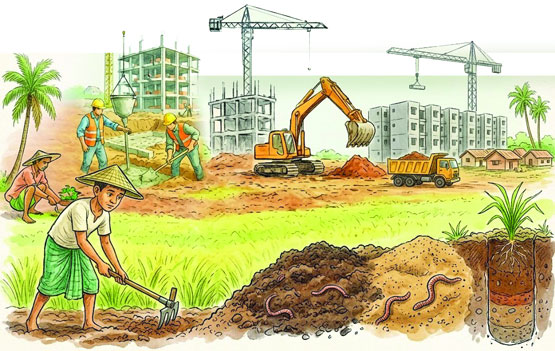
Farmland shrinking rapidly: Alongside plastic pollution, the country is losing agricultural land at an alarming rate.According to the Soil Resource Development Institute (SRDI), 67.38% of Bangladeshs total land area was arable in 1976. The share fell to 64.96% in 2000 and 60.4% in 2010.Between 1976 and 2010, Bangladesh lost an average of 42,063 hectares of agricultural land every year.SRDI estimates that if the current trend continues, agricultural land could decline by another 10% by 2030 and 20% by 2050.
Agricultural land is increasingly being converted into industrial facilities, residential areas, roads and other infrastructure. SRDIs updated land-use assessment of 50 upazilas in FY2024-25 found that agricultural land had declined in almost all the surveyed areas, while land used for settlements, industries, roads and other non-agricultural purposes had increased.
Aminur Rasul, environmentalist and president of the Climate Action Forum, said plastic and polythene are banned products that pose a major threat to the environment and biodiversity.”Plastic and polythene are banned products and major enemies of the environment and biodiversity. Yet the question is how their production is increasing. There could be large-scale corruption behind this.”
He said laws exist to protect agricultural land, but their enforcement remains weak.”If this continues, there will come a time when people will have to face severe food shortages.”
Food import dependence rising: The deterioration of soil fertility and decline in farmland are already contributing to growing dependence on food imports.According to the Ministry of Food, Bangladesh imported 7.67 million tonnes of rice and wheat in FY2024-25. In the recently concluded FY2025-26, combined public- and private-sector imports of rice and wheat rose to 8.6 million tonnes, the second-highest amount in the countrys history.The highest volume was recorded in FY2017-18, when severe floods pushed foodgrain imports to a record 9.7 million tonnes.
Bangladesh Bank data show that the country spent around $2.45 billion on foodgrain imports during July-April of FY2025-26, up 18% from the same period a year earlier.Spending on wheat imports alone reached $1.93 billion, an increase of 49% year-on-year.Imports of edible oil, pulses and fruits are also increasing.
According to UN projections, Bangladeshs population could reach around 186 million by 2030 and more than 200 million by 2050. With food demand rising alongside population growth, continued loss of farmland and declining soil fertility could create a major production shortfall.
Experts say immediate action is needed to protect agricultural land, preserve soil fertility and curb plastic and polythene use.Failure to act could reduce domestic food production while increasing import bills and putting additional pressure on foreign-exchange reserves.The twin challenges of plastic pollution and farmland loss are therefore no longer merely environmental concerns. They are increasingly becoming a critical issue for Bangladeshs future food security.