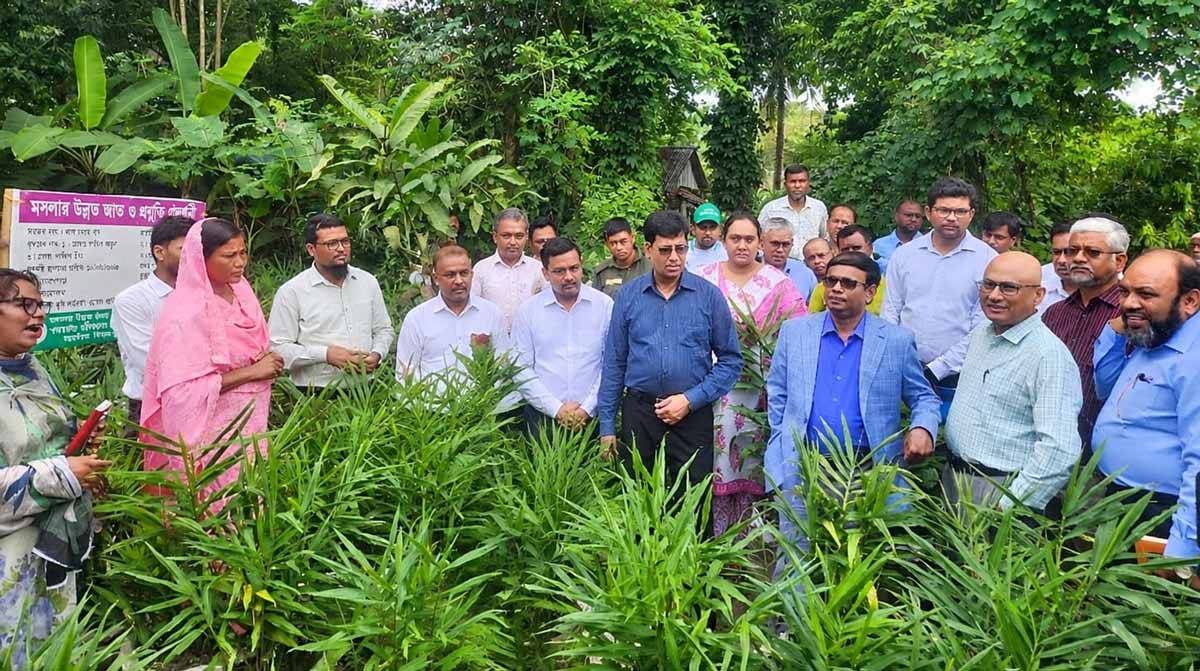
A field day and exchange meeting on improved spice varieties and modern agricultural technologies was held in Mohanpur upazila of Rajshahi on Friday, with a focus on expanding spice cultivation and encouraging farmers to adopt modern farming methods.
The event was organised by the Department of Agricultural Extension (DAE), Mohanpur, at Chandopara village under Jahanabad Union.
The programme showcased various agricultural initiatives undertaken by local farmers, including ginger cultivation, black pepper vine (chuijhal), bay leaf, vermicompost, family nutrition gardens and improved rice varieties.
According to the organisers, Chandopara, once known as a “ginger village” for its extensive ginger cultivation, is gradually transforming into a “spice village” with the diversification of spice crops.
Agriculture Secretary Md Selim Khan attended the programme as the chief guest. Chairman of the Barind Multipurpose Development Authority (BMDA), agriculturist Md Hasan Zafir Tuhin, and Additional Joint Secretary of the Ministry of Agriculture Khorshed Alam were present as special guests.
Director General of the Department of Agricultural Extension Md Abdur Rahim chaired the programme, while Mohanpur Upazila Nirbahi Officer (UNO) Fahima Binte Akhter delivered the welcome address.
During the exchange session, farmers raised several demands, including the establishment of a research centre for betel leaf cultivation and an increase in government allocation of fertiliser.
Farmer Md Masud Rana spoke on behalf of the farmers, while Mosa Sabina Begum spoke on behalf of women farmers.
Agriculture officials said around 25,000 sacks of ginger are currently being cultivated in the village. The ginger produced there is also being sold as seed at around Tk 200 per kilogramme. Each sack produces approximately 1.5 to 2kg of ginger.
Around 200 chuijhal plants are being cultivated in four gardens in the village, while approximately 180 bay leaf trees have been planted at two locations.
The village also has three vermicompost projects, producing around 500kg of organic fertiliser a month. However, local demand is estimated at nearly 4,000kg per month, indicating considerable potential for expanding organic fertiliser production.
In addition, around 35 family nutrition gardens have been established in the village. Farmers are growing eggplant, bitter gourd, pointed gourd, okra, chilli, papaya, banana, pumpkin and bottle gourd without using chemical pesticides or fertilisers.
Farmers are also being encouraged to cultivate improved varieties of rice.
Speakers at the programme said the adoption of improved varieties and modern agricultural technologies could increase productivity and farmers’ incomes from the same amount of land.
They also stressed that expanding spice cultivation could help reduce Bangladesh’s dependence on imported spices while creating new income opportunities for rural communities.
Among others, DAE Rajshahi region Additional Director Dr Md Azizur Rahman, DAE Rajshahi Deputy Director Mohammad Nasir Uddin, Additional Deputy Director (PP) Dr Md Abdul Majid, Mohanpur Upazila Agriculture Officer Kamrul Islam, Additional Agriculture Officer Md Momenul Islam, Agriculture Extension Officers Md Abdul Matin and Shubha Bhowmik attended the programme.
Mohanpur Police Station Officer-in-Charge Mizanur Rahman and Upazila Krishak Dal President Golam Mostofa Bablu were also present, along with local farmers and representatives from different professions.
Around 400 farmers, including a large number of women farmers, attended the event.
The guests later visited displays of various spices and agricultural products produced by local farmers and exchanged views with them on modern cultivation techniques and agricultural practices.