The school feeding programme has gained widespread support in the remote river-island areas of Lalmonirhat, improving students’ nutrition and encouraging children to attend school regularly.
Students, teachers and guardians have called for the pilot initiative to be expanded to primary schools across the country, citing its role in reducing dropout rates, improving classroom attention and supporting children’s health.
The government introduced the programme to address malnutrition among primary schoolchildren and prevent them from dropping out. As part of the initiative, the programme began in 310 schools in Patgram and Kaliganj upazilas of Lalmonirhat on December 28 last year.
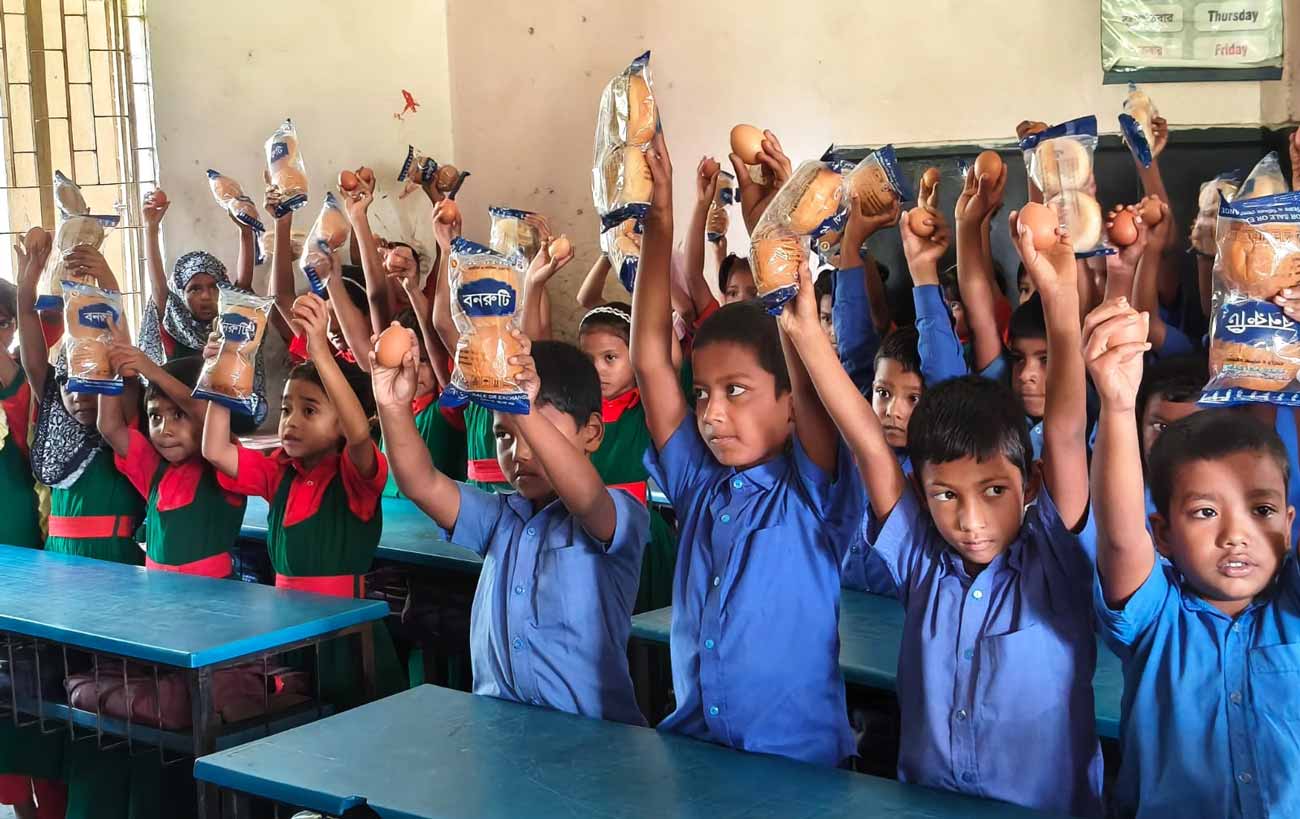
Under the programme, children from pre-primary to Class V receive free nutritious snacks during school hours. Each student is provided with a bun, while the accompanying food varies by day. Packaged milk or a banana is served on alternate days, while a boiled egg is provided with the bun on the remaining three days.
The initiative has brought changes to schools in a district marked by riverine chars surrounded by the Teesta, Dharla and Saniajan rivers. Lalmonirhat has 36 char areas, where many schools have long struggled with irregular attendance and high dropout rates.
According to local education officials and teachers, attendance at participating schools has increased significantly, reaching around 90-97 per cent in some institutions. They say the food helps children remain energetic and attentive during lessons, particularly those who travel long distances from remote char villages.
The buns are produced using automated machinery at Al Madina Bakery in Hatibandha upazila and distributed in packets bearing the government logo. Boiled eggs and bananas are supplied through local women working near the schools, while packaged 200-millilitre milk is supplied by another organisation. The government selected the organisations through a tender process.
ESDO, an NGO implementing part of the programme, supervises the supply of buns, eggs and bananas. Another NGO, identified as RDA, supplies the packaged milk.
Guardians Azizur Rahman and Manjum Ali said their children had previously been reluctant to attend school regularly, but the free meals had encouraged them to go.
“As poor families, we cannot provide food or money for our children's tiffin every day. Children who eat only what is available at home in the morning often struggle to stay at school throughout the day,” they said, calling for the programme to continue nationwide.
Students Heshne Hasin Kingbodonti and Taslima Yasmin Humaira of Madanpur Bairati Government Primary School said they often found it difficult to concentrate in class when they became hungry.
“After eating at home in the morning, staying at school until the afternoon was difficult. Hunger affected our concentration. Now the nutritious snacks provided by the government give us the energy to continue our lessons. The food is also of good quality,” they said, expressing hope that distribution would continue.
Asaduzzaman Dulu, headteacher of Votmari Government Primary School, said most of his students came from char areas across the Teesta River.
Previously, many children became weak and inattentive in the afternoon after spending the day at school, as they often had no food beyond breakfast. The school had also faced concerns over student dropouts, he said.
“Since the school feeding programme began, attendance has increased, and the children have more energy to remain attentive in class. Attendance is now around 95-97 per cent,” he said.
He added that the school was now struggling to accommodate the growing number of students and urged the authorities to extend the programme nationwide to improve nutrition and prevent dropouts.
Babul Akhtar Zaman, district manager of ESDO, said the programme had also created income opportunities for rural women. By involving one woman near each participating school in preparing and supplying boiled eggs and bananas, the initiative has helped develop small-scale women entrepreneurs.
The women receive payments every week and can earn around Tk 4,000-5,000 a month, providing an additional source of income for those who were previously unemployed, he said.
Ahsan Habib, assistant district primary education officer in Lalmonirhat, said attendance at schools in the two upazilas had previously stood at around 70 per cent. Following the introduction of school feeding, it had risen to approximately 90-95 per cent, alongside improvements in students’ nutrition and learning conditions.
He said the programme had generated considerable interest in the district's char schools and should be expanded to primary schools across Bangladesh.