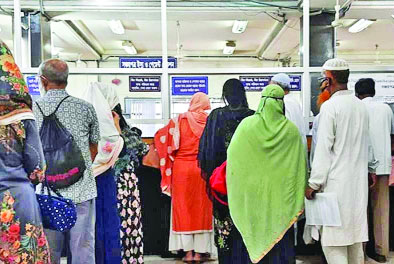
The file photo shows that the bank customers queue up at a teller counter amid growing complaints of harassment and delays in withdrawing their own money
Millions of customers across Bangladesh, who once trusted banks to safeguard their hard-earned savings, are now finding themselves hostages to the system. Unable to withdraw their own money despite repeated visits, many face humiliation, frustration, and financial paralysis. From the capital Dhaka to the port city of Chittagong and remote districts like Cox's Bazar, the same distressing picture emerges - banks citing "no cash available" and offering small token withdrawals instead of fulfilling legitimate requests.
A Crisis Rooted in Weak Banks and Loan Scandals: The withdrawal harassment is most severe in banks weakened by years of mismanagement, loan scams, and poor governance. Despite reforms and liquidity injections by Bangladesh Bank after the new government took office in 2024, many institutions still fail to meet withdrawal demands. In a sweeping move to restore stability, Bangladesh Bank dissolved the boards of 14 weak banks, printed Tk 52,000 crore for liquidity support, and allowed these troubled institutions to borrow from stronger banks. Negative current account balances were converted into demand loans.
While these measures allowed small depositors to withdraw limited sums, large savers remain trapped. Some banks can pay no more than Tk 5,000 per month to customers, advising them to "be patient."
Stories of Personal Loss and Frustration: For many, the consequences are devastating. Shahida Noor, from Maheshkhali, Cox's Bazar, saved a few lakh taka from her poultry farm earnings in Union Bank's Badarkhali branch. When she fell ill and needed money for treatment, the bank told her there was no cash. After repeated pleas, she was offered just Tk 5,000 - but only after a two-week wait. Abdul Quader, a schoolteacher, went to his bank 18 times to withdraw Tk 1.27 lakh. He did not receive even Tk 1,000.
Kabir Ahmed, a Union Bank customer in Feni, spent five years saving for his daughter's wedding. When the big day approached in mid-2024, he discovered he could not withdraw the Tk 6 lakh he needed. A year later, he is still waiting. "I feel helpless," Kabir said. "I saved for my daughter's happiness, and now I cannot even give her the wedding she deserves."
Chittagong and Cox's Bazar: Daily Lines, Daily Disappointment: In Chittagong and Cox's Bazar, long queues outside bank branches have become a daily ritual. Customers report being turned away on flimsy pretexts.
Security guards often deny entry to customers with large checks, allowing only those seeking small withdrawals to come inside.
Mahamudul Haque, a businessman, shared: "When I gave a check for Tk 50,000, they gave me Tk 5,000. My business is on the verge of collapse. I cannot even pay my employees." This liquidity drought affects not just personal savings but the survival of small businesses and households.
NGO Workers and Remittance Recipients Hit Hard: Farhana Bohni, an NGO worker for ActionAid, said her project funds were deposited at First Security Islami Bank. Every time she tried to withdraw money, the response was the same: "No funds available." "This is not just a financial crisis - it's social harassment," Farhana said. "We cannot pay our project staff, and our credibility is at stake."
The Humanitarian Dimension: What began as a financial problem has turned into a humanitarian crisis. Customers are unable to pay medical bills, school fees, or urgent business expenses. In some cases, arguments and even physical confrontations have erupted between desperate customers and bank officials.
A Union Bank branch manager admitted under condition of anonymity: "We can only distribute about Tk 1 lakh a day per branch. We know this is unbearable for customers, but we simply do not have the liquidity."
Mergers, Mismanagement, and Mounting Losses: Bangladesh Bank has taken a hard line on merging poorly performing private banks plagued by corruption. Institutions failing to improve key indicators like Camels rating, loan recovery, and advance-deposit ratios face forced mergers.
Some banks have survived purely on borrowing and still fail to repay earlier loans - now, they will be denied further liquidity support. The numbers are staggering: Total deposits in five merger-targeted banks: Tk 1,47,368 crore. Loans disbursed: Tk 1,90,484 crore. Default rate: 77% (Tk 1,46,918 crore). Capital deficit: Tk 45,203 crore. Number of customers affected: 9.2 million. Bank staff employed: over 15,000.
Bank Officials Offer Partial Relief, But Confidence Erodes: Nazrul Islam Swapan, chairman of merged Exim Bank, claimed: "No customer leaves empty-handed from Exim Bank. We pay Tk 5-10 lakh where possible. But corporate clients demanding Tk 50 crore or more must wait."
Tohurul Haque, Social Islami Bank's Dilkusha branch manager, admitted that unrest among customers has increased since the merger announcement but insisted the situation will improve soon.
Economists: Structural Reform, Not Band-Aids, Needed: Dr. Salehuddin Ahmed, financial advisor and former central bank governor, warns that superficial fixes will not restore public trust. "Eighty percent of the banking sector's money has been taken away. The IMF estimates $35 billion is needed to rebuild. In this context, telling customers 'there is nothing to worry about' is a cruel joke." He stressed that without transparent accountability for loan scams, strict supervision, and recapitalization, confidence will remain shattered. Other economists point out that the crisis reflects years of political interference in bank licensing and loan approvals. Banks like Padma Bank were approved for political reasons, now leaving depositors stranded.
Public Trust in Banking at a Crossroads: For ordinary Bangladeshis, the crisis has sparked a troubling question: Is money safe in the bank? Even after a year of new government efforts, the right to freely access deposits - a fundamental banking principle - remains restricted. The social contract between banks and the public is fraying. Customers, especially in rural and semi-urban areas, are beginning to explore alternative savings methods, including cash storage, gold, and informal lending groups.
A Slow Path to Recovery: Bangladesh Bank says the problems are being resolved "step by step" but admits that full normalcy will take more time. Meanwhile, for millions of customers - from poultry farmers in Cox's Bazar to garment exporters in Chittagong - waiting is no longer an option. They want their money back now. The crisis has exposed not just the fragility of some banks, but the urgent need for a transparent, accountable, and people-focused banking system. Without restoring depositor confidence, no amount of liquidity injections or mergers will solve the problem.