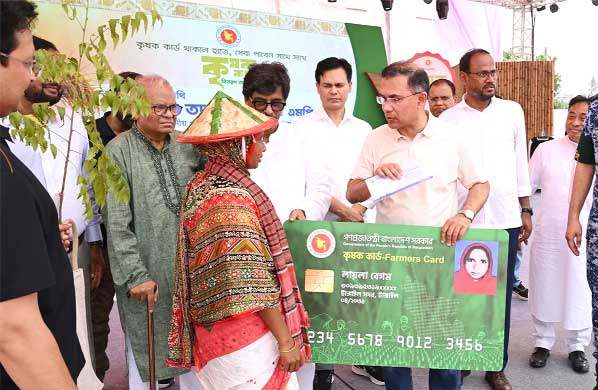
The Krishak Card is a comprehensive digital identity card for every farmer in Bangladesh. The Krishak Card program announced in the BNP election manifesto is a comprehensive digital identity for the country's farmers, which is an initiative to ensure access to multiple services under one umbrella. Krishak Cards are in place in many countries of the modern world to facilitate agricultural services. For example, digital identity cards, mobile banking, subsidy provision and training services are available for farmers in various countries of the world, including Kenya, Nigeria, Brazil, Thailand, India and Pakistan.
These countries are using farmer cards to ensure transparency and efficiency in overall agricultural management, including the supply of agricultural inputs, agricultural credit, and the expansion of sustainable farming technologies. Like other countries in the world, the government of Bangladesh has also decided to provide necessary digital agricultural services, including the collection and supply of all agricultural information to farmers through modern quality farmer card management. One of the promises made in the government's election manifesto was the farmer card. The government has pledged to introduce this card as part of a fundamental transformation in the agricultural sector.
The government has taken many steps to advance the agricultural sector. One of these initiatives is the Krishak Card. It is basically a card with a chip. This card will be linked to a self-contained digital database in which the amount of land of the farmer, the type of crop produced and other agricultural-based information will be stored. As a result, all services related to agriculture, fisheries and livestock can be delivered to the farmer in a transparent and fastest way at the scheduled time.
The main reality of this sector is the managerial weakness in the procurement of agricultural products from agricultural production to the marginal stage and the violence of middlemen. Due to these reasons, farmers are facing the most trouble. Sometimes due to bad seeds, the crop does not yield the desired amount. Sometimes due to high yield, the price falls. As a result, farmers cannot even cover the production cost by selling the crop. Sometimes due to the impact of climate change or lack of storage opportunities, the excess crop is wasted. Or farmers are forced to sell it at a low price. In this way, in most cases, they have to suffer financially. In such a reality, the launch of the government's 'Farmer Card' program as part of the implementation of election promises is an initiative to awaken hope in the minds of the public. If it is fully implemented, it is possible to change the current situation of farmers to a great extent. In this case, the prerequisite is that there should be no managerial weakness in its implementation. For a long time, there have been allegations of middlemen, irregularities and lack of information in the distribution of agricultural subsidies, incentives or loan facilities. Even before this, almost a similar initiative was taken in 2007. At that time, 'Agricultural Input Support Card' was issued. Again, 'Fisherman Card' has also been issued since 2015. But studies by many concerned have revealed that none of these have been fruitful. In many cases, the real beneficiaries have been deprived, while powerful groups have received benefits. Therefore, why these initiatives could not be implemented successfully in the past must also be taken into consideration. Maximum caution must be exercised in card distribution.
Farmers with real needs must be identified through an accurate digital database. If there is a mistake in determining the real beneficiaries, then the purpose of this initiative will not be fulfilled. According to the information of the Department of Agricultural Extension, 16.5 million agricultural families are mentioned, who are dependent on agriculture in one way or another. Among them are landless, marginal, small and large farmers. Initially, it has been decided to distribute 22,000 farmer cards as a pre-pilot project, of which more than 20,000 are landless, marginal and small farmers. Later, when the distribution of these cards starts for the farmers of the entire country, the government will still have to be careful in the selection of beneficiaries. For this, the issue of administrative capacity and control of corruption at the local level is very important. In the past, there have been examples of irregularities in the preparation of lists and distribution of benefits in various social security programs, from which it is important to learn.
To make this initiative effective, equal importance must be given to other structural problems of agriculture. Such as development of irrigation system, addressing the effects of climate change, ensuring fair prices and modernizing the market system. If the government implements the plans for digging canals, restoring groundwater levels and building cold storage, the impact of the farmer card program will increase manifold. Because it is not possible to ensure the overall development of farmers with cash assistance alone; an integrated agricultural policy is needed.
The important aspect is the storage and marketing of agricultural products. The development of cold storage and supply chain management is essential to solve the dual problem of farmers not getting fair prices when production is high in season, and consumers have to pay high prices in the off-season. If farmers can be connected to these infrastructural facilities through the farmer card, it can become a complete support system.
The plan to link this card to a bank account and provide direct financial assistance will bring farmers into the formal financial system. This will increase transparency and allow farmers to easily access credit, insurance, and other financial services. However, the effectiveness of this digital system will depend on the technical capacity at the field level, banking infrastructure, and the practical skills of farmers. The risk of creating dependency on a specific dealer or supply system through the farmer card must also be taken into account. If farmers are forced to buy seeds, fertilizers or other inputs from a specific source, competition in the market may be reduced and farmer independence may be limited. Therefore, it is important to ensure alternative sources and a competitive market structure in policymaking.
Defining a farmer is also an important question here. Defining a farmer solely on the basis of land ownership can leave out a large number of sharecroppers, agricultural laborers, and women workers. However, in reality, a large portion of agricultural production depends on the labor of these people. Therefore, the government must have a truly inclusive image. 'Farmer Card' is a promising initiative, but its success will depend on its implementation. Without transparency, accurate information-based planning and effective supervision at the field level, this initiative will not yield the expected results. The main goal of the government should be that farmers actually benefit from it. The statement that if farmers are good, the country will be good is not only a political promise, but it is also a great truth in economic terms. Therefore, it is hoped that 'Farmer Card' will not be limited to a paper project but will become a strategy for real change.
Author: Journalist.