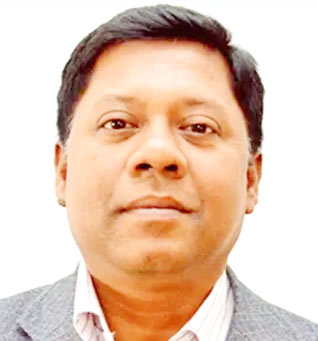
Naushad is 53 years old. He has been driving a rickshaw in Rajshahi for two decades. Every alley, every corner of this city is familiar to him like the back of his hand-something only a person who has spent his life on these hot, tarred roads can do. It was a hot afternoon on April 23, 2026. Naushad had wrapped a towel around his head in search of a handful of food, but despite a long wait, no passengers were found. According to the Bangladesh Meteorological Department, the temperature that day had reached 40 degrees Celsius-the highest of the year. The streets were deserted. This silence was not the tranquility of a holiday, but rather the silence of human defeat in the face of nature's overwhelming might. Naushad was not resting; he was waiting for the heat to subside a little so that at least one passenger could be found. But the hot air did not subside, but rather, with time, it pierced his body like a fire. This is the true picture of Bangladesh's April 2026 heatwave. This is not just a statistic confined to weather charts, BMD bulletins, or ministers' press releases. This is a reflection of the thirsty people hunkered down under flyovers, with no income. When the perceived temperature is four to five degrees higher than the thermometer reading due to the humidity in the air, every breath is a battle. These people are looking for a way out of a crisis that our country's institutional systems are still reluctant to acknowledge as a full-fledged 'disaster'. The heat of the fire hidden behind statistics By April 23, 27 districts of Bangladesh were gripped by a severe heatwave. While the temperature in Rajshahi reached 40 degrees Celsius, it was not an isolated incident. In early April, the Meteorological Department (BMD) had predicted that several mild to severe heatwaves could occur this month. And that is exactly what happened. In Chuadanga, the temperature touched 40 degrees Celsius at the beginning of the month and on April 21, it reached 42.6 degrees. The average temperature in the capital Dhaka and other districts was 4 to 5 degrees Celsius higher than the normal average temperature of the last 30 years. On April 23, the average temperature in Dhaka, which should have been 33.6 degrees in the last three decades, reached 38.4 degrees. In Khulna in the south, the deviation was even more severe-5.9 degrees higher than the historical average.
These deviations are giving us a dire message for the future. In the last two decades, the average temperature of Dhaka has increased by about 2.75 degrees Celsius. This is well beyond the global average warming rate (1.2 degrees) and the 1.5 degrees limit set by the Paris Agreement. Due to its geographical location, the negative impact of global carbon emissions is much more pronounced in Bangladesh. BMD's own publication 'Bangladesh's Changing Climate' confirms that the maximum temperature in our country is increasing faster than the minimum temperature. In the 1980s, heat waves used to last for two-three days at most, but now they are lasting for more than a week. Before the end of April 2026, the country has recorded 23 days of heat waves-which is equal to the record for the entire year of 2019 in the history of records that began in 1948. This is no longer just 'weather', it is a new and hostile climate that is knocking on our door.
The Heat of Inequality: Cities and Villages
The heat is not the same for everyone. The heat in Dhaka is essentially 'urban' in character. The concrete jungle and tin roofs here absorb heat during the day and continue to radiate it long after sunset. The extreme lack of vegetation and chronic traffic congestion further exacerbate the crisis. According to a 2025 World Bank report, Dhaka's heat index is about 65 percent higher than the national average. Especially for residents of slum areas, where there is no electricity and no ventilation under tin roofs, spending a night in temperatures above 30 degrees is not only uncomfortable, but also extremely dangerous for life. In rural Bangladesh, on the other hand, the heat wave is creating a different crisis. Farmers in the northwestern region are now leaving for their fields before sunrise to finish their work, to avoid the scorching midday sun. As the water table drops, water is not coming out of tube wells, and irrigation ponds are drying up. Our agricultural system-which accounts for 4 percent of the country's employment and 11 percent of GDP-is now at extreme risk. Rice and wheat varieties are not able to adapt to these unusual temperatures, increasing the risk of crop damage.
The hemorrhaging of the economy and the value of life Extreme heatwaves not only cause sweat and fatigue, they are also breaking the backbone of our economy. According to the Lancet Countdown 2025 report, Bangladesh lost about $24 billion in lost productivity due to heatwaves in 2024, equivalent to five percent of its GDP. More than half of this loss was in the agricultural sector. In addition, 250 million working days were lost in 2024 due to heat-related physical and mental illnesses. This is a huge economic hemorrhage. If this loss had been caused by any other reason, an emergency cabinet meeting would have been called, but since it is 'weather', we are accepting it as fate.
But for working people, it's not just statistics. There is no 'holiday' for construction workers in Mirpur, delivery riders in Mohakhali or garment workers in Gazipur. Their income is directly linked to the temperature. The march, which began with the death of a rickshaw puller in Bogra on April 2, 2026, is getting longer and longer. Although the Department of Health has started keeping a count of heatstroke deaths, it is based only on data from government hospitals, which is insignificant compared to the actual number. In addition to heatstroke, the long-term effects of heat on dehydration, respiratory problems and mental health are crippling society. Doctors advise staying indoors, but for those whose livelihood is in the dust of the streets, this advice sounds like a cruel joke.
The fragile structure of the electricity and education systems
The demand for electricity is increasing in line with the heat wave, but the supply system is struggling. By the end of April 2026, load shedding had exceeded 2,500 MW, and the shortage was even more pronounced in rural areas. Our dependence on imported coal or maintenance of foreign power plants has made our energy security fragile. While children's lives are at stake in the intense heat, hour after hour of load shedding is turning the crisis into a humanitarian disaster. The same is true of the education system. Every year, schools are closed when a heat wave begins, but this is not a permanent solution. Our school buildings were not built with these extreme temperatures in mind. There have been no architectural changes or reforms in the academic calendar to alleviate the hellish suffering that children endure in their tin-roofed classrooms. Closing schools cannot be a specific 'heat policy'; it is actually a lack of foresight. Climate injustice: Who is responsible, who is punished?
At the root of it all is a profound global injustice. Bangladesh is responsible for only 0.56 percent of global greenhouse gas emissions, yet we are in the top seven countries affected by the effects of climate change. Since 1980, Bangladesh's perceived temperature has increased by 4.5 degrees, the second highest in the world. We are not the creators of this problem, but rather the victims of the ultra-consumer lifestyles of rich countries. Despite the grand promises made at international climate conferences, they are like grains of sand in the ocean compared to what is needed. This is a moral crisis where poor countries are suffering the consequences of the sins of others. The way out: what needs to be done?
Heatwaves should be declared a 'national emergency' rather than a regular seasonal event. We need an effective 'National Heatwave Response Plan'. This could include setting up cooling centers and drinking water distribution centers at every union and city intersection. A law should be enacted to mandate mandatory rest periods for outdoor workers during extreme temperatures. The Department of Health should be given the ability to track heat-related illnesses and deaths in real-time. It is essential to ensure tree plantation and water body protection by bringing major changes in urban planning. Reflective roofs and improved ventilation systems should be made mandatory in building construction. If cities like Ahmedabad or Athens can implement heatwave response plans, why can't we? We have the technical capacity, what we lack is political will. For Rajshahi's rickshaw puller Naushad, this crisis is not a theoretical discussion. Every hot day means less money in his pocket and hungry faces at home.
He has to pay the full price for a crisis he did not create, with his own labor and health. How long will we, who are observing this situation from air-conditioned rooms, remain blind? When the sun starts punishing like a ruler, it is not possible to escape it by simply holding an umbrella; a holistic and sensitive system change is needed. Naushad's fight for survival has now become a fight for our existence.
We need to rethink our development thinking for this huge population. If we judge the quality of life only by GDP growth, the cries of these hot roads will remain unknown. We need to increase our adaptive capacity in this new reality of climate change in such a way that even the most marginalized people in society are protected from this unbearable heat. If the state and society do not stand up against this silent killer heat wave today, then in the coming years this fire will consume not only the Naushads, but the entire system.
Author: Researcher and development professional.