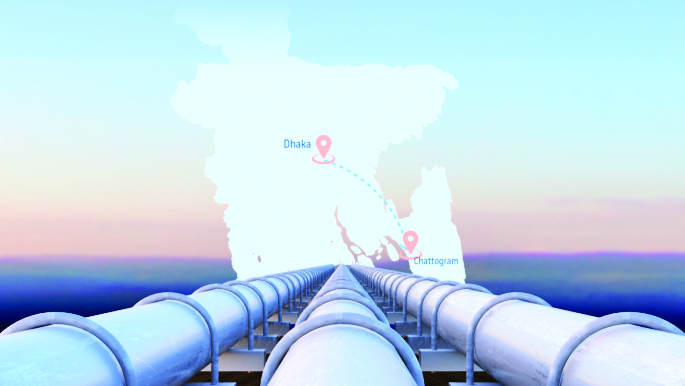
Bangladesh today takes a historic step in energy transport efficiency with the official launch of the country’s first direct fuel oil pipeline from Chittagong to Dhaka. The mega infrastructure project, completed after years of delays, promises to slash transportation time, cut annual costs by Tk 226 crore, and significantly reduce system losses.
The inauguration ceremony is being held this morning at the Despass Terminal of Padma Oil Company in Guptakhal, Chittagong. Advisor to the Ministry of Power, Energy and Mineral Resources, Fawzul Kabir Khan, is presiding over the event, joined by Energy Secretary Mohammad Saiful Islam and Major General Muhammad Hasan-uz-Zaman, Chief of the Engineering Division of the Bangladesh Army.
From 48 Hours to 12 Hours: Until now, it took approximately 48 hours for fuel oil to reach Dhaka from Chittagong by waterway. The new underground pipeline network will deliver the same supply in just 12 hours, providing a faster and more secure supply chain for the capital’s fuel needs. Bangladesh Petroleum Corporation (BPC), which implemented the project through the Army’s 24 Engineering Construction Brigade, sees this as a game changer. “This marks the beginning of a new era in fuel supply management for the country,” said Petroleum Transmission Company Engineer and Project Director Md. Aminul Haque. A Long-Awaited Project: The project received approval from the Executive Committee of the National Economic Council (ECNEC) in October 2018, with a planned completion date of December 2020.
However, COVID-19 disruptions and logistical challenges extended the timeline to March 2025 and increased costs to Tk 3,653 crore.
The infrastructure consists of: 241.28 km of 16-inch diameter underground pipeline from Chittagong to Godnail in Narayanganj, 8.29 km of 10-inch diameter underground pipeline from Godnail to Fatulla, 9 pumping and control stations, 286.88 acres of acquired land, Crossings over 22 rivers and canals. Additionally, the project features new, automated fuel depots in Mogbari (Comilla), Siddhirganj (Narayanganj), and Fatulla, enhancing both storage and safety.
Capacity and Efficiency Gains: During pre-commissioning trials in February 2025, the pipeline successfully transported 50 million liters of diesel without any system loss. The current transport capacity is 350 metric tons per hour, or 2.7 to 3 million metric tons annually, with scope to expand to 5 million metric tons in the future.
“This is not only about cost savings,” said Haque. “It is about security, operational efficiency, and ending our reliance on slow, theft-prone river transport.”
Massive Cost Reduction: Before the pipeline, BPC relied on over 110 oil tankers per month for river transport, costing around Tk 326 crore annually. With the new system, the cost will drop to Tk 90 crore-an annual saving of Tk 226 crore.
Additional savings will come from preventing fuel theft, spillage, and evaporation losses-common issues in the previous system.
Modern Control and Monitoring: To ensure safety, a central control room has been set up in Patenga, Chittagong. From there, every stage of the fuel’s journey to Dhaka will be monitored in real time, with automated systems tracking flow rates, pressure, and potential leak points.
Strategic Importance: Energy experts note that this project could serve as a model for other parts of the country, reducing dependence on costly and vulnerable transport methods. It is also expected to ease pressure on Chittagong Port by reducing oil tanker traffic, freeing capacity for other cargo.
According to BPC officials, the improved supply chain will also benefit the industrial sector by ensuring a more stable fuel supply, potentially reducing energy costs for factories and transport services.
Quote from Energy Ministry Advisor: “This is not just an energy project; it’s a strategic infrastructure milestone that will serve the country for decades. The savings will help strengthen our energy security and fund further improvements in the sector.” - Fawzul Kabir Khan. With today’s launch, Bangladesh moves one step closer to modernizing its energy logistics, promising faster, cheaper, and more reliable oil delivery to the nation’s heartland.