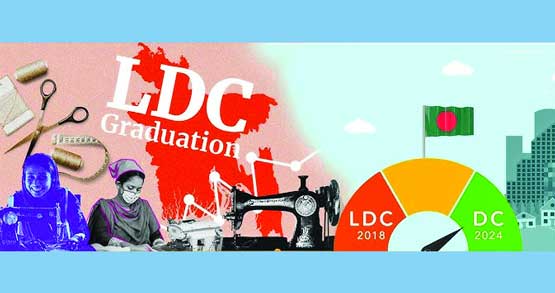
Bangladesh has affirmed that it will move ahead with its planned transition from Least Developed Country (LDC) status-set for November 24, 2026-despite growing calls from the business community to delay the graduation by three to five years.
Background: The Graduation Timeline: Bangladesh’s journey toward LDC graduation officially began in 2018. Originally slated for 2024, the deadline was extended by two years due to the COVID-19 pandemic. Now, with preparations in full swing, the current target remains November 24, 2026, as per United Nations guidelines.
Business Community Pushback: What’s Fueling the Delay Requests: On August 24, 2025, leaders from 16 major trade associations convened at a press conference titled “LDC Graduation: Challenges Ahead”, urging the government to postpone graduation for 3-5 years. Their concerns included: Loss of duty-free, quota-free access to markets like the EU, UK, Canada, and Australia, potentially reducing exports by 6-14%. Increased borrowing costs as concessional financing options, such as IDA loans, and WTO-related flexibilities would sunset post-graduation. Rising intellectual property and rules of origin constraints-particularly affecting the pharmaceuticals and RMG sectors-which would increase production costs. Businesses argue that these risks-amid global instability and domestic economic pressures-could undermine the sustainability of graduation, especially without proper preparations.
Government Position: No Initiative to Postpone: Contrary to business appeals, the Interim Government, under Chief Adviser Prof. Muhammad Yunus, has reaffirmed its commitment to the 2026 graduation timeline. On March 13, 2025, a government decision confirmed that graduation will proceed as scheduled, rejecting internal speculation about deferment. In April 2025, during a high-level meeting, Yunus instructed officials to ensure strong monitoring and preparedness. He emphasized there is no possibility of reversing the graduation decision and directed the creation of a dedicated trade negotiation body to safeguard national interests. Anisuzzaman Chowdhury, Special Assistant to the Chief Adviser, reinforced the view that “LDC graduation is a sovereign decision” and highlighted those preparatory activities-including stakeholder consultations across key sectors-are already underway.
Smooth Transition Strategy (STS) in Action: To guide the transition, the government has established a Smooth Transition Strategy (STS) Committee, chaired by Anisuzzaman Chowdhury. Members include officials from the Planning Commission, CPD, Commerce, and Research institutions like RAPID and BIDS. Dr. Manjur Hossain (Planning Commission) affirmed that while the government is preparing intensively, any final decision to defer would rest with the next elected government. Mohammad Abdur Razzak (RAPID) acknowledged that while Bangladesh enjoys LDC benefits, obtaining a deferment is extremely difficult, especially in the current competitive global environment. He noted the country’s recent performance-exports up 8%, remittances rising-makes it hard to justify a delay. Bangladesh already received a two-year pandemic-related extension and would need to present equally compelling reasons-such as disasters or economic shocks-to the UN Committee for Development Policy (CDP) to secure another. Moreover, major partners like the EU, UK, and Canada have committed to retaining LDC trade benefits for three years post-graduation (until 2029), which partially cushions potential losses.
Expert Views: Prepare Rather Than Postpone: Dr. Mustafizur Rahman (CPD) cautioned that deferment could be politically risky and divert attention from the necessary reforms required for sustainable transition. Instead, graduation should be used as a catalyst for deeper structural change. Dr. Fahmida Khatun (CPD) flagged key risks-including limited export diversification, rising debt servicing, low forex reserves, and a fragile banking sector-that should be addressed urgently. She argued that graduation should spur reform rather than be deferred.tar. Economists also noted that key trading partners are extending automatic trade benefits post-graduation, lowering the urgency for deferment and highlighting the importance of negotiation in investment and trade agreements.
Graduation or Delay: At the center of this debate lies a fundamental question: Can Bangladesh handle the costs of graduation, or is more time needed? For graduation: Meeting UN criteria and timeline builds diplomatic credibility. Aid partners are offering transition grace periods.
Graduation is a symbolic milestone celebrating development gains. Against graduation: Loss of preferential advantages could hit exports. Higher borrowing costs and limited flexibility post-LDC pose fiscal risks. Current consensus favors preparation-not procrastination. The government is mobilizing cross-ministry coordination, trade negotiation architecture, and stakeholder preparedness to make Bangladesh’s LDC exit smooth and sustainable.