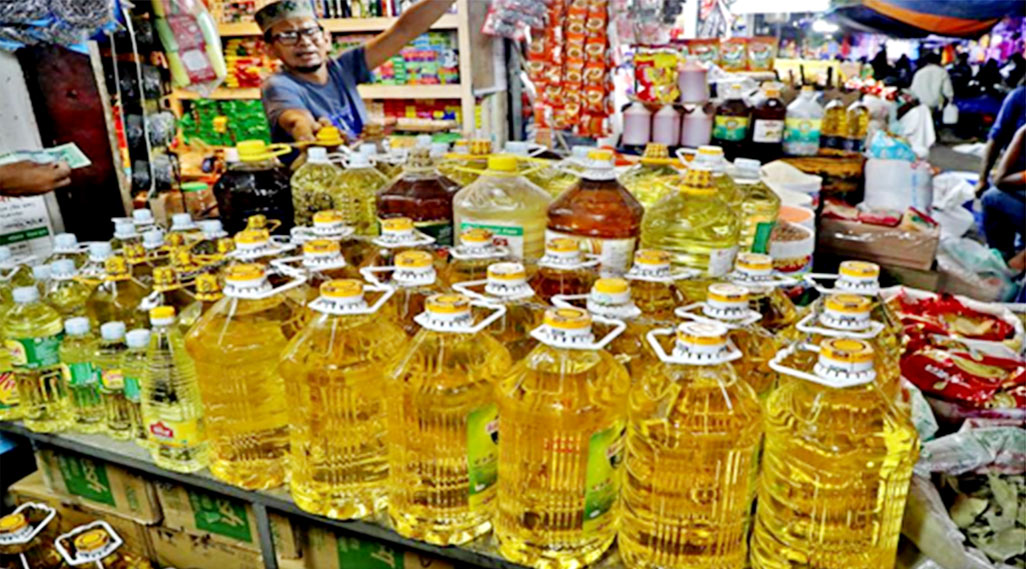
A growing shortage of bottled soybean oil across markets in the capital and beyond is forcing consumers to pay higher prices or turn to loose oil, raising concerns over market manipulation despite claims of adequate supply.
At Segunbagicha kitchen market on Sunday, private employee Mahmud Ali expressed frustration after failing to find bottled soybean oil in multiple shops. "I went to four shops but couldn't find any bottled soybean oil. Finally, I had to buy two litres of loose oil at Tk 200 per litre. The market feels like a cat-and-mouse game over oil, and no one is monitoring it," he said.
While some consumers managed to find bottled oil, they had to pay above the government-fixed price. Monira Akter from Tejkunipara said she bought a five-litre bottle for Tk 970Tk 15 higher than the official rate. "Many shops didn't have bottled oil. I found it here, but had to pay extra. If it's not available, you're forced to pay more," she said.
Similar experiences are being reported across the country. In many areas, bottled soybean oil is either unavailable or sold at inflated prices. The shortage has pushed up demand for loose oil, further driving up prices.
A market visit to Karwan Bazar, Tejkunipara, Mohakhali, and Segunbagicha revealed that most retailers do not have bottled soybean oil in stock. In some cases, shop owners are reportedly selling limited supplies discreetly to known customers at higher rates. Five-litre bottles are being sold for Tk 960-970, compared to the government-fixed price of Tk 955.
Loose soybean oil is being sold at Tk 195-198 per litre, while palm oil is priced at Tk 184-185 per litre. These rates are significantly higher than the fixed prices of Tk 176 for soybean oil and Tk 166 for palm oil. Consumers are therefore paying an additional Tk 19-22 per litre for soybean oil and Tk 18-19 per litre for palm oil.
Despite the situation, data from the National Board of Revenue (NBR) shows no major disruption in imports. Between January and March this year, Bangladesh imported 259,476 tonnes of crude soybean oil-77,460 tonnes in January, 107,693 tonnes in February, and 74,323 tonnes in March. During the same period, 422,177 tonnes of crude palm oil were imported, along with around 700,000 kilograms of refined sunflower oil.
Market players, however, are blaming each other for the crisis. Retailers and wholesalers allege that companies are reducing supply as the government has not approved price hikes in line with rising global costs. Some allegations also point to unethical practices, including forcing retailers to purchase additional products-such as spices, tea, flour, or rice-along with soybean oil, increasing their business costs.
On the other hand, oil refiners cite global and domestic pressures. They say prices of soybean and palm oil have surged in the international market due to geopolitical tensions, including the ongoing US-Iran conflict. The Bangladesh Vegetable Oil Refiners and Vanaspati Manufacturers Association recently requested a price adjustment from the government, but no approval has been granted.
Industry insiders claim that companies are currently selling oil at a loss of at least Tk 15 per litre due to rising production costs. Shafiul Athar Taslim, director of TK Group, said global edible oil prices have increased by $150-200 per tonne in recent months. "We are maintaining supply despite losses. There is no shortage at the mill level-trucks are being loaded without delay," he said.
However, he suggested that hoarding by intermediaries might be contributing to the market disruption, as some may be stockpiling oil in anticipation of future price hikes.
Meghna Group, which markets Fresh and No. 1 brands, also claimed that supply remains stable. General Manager Mujibur Rahman said the company is supplying 400-450 tonnes of soybean oil and around 400 tonnes of palm oil daily. He acknowledged, however, that discrepancies may exist at the dealer or retail level. Some traders are reportedly opening large five-litre bottles and selling them in smaller quantities due to higher margins in loose oil.
City Group also stated that supply of its Teer brand oil is continuing as usual.
Consumer rights advocates have criticised the lack of effective market monitoring. CAB President AHM Shafiquzzaman said the level of oversight needed in such a situation is largely absent. "Unscrupulous traders are taking advantage. The government must take stricter action to protect low-income consumers," he said.
Meanwhile, the Directorate of National Consumer Rights Protection claimed that supply has improved compared to the previous week. Director Abdul Jalil said regular monitoring is underway and the market remains under control. He added that a decision on reducing import duties may be taken within a few days, which could help stabilise prices.
Despite these assurances, consumers continue to struggle with limited availability and rising costs, highlighting ongoing challenges in ensuring a stable and transparent edible oil market.