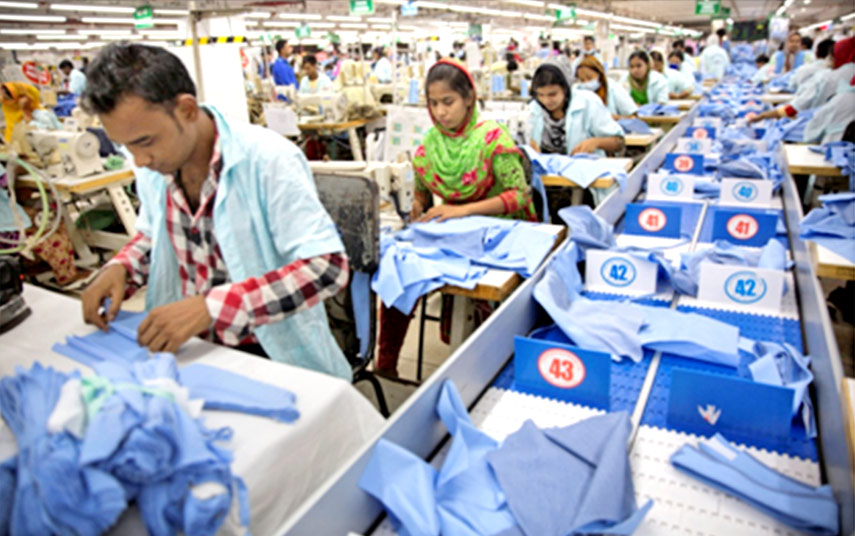
A deepening fuel crisis coupled with rising energy prices and persistent power outages is severely disrupting industrial operations in the key manufacturing hubs of Savar and Ashulia, threatening Bangladesh's vital ready-made garment (RMG) sector. Factory owners and workers report that widespread load-shedding and shortages of fuel are not only reducing production but also delaying shipments, increasing costs, and creating uncertainty among international buyers.
At several garment factories, production has dropped by an estimated 10 to 15 percent in recent weeks, as companies struggle to maintain operations amid unreliable electricity supply. During a visit to a major industrial facility owned by J.K. Group in Savar municipality on Saturday morning, operations were seen continuing under a gas-powered generator due to a power outage. Mahbub Alam, General Manager of the factory, said the combined impact of fuel shortages and rising prices has significantly reduced output.
"Previously, we produced between 100,000 and 110,000 pieces daily. Now production has fallen to around 80,000 to 90,000 pieces," he said.
The crisis extends beyond factory floors. Alam noted that transporting finished goods to the port city of Chattogram has become increasingly difficult, as fuel shortages are causing delays for covered vans carrying shipments.
"Many vehicles are getting stuck on the way due to a lack of fuel. As a result, goods are not reaching depots on time. This is becoming a major problem-not just for us, but for many large factories," he said.
In some cases, manufacturers are being forced to send goods by air at their own expense to meet delivery deadlines, significantly increasing operational costs.
The situation is further aggravated by the high cost of running generators during prolonged power cuts. Despite rising expenses, factory owners say international buyers are unwilling to increase prices, squeezing profit margins and putting financial pressure on manufacturers. A similar scenario was observed at Stitches Limited, a factory under Standard Group in Karnopara, Savar, where production continues on backup generators due to electricity shortages. Jahangir Hossain, Chief Production Planning Officer at the facility, warned that the situation is becoming unsustainable.
"If this continues for a few more days, it will be very difficult to keep the factory running," he said, adding that the factory employs around 1,500 workers.
Daily production at the plant has dropped sharply-from 15,000-20,000 pieces to around 10,000 pieces. Faridul Alam, Executive Director of AKH Group, one of the largest garment manufacturers in Hemayetpur, said production losses are averaging around 10 percent due to the ongoing crisis. However, he emphasized that delays in shipment pose an even greater risk than reduced output.
"Producing slightly less is manageable, but failing to ship products on time is a major issue," he said. "Due to fuel shortages, goods that should be dispatched in the morning are often sent in the afternoon. Sometimes vehicles run out of fuel midway, causing further delays." Such disruptions are already affecting business relationships, with some international buyers reportedly reducing purchase orders due to missed deadlines.
Industry leaders are now urging the government to take immediate action to stabilize fuel supply and ensure uninterrupted power to keep the sector operational.
"The garment industry is in serious trouble due to the ongoing electricity and fuel crisis," Alam said. "Urgent steps are needed to keep this sector running."
The impact of the crisis is also being felt by workers, many of whom are struggling with power outages at home.
Sumaiya Akter, a garment worker at Medlar factory in Narsinghpur, Ashulia, said frequent load-shedding is affecting her daily life and work performance.
"I manage while I'm at the factory, but at home it's very difficult," she said. "I can't sleep at night due to power cuts. Without proper rest, it becomes hard to do household chores and come to work on time. I feel exhausted at work."
Bangladesh's RMG sector, the backbone of the country's export economy, now faces mounting challenges as energy instability threatens productivity, supply chains, and worker well-being. Industry stakeholders warn that without swift intervention, the crisis could have longer-term implications for the country's competitiveness in the global apparel market.