Some commercial banks in the country are collecting deposits at an interest rate of 2 to 4 percent higher than the prevailing market rate. Although at first glance this seems profitable for depositors, the assessment of Bangladesh Bank and economists says that behind this high interest rate is the acute liquidity crisis of weak banks. As a result, the risk of depositors and the banking sector is increasing under the guise of high interest rates.
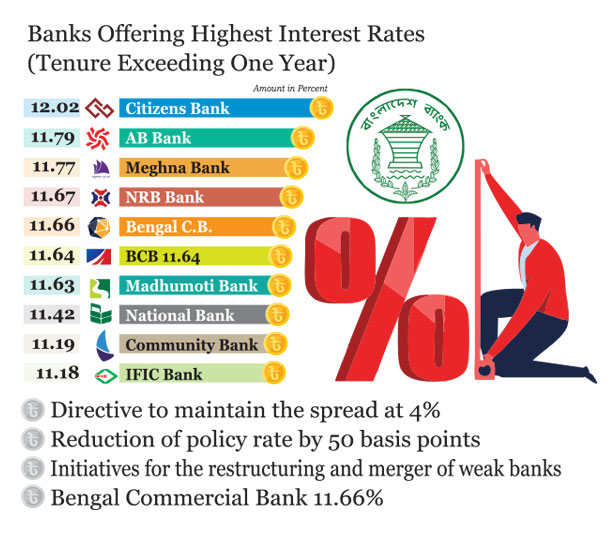
According to Bangladesh Bank data, some banks were paying more than 12 percent interest on deposits till May this year. Before the interest rate cap was lifted, the average rate was 6 to 8 percent, while the current rate is almost double. Citizens Bank paid the highest interest of 12.02 percent on deposits with a maturity of more than one year.
This was followed by AB Bank (11.79 percent), Meghna Bank (11.77 percent), NRB Bank (11.67 percent), Bengal Commercial Bank (11.66 percent), Bangladesh Commerce Bank (11.64 percent), Madhumoti Bank (11.63 percent), National Bank (11.42 percent), Community Bank (11.19 percent) and IFIC Bank (11.18 percent). Some banks are also paying interest of 10 to 12 percent on deposits with a maturity of less than one year. Economists fear that if this high interest rate competition continues for a long time, the cost of funds for banks will increase. This will have an impact on loan interest and investment. At the same time, the financial crisis of weak banks, defaulted loans and the risk to depositors may also increase. Banking sector stakeholders say that the main reason for this interest rate competition is not to increase profits, but to try to survive.
Some banks are struggling to maintain the mandatory liquidity ratio, cash reserve ratio (CRR) and statutory liquidity ratio (SLR). Some banks are even having trouble returning money to depositors. So, they have resorted to high interest rate strategies to retain old deposits, collect new deposits and meet daily cash needs. Bangladesh Bank officials said that many customers are moving to stronger banks due to irregularities, benami loans, poor management and increase in defaulted loans.
After the introduction of market-based interest rates, banks have gained more freedom in setting interest rates. Taking advantage of that, some weak banks are aggressively collecting deposits, while strong banks are receiving sufficient deposits at comparatively low interest rates.
Tarek Riaz Khan, the recently retired managing director of NRB Bank, said that some banks are taking deposits at higher interest rates to overcome the liquidity crisis. He said that due to the recent crisis, NRB Bank has also had to collect deposits at slightly higher interest rates.
Syed Mahbubur Rahman, chairman of the Bankers Association of Bangladesh (ABB) and managing director of Mutual Trust Bank, said that this is not unusual in the current situation. According to him, taking money from the interbank money market requires high interest and has to be repaid quickly. But collecting deposits allows the money to be used for a long time, which helps in dealing with the cash crisis.
However, according to economists, this strategy increases risk in the long run. Former Chief Economist of Bangladesh Bank Dr. Mustafa K. Mujeri said, taking deposits at 12 percent interest requires distributing loans at higher interest rates. This makes it difficult to find quality borrowers, reduces the bank’s profits and creates the risk of increasing defaulted loans. Therefore, instead of keeping deposits just because of the temptation of high interest rates, the bank should consider the financial report, defaulted loan rate, capital adequacy and good governance status.
To deal with the situation, Bangladesh Bank has directed to limit the spread between loans and deposits to 4 percent. Executive Director and Spokesperson Arif Hossain Khan said, in addition to reducing unfair competition in interest rates, work is underway to restructure, merge and ensure good governance of weak banks. In addition, on July 30, the central bank cut the policy interest rate by 50 basis points, which is effective from Sunday. Bangladesh Bank officials hope that this will reduce the cost of raising funds for banks and may also reduce the unhealthy competition to collect deposits at high interest rates.
According to economists, the permanent solution to the problem is not higher interest rates; the most important thing is to collect defaulted loans, strengthen capital, ensure good governance, and restore depositors’ confidence. Because as the promise of high interest rates increases, the risk to depositors also increases.