Bangladesh's banking sector is facing growing pressure on earnings as weak private-sector credit demand and declining returns on government securities reduce two of the major avenues for generating income.
Bankers say yields on Treasury bills have fallen below 9 percent, while interest rates on Treasury bonds have declined to slightly above 10 percent from around 12 percent previously. The declining returns have made investment in government securities less attractive than it was during the period of high interest rates.
At the same time, sluggish investment in the private sector has weakened demand for bank loans. According to Bangladesh Bank data, private-sector credit growth fell below 5 percent in May 2026, leaving banks with fewer opportunities to expand their lending portfolios and generate interest income.
The combination of lower investment returns, weak loan demand and abundant liquidity has created a difficult operating environment for banks. While banks continue to hold substantial funds, they are struggling to deploy those resources profitably.
The situation is particularly significant because the income structure of Bangladesh's banking industry has changed considerably over the past few years. In 2021, the 52 major banks in the country earned a combined Tk 40,793 crore. Of the total income, 47 percent came from lending, 34 percent from investments and 19 percent from commissions.
By 2025, however, the composition had changed dramatically. Investment income emerged as the largest source of earnings for banks, accounting for 73 percent of total income. In contrast, the contribution of net interest income declined to only 6.8 percent.
The shift was largely driven by a sharp increase in the yields on Treasury bills and government bonds from late 2023 onward. Banks responded by increasing their investments in government securities because they offered comparatively attractive returns at a time when private-sector credit demand remained subdued. However, the recent decline in Treasury yields is now reducing the profitability of that strategy.
Lower Treasury yields squeeze investment income: Bankers say the decline in yields on Treasury bills and bonds has come at a time when banks are already dealing with weak demand for loans. Treasury bills currently offer returns of less than 9 percent, while yields on Treasury bonds are slightly above 10 percent. These rates are considerably lower than the approximately 12 percent returns previously available from government securities.
As a result, banks that previously relied heavily on government securities for relatively safe and attractive returns are now facing lower income from their investment portfolios.
Syed Mahbubur Rahman, managing director of Mutual Trust Bank, said lower yields on Treasury bills and bonds, adequate liquidity and healthy deposit growth have reduced banks' need to collect deposits at high interest rates.
“Currently, the interest rates on Treasury bills and bonds are lower than before. Banks have excess liquidity in their hands, while deposit growth is also good. I think deposit rates will fall below inflation,” he said.
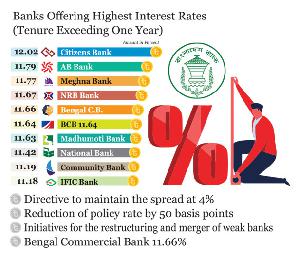
According to Mahbubur Rahman, the changing liquidity situation is also affecting the way banks set deposit and lending rates. Bangladesh Bank has instructed banks to keep the spread between lending and deposit rates within 4 percentage points. Consequently, banks are adjusting interest rates on both loans and deposits, although deposit rates are being adjusted downward first.
The development has important implications for banks' earnings. If lending rates fall while demand for loans remains weak, banks may find it difficult to increase interest income. On the other hand, if deposit rates are reduced, banks can lower their cost of funds and potentially protect their margins. The problem is that lower funding costs alone may not be enough to restore earnings growth if banks cannot find enough viable borrowers.
Credit demand remains weak: Private-sector credit growth has remained weak amid subdued investment activity in the economy. Businesses have been cautious about expanding operations and making new investments, while high borrowing costs over the past several months have also discouraged some potential borrowers.
For banks, this means that even when liquidity is readily available, there are not enough strong loan proposals to deploy funds at profitable rates. The situation contrasts sharply with periods when banks faced strong demand for credit and could expand lending portfolios rapidly.
A slowdown in credit demand also creates a broader problem for the banking sector because lending traditionally represents one of the core sources of bank income. When loan growth remains weak for an extended period, banks' interest income comes under pressure. The recent data on the income structure of banks highlights the extent of this change.
In 2021, lending accounted for nearly half of the total income of the country's 52 major banks. Four years later, its relative contribution had fallen substantially, while investment income became dominant.
This means that banks have become increasingly dependent on income from investments, particularly government securities, at a time when their traditional lending business has been unable to provide sufficient momentum.
Banks sitting on rising excess liquidity: The banking sector's liquidity position has also changed significantly. According to Bangladesh Bank data, excess liquidity in the banking sector increased to Tk 3,27,877 crore in May 2026, compared with Tk 2,35,500 crore in the same month of 2025. The increase of more than Tk 92,000 crore in excess liquidity reflects the mismatch between the availability of funds and demand for credit.
For banks, excess liquidity is not automatically a positive development. While it reduces the immediate risk of a funding shortage and allows banks to meet withdrawal demands comfortably, idle funds can weigh on profitability if they cannot be invested in sufficiently profitable assets.
Banks can place excess funds in government securities, but declining yields have reduced the attractiveness of this option. They can also lend to businesses and consumers, but weak credit demand and concerns over asset quality are limiting the scope for rapid lending expansion. The result is a challenging situation in which banks have money but relatively fewer attractive opportunities to deploy it.
Deposit rates likely to decline further: Mohammad Ali, managing director of Pubali Bank, said banks had previously been able to mobilise deposits in substantial amounts because of relatively high interest rates. “Depositors previously received attractive interest rates. As a result, deposit growth was satisfactory. But now the top commercial banks have excess liquidity in their hands and loan demand is weak. Therefore, banks have moved away from offering high interest rates and have already reduced deposit rates,” he said.
The decline in deposit rates could help banks reduce their cost of funds. However, it may also alter depositors' preferences and intensify competition based on the financial strength and credibility of individual banks.
A managing director of another commercial bank, speaking on condition of anonymity, said depositors are now placing greater importance on financially strong and credible banks rather than simply looking for the highest interest rates. According to the banker, banks will be able to increase their investment in Treasury bills and government bonds if they can reduce their cost of funds.
However, the banker noted that comparatively weaker banks are still having to offer higher deposit rates to attract and retain depositors. This creates a two-speed banking market. Stronger banks with adequate liquidity can reduce deposit rates because they do not urgently need additional funds. Weaker banks, meanwhile, may continue to compete aggressively for deposits because they need to strengthen their liquidity and funding position.
4% spread cap adds another challenge: The central bank's instruction to maintain the interest-rate spread within 4 percentage points is another factor influencing banks' earnings. The spread between the rate a bank pays to depositors and the rate it charges borrowers is a key component of traditional banking profitability.
When banks reduce deposit rates, their cost of funds declines. But if lending rates are also reduced because of regulatory restrictions and weak demand, the benefit to banks may be limited.
The situation becomes more complicated when banks have to compete for quality borrowers. With credit demand weak, banks may have to offer more competitive lending rates to attract financially sound businesses.
At the same time, banks cannot simply increase lending to weaker borrowers to boost credit growth, particularly given the banking sector's longstanding concerns over non-performing loans and asset quality. Therefore, banks are increasingly focusing on balancing liquidity, funding costs, credit risk and investment returns.
Shift in banking business model: The recent changes suggest that Bangladesh's banking sector is undergoing a broader adjustment in its business model.
During periods of high Treasury yields, government securities provided banks with an opportunity to generate relatively attractive returns without taking the same level of credit risk associated with lending to private borrowers.
That strategy became particularly important from late 2023, when yields on Treasury bills and bonds increased sharply. Banks subsequently increased their investments in government securities, contributing to the dramatic rise in the share of investment income in their overall earnings.
But as Treasury yields decline, banks may once again need to focus more heavily on their core lending business. The challenge is that the recovery of lending income depends largely on a revival of private investment and stronger demand for credit. If businesses remain cautious and investment continues to move slowly, banks may struggle to increase their loan portfolios even if borrowing costs decline.
Liquidity is no longer the main concern: The current situation also marks a significant change from periods when banks faced acute liquidity shortages. The rise in excess liquidity to Tk 3,27,877 crore in May 2026 indicates that liquidity availability is no longer the principal problem for much of the banking sector. Instead, the key challenge is profitable deployment of funds.
Syed Mahbubur Rahman's assessment that deposit rates could fall below inflation indicates that the competition for deposits is weakening as banks become more liquid. For depositors, however, lower interest rates could reduce the real return on savings, particularly if inflation remains elevated.
For banks, lower deposit rates could provide some relief by reducing funding costs. Yet if lending growth remains sluggish and Treasury yields continue to decline, banks may not be able to translate lower funding costs into a substantial improvement in overall profitability.
Outlook depends on investment recovery: Bankers and financial-sector observers say the outlook for bank earnings will increasingly depend on whether private-sector investment recovers.
A revival in business investment would increase demand for working capital, industrial loans, project financing and other forms of credit. That would give banks an opportunity to deploy their excess liquidity through lending rather than relying heavily on government securities.
Until then, banks are likely to remain caught between falling investment returns and weak credit demand.
The decline in Treasury yields means investment income may lose some of its previous strength, while private-sector credit growth below 5 percent shows that lending has yet to become a strong alternative source of income.
The banking sector therefore faces a delicate balancing act. Banks need to lower funding costs, maintain adequate liquidity, attract quality borrowers and manage credit risks while finding profitable avenues for their surplus funds. The sharp rise in excess liquidity over the past year provides banks with a stronger liquidity cushion, but it also underscores the depth of the demand problem. As Mohammad Ali noted, banks are already moving away from high deposit rates because excess liquidity and weak loan demand have reduced their need to compete aggressively for funds.
Meanwhile, Mahbubur Rahman's observation that deposit rates could fall below inflation points to a likely period of further adjustment in the deposit market. For the banking industry, the immediate priority will therefore be to convert excess liquidity into productive and quality lending. Without a meaningful recovery in private-sector investment, banks may have limited scope to expand interest income.
In the longer term, a stronger investment climate, lower borrowing costs, improved confidence among businesses and better credit demand will be crucial to restoring lending as a major contributor to bank earnings. Until such a recovery takes place, the banking sector is likely to remain under pressure from the twin challenges of lower returns on government securities and weak demand for private-sector credit, forcing banks to rethink how they deploy their growing liquidity and sustain profitability.