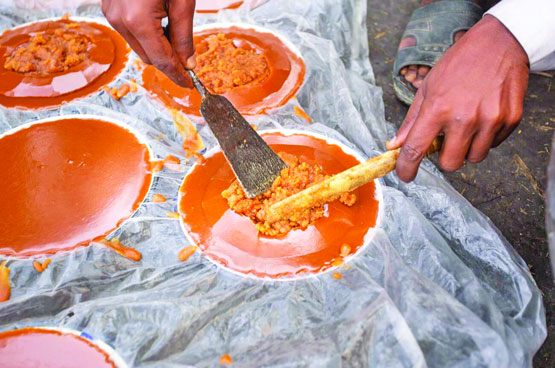
Towards the end of Ashwin, the palm trees have to be prepared for harvesting. The bark of the tree is ‘harvested’. After picking the tree, it’s time to cut the tree. The sap is extracted by cutting the trees on specific days of the week with a thick rope tied around the waist. The people of this region make various types of pitha with juice and jaggery.
Various types of patali are made. There are variations in shape, color and taste. People here are especially fond of coconut patali. This patali is sent to their relatives. And this special type of patali can be made only by the artisans here. Its characteristic is that the external coating of this patali is hard. But the inside is like melted wax. According to the scientific officers of the Agricultural Research Institute, the soil in this region is generally sandy loam.
And the water has no salinity. As a result, the roots of the tree can go far down. All in all, the juice of Khajura, Baghapara, Chougacha, Shalikha dates of Magura are fragrant and delicious.
After the British took control of Bengal in 1757, Saheb started coming to this country from India in groups. A gentleman named Balke entered into the business of making sugar. He established a large sugar factory at Dhoba in Burdwan district (now India). He started making sugar by taking palm molasses from Jessore. Due to high cost, he formed Dhobao Sugar Company and set up two big sugar factories at Kotchandpur and Trimohani. Until 1882, Mr. Buckley’s two factories are doing well. Then the losses started.
An English gentleman bought the Kotchandpur factory. Later another gentleman named Saints Barry bought the Trimohani factory. According to the information stated in the Jessore District Gazetteer, in 1842, gentlemen living in Calcutta formed Gadstone and Company and entered the sugar business. They set up a big sugar factory at Chougacha. The manager of this factory was a foreigner named McLeod Smith. Many memories of the McLeod family still exist in Kotchandpur. Apart from Kotchandpur, this company had more sugar factories in Jhikargacha, Trimohani, Chougacha, Narkelbaria. These factories run well for three to four years. Later the losses started. Even after 1850, the Kotchandpur and Chougachar factories were still in operation. In 1853, New House set up a large scale factory at Taherpur. After running for three to four years, losses start. Later sugar production was stopped and ‘Ram’ liquor was made in this factory.
According to information published in the Jessore District Gazetteer published by LSS O’Malley, the demand was higher as the quality of sugar produced in the factories of native Moiras was better than that of the Sahebs. The sugar industry made from palm molasses suffered a setback when white sugar produced from sugarcane was imported. After 1890, the indigenous sugar market developed in the Jessore region lost its market. The sugar factories built in Jessore district started to close down. There were about 500 small and big sugar factories in Kotchandpur and surrounding areas alone. However, district gazetteers have different information about sugar production. In 1874, 1 lakh 56 thousand 475 maunds of sugar were produced in 63 factories of Kotchandpur. A type of algae was used to make this sugar. There was a lot of algae in the Kapotaksha river. The molasses was broken and kept in baskets inside the dark factory. Moss was spread over the basket. The juice dripped off and became sugar. The sacks were dried in the sun and sent to different places. The quality of the sugar produced the first time was good. It was called Nalua Chini.
The East India Company started the sugar business. In 1775, the East India Company exported 1,900 tons of sugar through the port of Calcutta. In 1924, it further decreased to 50. Even in the 1950s a few survived as witnesses. Later they disappear in the womb of time.
Khan Bahadur MA Momen wrote in the book Final Report on the Survey and Settlement of Jessore, around 1908 there were 6 million palm trees in Jessore region. 25 lakh maunds of molasses were made from this tree. However, sugar production from dates had almost disappeared at this time.
It is a matter of great regret that the number of palm trees is decreasing day by day. Tree killers have been noticed for some time now. They are buying palm trees for brick kilns at high prices. Due to the cultivation of other cash crops, people’s dependence on palm trees has decreased. There is no plan to plant palm trees. Still there are trees. With the sharp knife, he tore open the chest of the tree and brought out the sweet juice. Even the poor family of ‘gaon-geram’ is filled with the smell of juice, jaggery, pitha-pies.