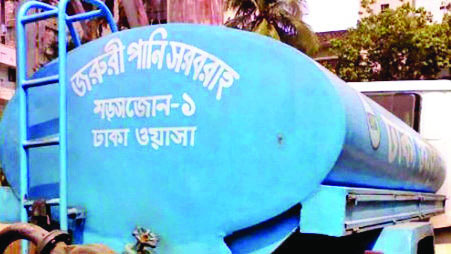
To free the capital city residents from risks, Dhaka WASA took the initiative to purify river water instead of underground and provide drinking water. In 2009, it announced that 70 percent of the water demand would be collected from surface sources by 2021. Even though 2024 ended, that plan has not been implemented.
Although several projects were taken, the benefits were not fully realized. As a result, WASA has taken the initiative to meet the water demand by digging deep tube wells in Dhaka city again. For this, they have taken a project of Tk 1,520 million. This is putting the capital residents at further risk.
According to the relevant sources, Dhaka WASA is currently supplying 2.65 to 2.97 billion liters of water daily from underground and surface sources. Of this, 70 percent comes from underground sources and 30 percent from surface sources. According to the Dhaka WASA master plan prepared in 2014, the potential water demand in Dhaka Metropolitan City will be 305.8 million liters in 2025 and 355.3 million liters in 2029.
Currently, the population of Dhaka is growing at a rate of five percent and the production of deep tube wells is also decreasing. It is estimated that the population of Dhaka Metropolitan City will be about 22 million in 2029. Per capita water consumption is increasing due to the improvement in the standard of living and socio-economic conditions of the people.
Out of the amount of water that Dhaka WASA is currently producing and supplying, 450 million liters per day is supplied from Sayedabad Water Treatment Plant Phase-1 and Phase-2 and 280 million liters from Padma (Jashaldia) Water Treatment Plant in Louhjang, Munshiganj. Besides, 500 million liters of water per day from Gandharvapur Water Treatment Plant in Rupganj Upazila of Narayanganj will be connected to the supply line by 2026. Similarly, there is a plan to connect 450 million liters of water from Sayedabad Water Treatment Plant (Phase-3) to the supply line by 2029.
Dhaka WASA claims that by 2029, it will be necessary to supply another 81.5 million liters of water from underground sources. That is why initiatives have been taken to implement the new project.
What is in the project worth thousands of crores
Deep tube wells will be dug under the ‘Emergency Water Supply in Dhaka City’ project. The project will be implemented from the current time by June 30, 2029. 62 new deep tube wells will be dug under the project. 388 deep tube wells will be replaced, 280 re-generated, 60 rehabilitated, 44 deep tube wells will have iron removal plants, 50 rainwater harvesting and 124 SCADA systems will be installed. By implementing the project in the entire Dhaka metropolis, the existing water supply system will be stabilized on an urgent basis against the increasing water demand and an additional 576 million liters of water will be supplied under the project. When asked about collecting groundwater instead of surface water, Dhaka WASA Managing Director (MD) Md. Fazlur Rahman told Daily Industry, “The population of Dhaka is increasing day by day. Due to which many plans are not being implemented. Currently, 30 percent of the water supplied to Dhaka city is surface water and 70 percent is underground. Our goal is to supply 70 percent of surface water to Dhaka from 2030. Water from Padma and Shitalakshya is coming to Dhaka. In the future, water from the Meghna River will also come to Dhaka.’
Regarding the digging of deep tube wells again, the MD of Dhaka WASA said, ‘We have made a plan, we currently have to provide water for the increasing population. For this, an emergency water supply project is being taken up in Dhaka city on an urgent basis. The project proposal has been sent to the Planning Commission.’
Water level dropping
An observation by the Planning Ministry has shown that the water level is dropping at an abnormally fast rate due to the extraction of large amounts of groundwater to meet the daily needs of Dhaka residents.
According to the Bangladesh Water Development Board (PWB), water was available in Dhaka city six meters or about 20 feet underground in 1970. However, water was not available before 73 meters or about 240 feet in 2023.
PWB has been monitoring the quantity and quality of water for 60 years through 1,272 observation wells across the country. According to one of their reports, the groundwater level in Dhaka is dropping by two meters or about six and a half feet every year. A major disaster is brewing underground in Dhaka. It is not visible because it is happening underground. But by analyzing the data, researchers have come to the conclusion that there is a disaster. Due to the excessive water extraction, the interior of Dhaka city is becoming empty. As a result, any kind of disaster can occur. To save Dhaka city from this disaster, a plan was made to feed the people of Dhaka with water from the surrounding rivers.
A standard rule of groundwater management is that the amount of water extraction can never be more than the recharge water. The amount of groundwater is not infinite. The government must make alternative arrangements considering national priorities. However, those concerned claim that without making alternative arrangements, the risk of digging deep tube wells in the heart of Dhaka will increase.
Explanation from WASA needed
Regarding the issue of supplying water to Dhaka by digging wells, urban planner Adil Muhammad Khan, a professor at the Department of Urban and Regional Planning at Jahangirnagar University, told Daily Industry that Dhaka WASA had taken the initiative to provide drinking water from the river without any kind of coordinated plan. But now, an explanation needs to be sought as to why it is moving away from these initiatives and is trying to dig deep tube wells in Dhaka city. Buriganga and Shitalakshya near Dhaka city are full of pollution. So how will WASA supply water from the river to Dhaka city? In fact, it took the project because it had to. We have seen how there are six or nine in the name of the project.
The executive director of the Institute of Planning and Development (IPD) and former general secretary of the Bangladesh Institute of Planners, said that Dhaka WASA cannot do all these works alone.
The government must have a coordinated plan, which I do not see. On the one hand, there is talk of supplying water from the river, on the other hand, the rivers near Dhaka are full of pollution. First, initiatives must be taken to reduce river pollution. I do not see any initiative for this.
‘There is no plan for the population of Dhaka. The population is increasing but there is no integrated plan for the increased population. That is why deep tube wells are being dug in Dhaka city and are being put at risk again. An explanation should be sought for these. Why was the master plan made earlier, talking about river water supply, and why is it not succeeding now? The DAP (Detailed Area Plan) that has been made at present is not suitable for living in Dhaka. If a habitable DAP can’t be given to the people of Dhaka, no plan can be successful.’ Adil Muhammad Khan was saying. Water expert engineer M. Enamul Haque told Daily Industry, ‘There is now black water in a little deeper part of Dhaka city. However, groundwater is available in a much deeper part. The water of the Jamuna flows from the north of Dhaka to the south. This is why Dhaka city is surviving. A project is being taken for surface water to be publicized in the media. Even if it had worked a little, the people of Dhaka city would have benefited a lot. But we have seen how much corruption has occurred during the Sheikh Hasina government. Dhaka WASA officials have taken money by sitting in offices abroad. The project to supply surface water to Dhaka residents has been taken up for publicity and publicity in the media.
Planning Advisor Dr. Wahiduddin Mahmud said, “The use of surface water will be increased without harming the environment. The water level is going down day by day. Therefore, the use of surface water will be increased.”