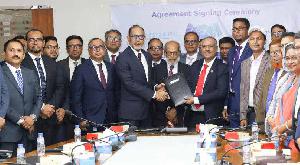
The interim government last month approved the establishment of a new bank by merging five financially distressed Shariah-based banks. Following this decision, the formal process of creating Sammlito Islami Bank PLC has now begun, coordinated by the Ministry of Finance and Bangladesh Bank.
The new bank:s memorandum and articles of association have already been sent to the Ministry of Law for vetting. Applications for licensing and registration as a company have also been initiated. According to sources from the Finance Ministry and Bangladesh Bank, the government aims to have the new bank operational by December 2025.
Employee Numbers and Costs Raise Concerns: The five banks set to merge-Exim, First Security Islami, Global Islami, Social Islami, and Union Bank-currently employ over 18,000 staff members. Their annual salary and allowances amount to nearly Tk 1,977 crore, excluding significant operational costs. This has raised questions among experts about whether the new bank can sustainably manage such a large workforce.
Currently, employees work as private bank staff, but post-merger, they will become part of a government-owned bank. Key concerns remain about whether they will receive the same status and benefits as other government bank employees. The government has also indicated plans to privatize the bank within five years, adding further uncertainty regarding employee status after the transition. No official decisions on these matters have been made yet, though detailed evaluations are expected once the bank:s formation process is completed.
Employee and Salary Breakdown: According to 2024 reports, the five banks collectively had 18,081 employees: Exim Bank: 3,487 employees, annual salary expenditure Tk 390 crore, First Security Islami Bank: 5,996 employees, Tk 652 crore, Social Islami Bank: 4,039 employees, Tk 530 crore, Global Islami Bank: 2,486 employees, Tk 205 crore, Union Bank: 2,073 employees, Tk 200 crore.
In addition to salaries, the banks spend significant amounts on operational costs. The government also faces the responsibility of managing depositor repayments during and after the merger. Observers have questioned whether the banks: operational expenditures post-merger could compromise the government:s capital injection. Finance Ministry officials, however, argue that government ownership will attract deposits and allow the bank to earn income from profitable investments, mitigating expenditure concerns.
Capital and Ownership Structure: The new bank:s authorized capital is projected at Tk 40,000 crore, with Tk 35,000 crore paid-up capital. Of this, the government will contribute Tk 20,000 crore-Tk 10,000 crore in cash and Tk 10,000 crore via Sukuk bonds. Institutional depositors will contribute Tk 15,000 crore, with shares issued in exchange through a bail-in process. Under this plan, a portion of customer and creditor dues will be converted into shares and settled accordingly. The Finance Ministry has allocated Tk 20,000 crore in the current fiscal year:s budget for the merger. After completing legal formalities and necessary documentation, the government will release capital to the new bank.
Implementation and Oversight: The Ministry:s Financial Institutions Division is overseeing the bank formation, including board structure and management. Post-merger, all assets and liabilities of the five banks will fall under the new bank, which will operate as a government-owned entity. Small depositors will receive priority in repayments, while larger depositors will be compensated in phases. According to Financial Institutions Division Secretary Nazma Mobarak, “We have started work on establishing the new bank.”
An eight-member working committee was formed in September to manage the merger, chaired by Bangladesh Bank Deputy Governor Md. Kabir Ahmed, and including senior officials from the Finance Ministry and Financial Institutions Division. The committee:s role is to draft an implementation plan and oversee the merger process.
Bangladesh Bank is also assessing branch locations and staffing requirements post-merger. Once the formalities are completed and capital is released, administrators will be appointed to manage the merger, dissolve the existing boards, and integrate the five banks into the new entity.
Current Financial Position of the Five Banks: The five banks collectively have 761 branches nationwide: Exim Bank: 155, First Security Islami Bank: 206, Global Islami Bank: 105, Social Islami Bank: 181, Union Bank: 114.
Their 2024 year-end financials indicate severe distress: Exim Bank: Assets Tk 62,627 crore, deposits Tk 42,835 crore, NPLs Tk 14,903 crore, capital shortfall Tk 11,088 crore, First Security Islami Bank: Assets Tk 69,217 crore, deposits Tk 43,141 crore, NPLs Tk 55,920 crore, capital shortfall Tk 47,862 crore, Global Islami Bank: Assets Tk 19,220 crore, deposits Tk 13,290 crore, NPLs Tk 13,088 crore, capital shortfall Tk 8,881 crore, Social Islami Bank: Assets Tk 47,717 crore, deposits Tk 30,921 crore, NPLs Tk 23,633 crore, capital shortfall Tk 21,655 crore, Union Bank: Assets Tk 30,315 crore, deposits Tk 22,967 crore (latest audited report pending).
Bangladesh Bank spokesperson Arif Hossain Khan told Daily Industry, “The government and Bangladesh Bank have completed their preparatory work. We expect the merged bank to begin operations within this year.” The new Sammlito Islami Bank PLC represents a major restructuring of Bangladesh:s Shariah-based banking sector, aiming to stabilize distressed institutions while raising questions about employee management, operational sustainability, and the long-term success of government-led consolidation.