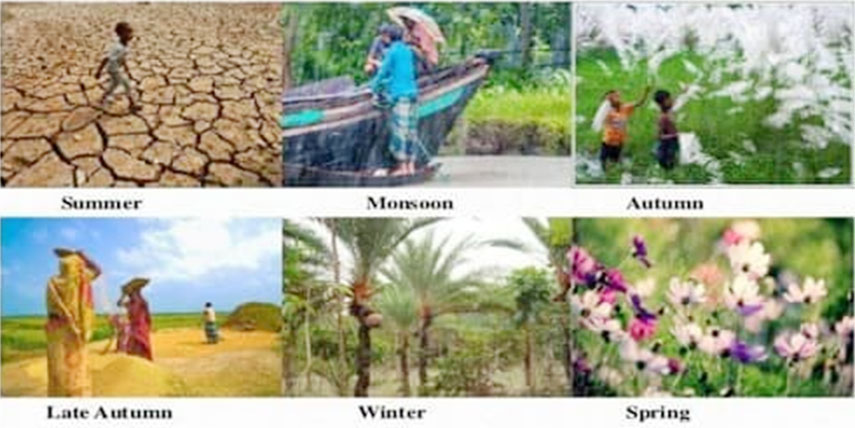
Bangladesh was once known for its diverse six seasons, each with its own rhythm and characteristics. Farmers used to schedule their crops for sowing, tending and harvesting in line with these natural rhythms. But in recent decades, global warming has visibly disrupted these natural rhythms. The natural cycles of the seasons are being disrupted, leading to increased uncertainty, extremes and anomalies in weather patterns. The impact is not limited to nature alone, but is having a profound impact on public health, agricultural production and the overall ecological balance.
An analysis of recent weather trends in Bangladesh reveals an increasingly worrying picture. Temperatures are rising at an abnormal rate during the summer, reaching 40 to 42 degrees Celsius in multiple heatwaves in 2024. Recent observations show that mild to moderate heatwaves began in many parts of the country in early April and quickly spread to 28 districts, with Chuadanga recording a maximum temperature of 39.7 degrees Celsius.
At the same time, sudden increases in temperature in very short intervals are noticeable, such as between April 1 and 2, the maximum and minimum temperatures increased by about four and a half degrees, which indicates unusual instability in the weather. On the other hand, severe cold waves are taking an equally worrying form in winter. The prolonged cold wave, dense fog, and temperature drop to 5 to 10 degrees Celsius in the northern and northwestern parts of the country in 2025 are a clear example of this change. In January 2026, although the winter was relatively short-lived, severe cold was felt in the first week, after which the temperature rose rapidly in the beginning of spring, resulting in a clear anomaly in the normal transition process of the seasons.
These temperature fluctuations are directly affecting agriculture. According to the latest report of the Meteorological Department, the heat wave has spread to 28 districts of the country, where the highest temperature was recorded in Chuadanga at 39.7 degrees Celsius. The maximum and minimum temperatures increased by about four and a half degrees between April 1 and 2. This increase in temperature has created a threat of damage to major crops like paddy and mango.
The ideal temperature for rice is below 35 degrees during the day and below 26 degrees at night for good production. If the temperature is above 35 degrees, the rice can become scorched, so there is a need to retain additional water in the field. In the case of mango, 25-35 degrees Celsius is ideal for mangoes that are still on the tree. If it is warmer or more intense than this, the fruit may become smaller and there is a possibility of dropping. This situation is increasing the risk of crop cultivation in Bangladesh and also significantly increasing the cost of production for farmers.
Abnormal temperature fluctuations have become a growing concern not only for agricultural production but also for ecological balance and public health. The negative impact on human health is increasing significantly due to intense heat waves in summer and sudden cold waves in winter. Colds, fever, heat-related illnesses, sudden infections and various respiratory problems have been seen relatively more recently. At the same time, irregular rains, prolonged droughts and uneven periods of heavy rainfall in different places are reducing soil moisture, which is deeply disrupting agricultural production, irrigation and water resource management and the long-term balance of natural ecosystems. The impact of this abnormal weather is more pronounced in the Barinder region, coastal areas and riverine areas and the level of problems such as crop failure, water scarcity and soil fertility decline has increased in these regions.
Experts have warned that if such climate extremes are not brought under control, it will not be possible to avoid long-term and multidimensional damage to agricultural production and the environment. The once clearly distinct six seasons are gradually fading away, and the effects of different seasons are gradually becoming blurred as they merge with each other. Sometimes winter is delayed, sometimes the monsoon is irregular, and sometimes untimely heavy rains or prolonged droughts are making the situation extremely complicated. As a result, both seasonal livelihoods and agricultural planning are now facing more uncertainty. The most direct and profound impact of this uncertainty is on the country's agricultural system, which is considered the foundation of Bangladesh's economy, food security and rural livelihoods. Irregular climate is disrupting the sowing, care and harvesting schedules of crops, reducing production and multiplying the risks of farmers, resulting in increasing financial stress.
The agricultural situation in the Barendra region is particularly challenging. This region, comprising Naogaon, Rajshahi and Chapainawabganj, has seen an increase in climate extremes over the past decade. Temperatures dipped below freezing in the winter of 2017 and reached 40-41 degrees Celsius in the summer of 2018. Temperatures were recorded at 41 degrees in 2022 and 39-40 degrees in April 2023. Prolonged periods of 38-40 degrees Celsius and rainfall deficits increase the risk of desertification. In this context, international studies have already highlighted the increasing drought and rainfall deficits in South Asia.
Clear steps are needed to address this crisis. It is essential to reduce carbon emissions by increasing the use of renewable energy, expanding social afforestation, preventing deforestation, and taking steps to conserve wildlife. River encroachment and filling of water bodies must be stopped, and initiatives must be taken to restore the natural flow of rivers. Environmental awareness needs to be increased, because everyone from the smallest to the largest creatures plays a role in maintaining the balance of the environment. Due to rising sea levels, coastal areas may be flooded, which will result in the displacement of a large number of people. Although some new chars have emerged due to river-borne sediment, salinity and waterlogging are increasingly increasing the negative impact on agriculture and water.
Considering the entire situation, it is clear that Bangladesh is standing at a critical environmental juncture. To address this crisis, a unified plan of coordinated efforts, scientific research, sustainable water management, greening and regional cooperation is essential. If timely steps are not taken, there will be no option but to leave an uncertain and hostile environment for future generations.
Author: Senior Agriculturist, Columnist and Chairman, DRP Foundation.rssarker69@gmail.com