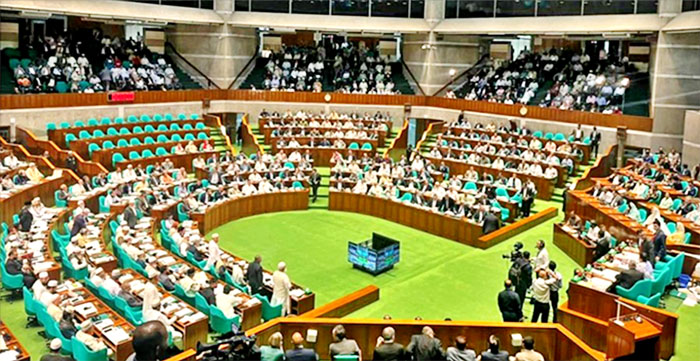
According to Article 65 (1) of the Constitution of the People's Republic of Bangladesh, the legislative power of the Republic is vested in the Parliament. The members of this Parliament, known as MPs (Members of Parliament), have the main constitutional functions of making and amending laws and approving the state budget. However, the reality is that the current MPs are more preoccupied with local development and administrative affairs than with policymaking.
Constitutional powers and qualifications
According to Article 66 of the Constitution, any Bangladeshi citizen who is 25 years of age or older can become a member of parliament. Constitutionally, an MP serves as a member of the legislature for a fixed term. They mainly work in parliament to make laws for the country and protect public interests and represent their constituencies. In addition, these MPs approve and scrutinize the country's annual budget and state expenditure in the National Assembly.
According to the National Assembly Secretariat and the Constitution, the main responsibility of an MP is to ensure the transparency and accountability of the government through questions, debates, and parliamentary committees. In addition, one of his duties is to express opinions on important national issues and to present the demands, problems, and expectations of the people of his constituency to the parliament.
According to Article 78(3) of the Constitution, no MP can be sued in court for any speech made or vote cast in Parliament. This constitutional protection allows them to freely express their views in Parliament, but sometimes questions arise about the accuracy of information.
The role of an MP in a country's emergency is to assist the President by passing laws in parliament during times of war or emergency and to ensure relief and security in their own areas.
Lawmaker or local 'lord'?
There are allegations that many MPs are getting too involved in local governance and development, forgetting their main work. Although there are separate ministries and local government institutions for local development, MPs are seen taking charge in almost all areas. There is widespread criticism of the exclusive dominance of MPs in the boards of directors of educational institutions, teacher recruitment and local arbitration system in particular. It is alleged that they do the least of all the work that MPs do - formulating and amending laws and policies, which is their main job.
According to Transparency International Bangladesh (TIB), MPs often maintain unwritten control over District Commissioners (DCs), Superintendents of Police (SPs) and Upazila Executive Officers (UNOs), going beyond constitutional limits.
Scope of powers of a member of parliament
A member of parliament does not have the power in the constitution to directly order the police to arrest or directly appoint someone to a job, but as the head of the law and order committee, he can give the police the necessary direction.
Some of the tools at the disposal of a member of parliament are very powerful. One of them is: DO Letter: When an MP writes a letter to the concerned authority recommending a job, it is called a DO letter, or demi-official letter. Through this, MPs play an influential role in approving transfers or projects. TR and Kabikha: Where and how much of the allocation for the Test Relief (TR) and Food for Work (Kabikha) schemes will go and who will benefit is primarily determined by the approval of the MP.
Social Security: MPs have the final say in determining who will receive old-age allowance, widow's allowance, or VGD cards through local public representatives.
Advisor: By virtue of his position, he is the chief advisor to the Upazila Parishad, which gives him the opportunity to monitor local administration. MPs serve as the president or head of the governing body or managing committee of schools, colleges, and madrasas, in particular, and can influence the appointment of teachers.
Employment: Members of Parliament cannot directly appoint anyone. However, in many local government and private sector recruitment processes (especially in educational institutions), the recommendation or influence of MPs dominates.
In this regard, ABM Mosharraf Hossain, Member of Parliament for Patuakhali-4 constituency, told Bangla Tribune, "The main job of an MP is to enact laws while sitting in parliament. But in the current context, they also have to play a major role in the development of roads, schools, colleges and religious institutions in the area. Starting from the bulk allocation of the area, members of parliament have to be directly involved in the overall development." Overall, according to the constitution, the main duties of an MP are to enact and amend laws in the National Assembly and approve the state budget.
Although it is not his job to directly implement development projects, it is his responsibility to ensure allocation for his area and supervise the work. In reality, an MP is not only a lawmaker, but also plays the role of the chief regulator of the area. Being an advisor to the Upazila Parishad by virtue of his position and having authority on the boards of directors of education and health institutions, he maintains absolute dominance in local administration. His decision is also considered final in the selection of beneficiaries of TR, Kabikha and social security schemes.
Although he does not have the opportunity to intervene in the judiciary, he plays an influential role in local arbitration and dispute resolution.
In all, from this five-year term, a member of parliament plays a policy-making role for the state, while at the field level, through DO letters and political influence, they serve as the unwritten guardians of development and administration.