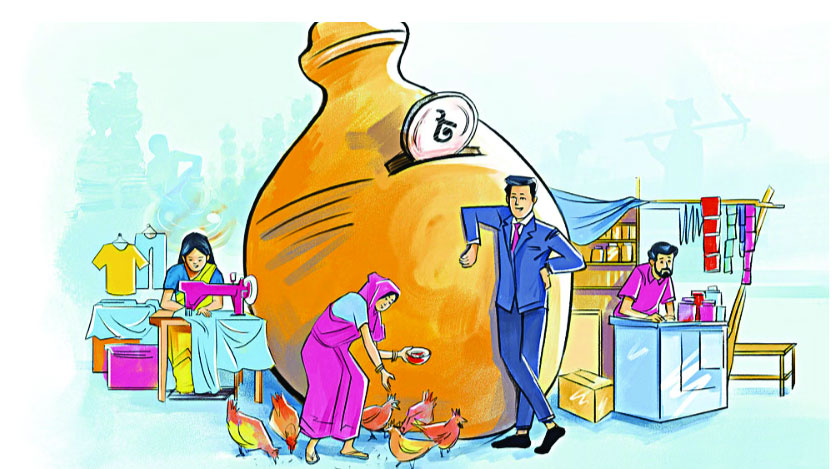
Although the number of economic units or business establishments in the country has increased significantly over the past decade, the foundation of the economy still largely depends on small entrepreneurs.
A decline in investment by expatriate Bangladeshis, along with a downward trend in employment in foreign and joint-ownership enterprises, has also been observed. This picture has emerged in the final results of the Economic Census 2024.
The report was published yesterday, Tuesday, at the Bangladesh Bureau of Statistics (BBS) auditorium in Agargaon, Dhaka. The State Minister for Planning, Zonayed Saki, attended as the chief guest. The event was chaired by BBS Director General Md Farhad Hossain Siddique. Also present were Statistics and Informatics Division Secretary Aleya Akter, Planning Division Secretary S M Shakil Akhtar, and other concerned officials.
According to the Economic Census 2024, the number of foreign and joint-ownership enterprises in the country rose from 1,644 in 2013 to 1,833 in 2024. While this reflects a modest increase in the number of such establishments (around 11.5 percent), employment in this sector has declined. In 2013, these enterprises employed 719,384 people, which fell to 542,701 in 2024. This represents a decrease of approximately 176,683 jobs over a decade, or about a 24.5 percent decline.
Meanwhile, investment by expatriate Bangladeshis has dropped by 88 percent over 11 years. In 2013, expatriates had investments in 1,942 establishments in the country; by 2024, this number had fallen to 222. Employment in these enterprises has also decreased from 11,395 to 4,148.
According to the census, the number of economic units in the country increased from 7,818,565 in 2013 to 11,702,792 in 2024. This represents an increase of 3,884,227 units, or nearly 50 percent growth over a decade. However, despite this expansion, 86 percent of entrepreneurs reported that lack of capital is one of their main challenges in running businesses.
Alongside the growth in economic units, employment has also increased. Currently, these units employ 30,632,661 people, which is 25.03 percent higher than the 24,500,850 recorded in 2013. In terms of employment participation, men account for 83.28 percent, women 16.71 percent, and third gender individuals 0.01 percent.
The report shows that small and cottage industries form the backbone of the country's economy. Of the total economic units, small industries account for 6,631,482 units (56.67 percent), while cottage industries make up 4,533,589 units (38.74 percent). In contrast, there are only 36,112 medium-sized enterprises (0.31 percent) and 9,286 large industries (0.08 percent). In terms of numbers, therefore, small entrepreneurs are the main driving force of the economy.
Sector-wise analysis shows that 90.02 percent of the country's economic units belong to the service sector, totalling 10,534,443 units. The industrial sector accounts for only 9.98 percent. By type of business, wholesale and retail trade, along with motor vehicle repair, dominate with a combined share of 41.82 percent.
An analysis of ownership structure reveals that 87.36 percent of permanent establishments in the country are individually or family-owned. Private limited companies account for 1.82 percent, while partnership-based enterprises make up 1.44 percent. Foreign and joint-ownership enterprises constitute a very small share, and a decline in employment in these establishments has also been observed, which is considered a weakness in the investment structure.
Geographically, the highest concentration of economic units-27.8 percent-is located in the Dhaka division. This is followed by Chattogram with 17.51 percent and Rajshahi with 14.36 percent. The lowest share is in Sylhet division at 4.67 percent. Other divisions include Khulna with 12.73 percent, Rangpur with 11.41 percent, Mymensingh with 6.63 percent, and Barishal with 5.61 percent.
A rural-urban analysis shows that there are currently 7,385,828 economic units in rural areas and 4,316,964 in urban areas. Although rural areas lead in terms of the number of units, the role of urban areas in employment is growing rapidly.
By nature of operation, 53.57 percent of the total units are permanent establishments, 4.91 percent are temporary, and 41.52 percent are household-based economic activities.
Speaking at the event, State Minister for Planning Zonayed Saki said that in the past, an artificial reality had been created in statistics, which obscured the true picture of the country. He stressed that it is now essential to move beyond that and present a reliable, data-driven reality. He added that even if the data are uncomfortable, they must be accepted and used for proper policymaking.
He further noted that despite the increase in the number of economic units, the country's small and medium enterprises are currently going through a difficult period, and providing protection and support to these sectors is a government priority.